
Insights
Confidence revisited: The distribution of information

Relevance-Based Prediction, a model-free technique, can assess the reliability of a prediction from the distribution of information that is used to form it.
December 2025
Prediction is like a voting process: Each datapoint casts a “vote” for the unknown outcome, and the final forecast averages these diverse views. But to know how confident we should be in the average, we need transparency into the votes that went into it. Linear regression and machine learning models can’t offer this visibility because they estimate parameters and then discard the data. However, as we show in a recent paper, RBP, a model-free technique, can assess the reliability of a prediction from the distribution of information that is used to form it.
RBP forms a prediction as a relevance-weighted average of observed outcomes. This approach enables us to form single-observation predictions called solo predictions; these are the votes cast by each historical observation for a specific prediction. By plotting and evaluating the distribution of solo predictions, we gain valuable insight into a prediction’s reliability.
As an illustration, we apply RBP to predict future 12-month changes in interest rates based on employment and inflation. Exhibit 1 shows the resulting point predictions (orange lines) and distributions of solo predictions (gray bars) for 2022-2023 and 2024-2025. We see that the 2022-2023 prediction was for rate hikes, though the solo predictions were split between very positive and negative votes, indicating high uncertainty. Conversely, the 2024-2025 prediction was for slight rate cuts, with a most probable outcome of little change pulled down by some left-tail possibilities.
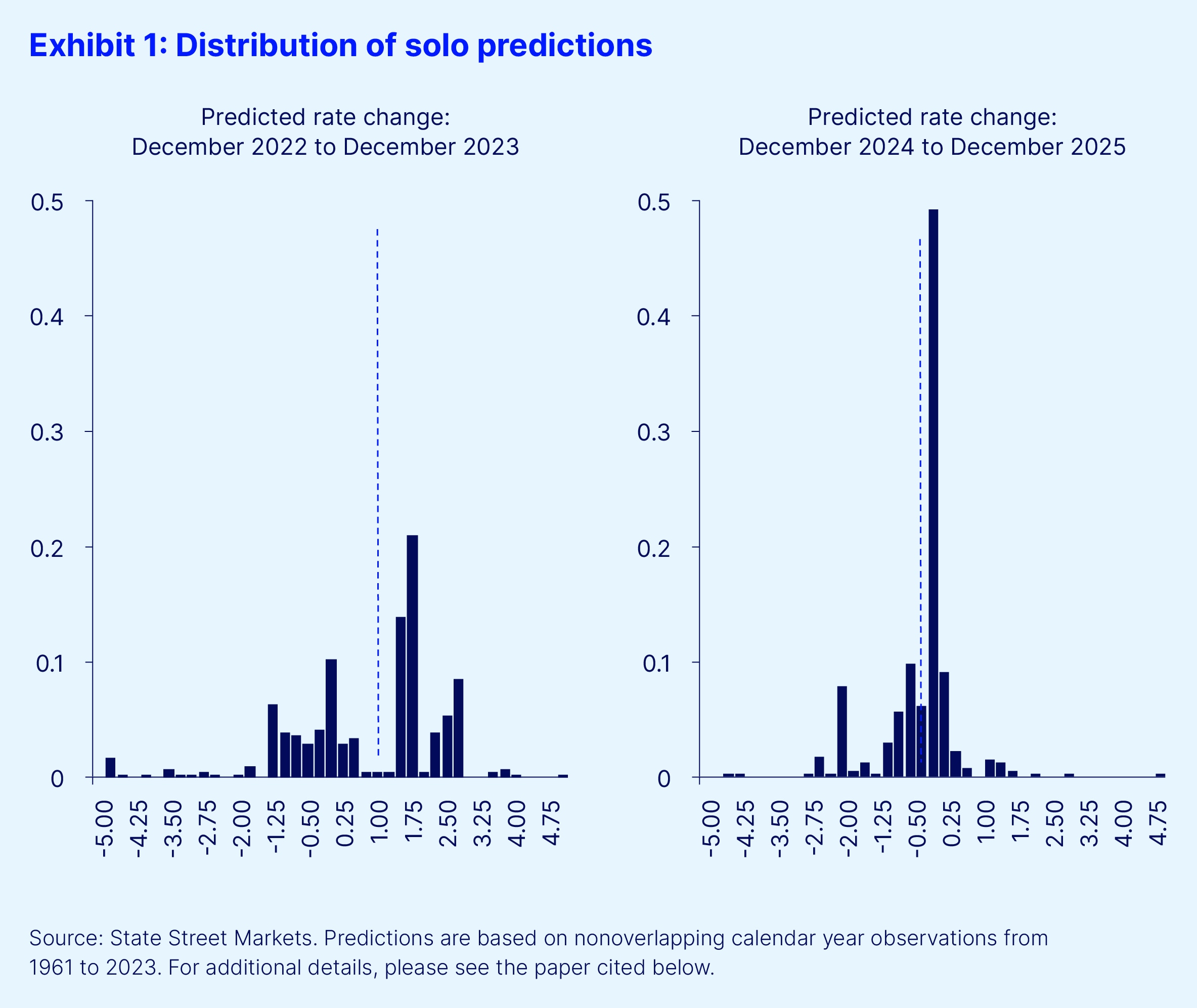
The point of this simple illustration is not whether it worked, but rather to show what we can learn from the distribution of information that forms a prediction. Such transparency is obscured by model-based approaches. However, RBP – a model-free technique – can assess a prediction’s reliability from the consistency of the underlying information, providing a novel perspective that complements conventional measures of confidence.


