
Insights
Institutional Investor Indicators: October 2025

The State Street Risk Appetite Index drops to neutral as investors favor defensive stocks, boosting equity holdings to 55 percent – the highest since the Global Financial Crisis.
November 2025
Our monthly video series offers an updated analysis of our institutional investor indicators.
- Our Institutional Investor Holdings Indicator shows the aggregate holdings of institutional investors across three asset classes: stocks, bonds and cash. This simple information can tell us a lot about how investors view the economy and markets.
- Our Institutional Investor Risk Appetite Indicator is based on flows — buying and selling activity — rather than portfolio positions. It reveals whether investors, in aggregate, are buying risk or selling it. While the Holdings Indicator tells us about the current location, the Risk Appetite Indicator tells us about the direction of travel.
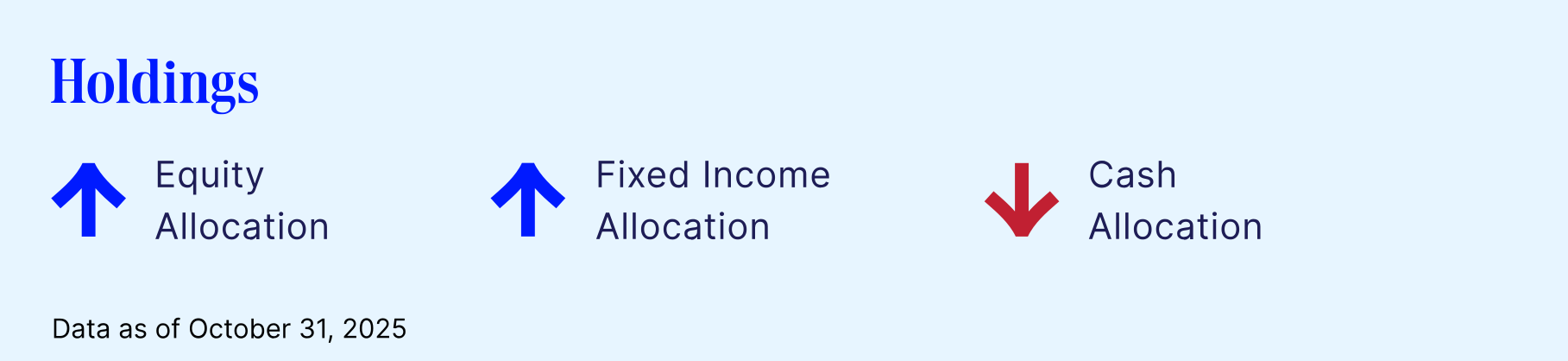
October has been a strong month for stocks, despite still-high geopolitical uncertainty in several major economies, mixed economic data where one can get it (think US government shutdown), and growing valuation concerns across a raft of risk assets. Global stocks (as measured by MSCI All Country World Index) have reached nine all-time highs during October. A strong earnings season clearly was a driver and helped to maintain the goldilocks narrative we are in: “The economy is strong enough to support robust corporate earnings, but weak enough to need rate cuts.” Furthermore, the market is getting comfortable with the Federal Reserve’s easing cycle, despite the upside inflation and downside labor market risks. Valuation risks – however high – do not seem to worry equity investors either. They continue to stay away from Value stocks in favor of Large Cap/Quality/Growth (aka Mag 7) – institutional investors’ allocation to Value stocks is currently at the lowest level since 2000. This is not surprising as Value strategies have struggled for 20 years. The focus on robust corporate earnings and the easing rate cycle is winning over valuation concerns, which has encouraged institutional investors to further increase their allocation to stocks to the highest level in 18 years.
View October 2025 commentary by Marija Veitmane, head of Equity Research for Markets.
Notwithstanding this constructive risk backdrop, institutional investors are getting a little bit more cautious with their relative trades/intra-portfolio allocations. This has driven our Risk Appetite Index to a neutral reading. Within equities, we have seen a shift in preferences from cyclical to defensive stocks. However, it is worth noting that the demand for defensive stocks is concentrated in the Healthcare sector, while investors are less keen on Consumer Staples, Utilities and Telecoms. Furthermore, there are some positive fundamental developments in the Healthcare sector that can explain this buying (improving earnings/margins, reduced regulatory risks as well as very low valuation and positioning risks). More importantly, institutional investors show unwavering support for the all-important Technology sector.
In the foreign exchange (FX) space we have seen tentative buying of the United States dollar during October from an extreme underweight position. The US dollar has historically been a safe haven currency, though this was not the case earlier this year. It is interesting that institutional investors (particularly domestic ones) have been buying dollars as the US government shut down. Buying dollars came at the expense of selling EM FX as well as weaker FX Carry flows. Another important indicator we are watching in the FX space is USD hedging. So far, we have seen only a small increase in hedging of US stocks by foreign investors. Perhaps, the falling cost of hedging might encourage this trend going forward.
The fixed income market is one area where institutional investors’ risk appetite is the strongest. There we see continued preference for higher yielding sovereign markets as well as High Yield credit.


