Insights
Institutional Investor Indicators: July 2026

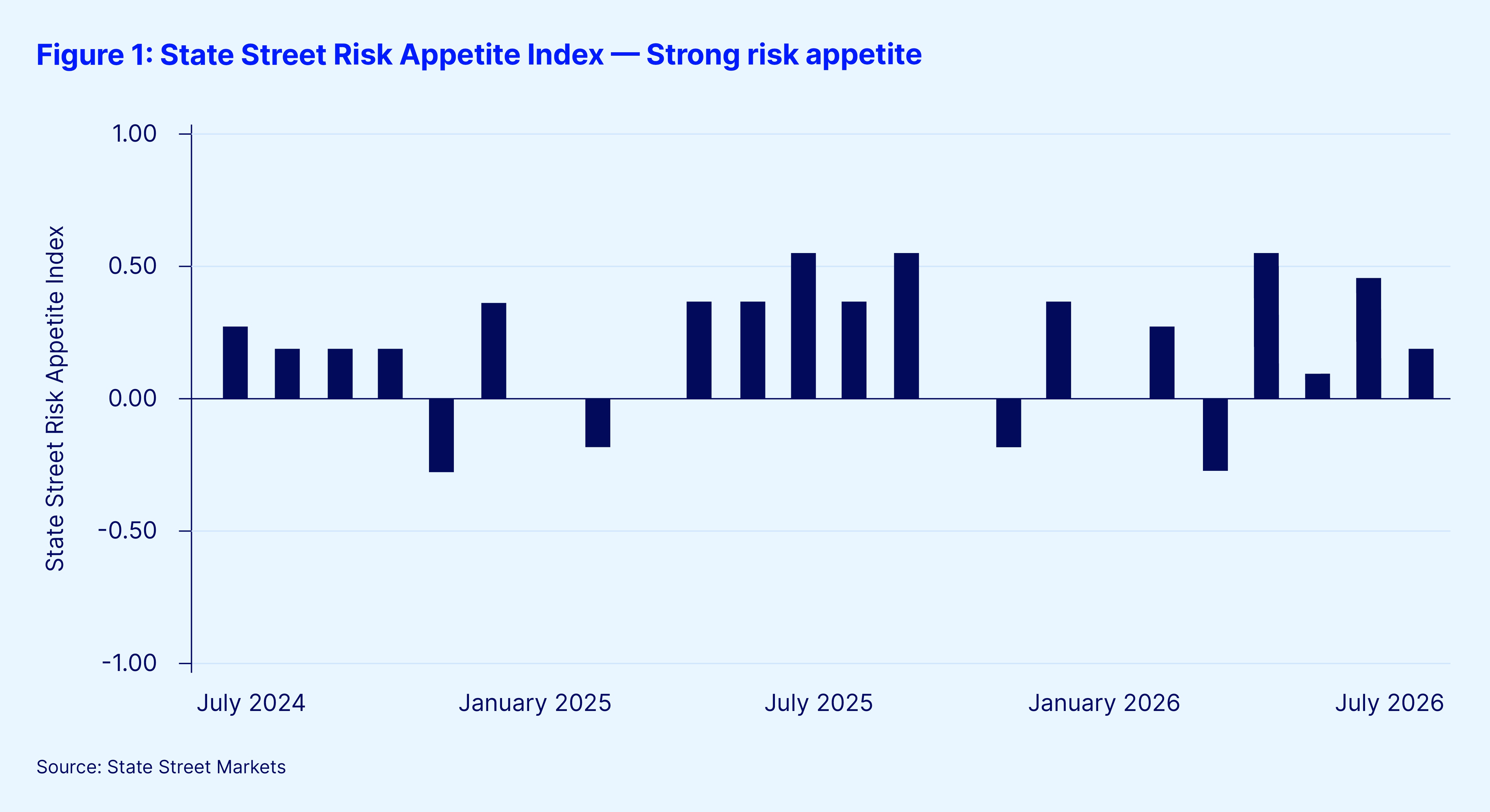
The State Street Risk Appetite Index declined to 0.18 in July from 0.45 in June, indicating continued, though more measured, institutional risk-taking.
August 2026
Our monthly series offers an updated analysis of our institutional investor indicators.
- Our Institutional Investor Holdings Indicator shows the aggregate holdings of institutional investors across three asset classes: stocks, bonds, and cash. This simple information can tell us a lot about how investors view the economy and markets.
- Our Institutional Investor Risk Appetite Indicator is based on flows — buying and selling activity — rather than portfolio positions. It reveals whether investors, in aggregate, are buying risk or selling it. While the Holdings Indicator tells us about the current location, the Risk Appetite Indicator tells us about the direction of travel.
The State Street Risk Appetite Index declined to 0.18 in July from 0.45 in June. Although this represents a meaningful moderation from one of the strongest readings of the past four years, the index remained positive, indicating that institutional investors continued to add risk, albeit with less breadth and conviction than in June.
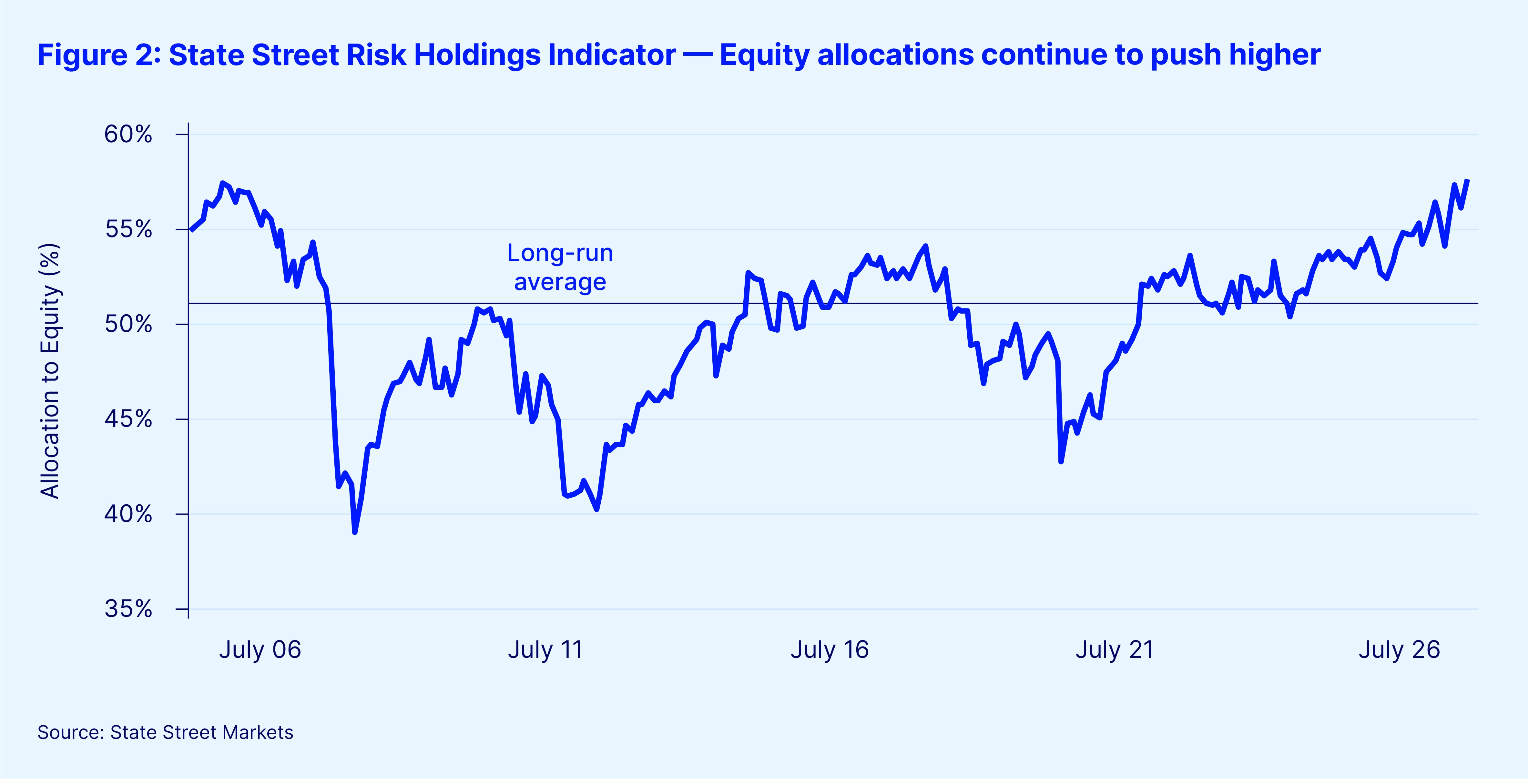
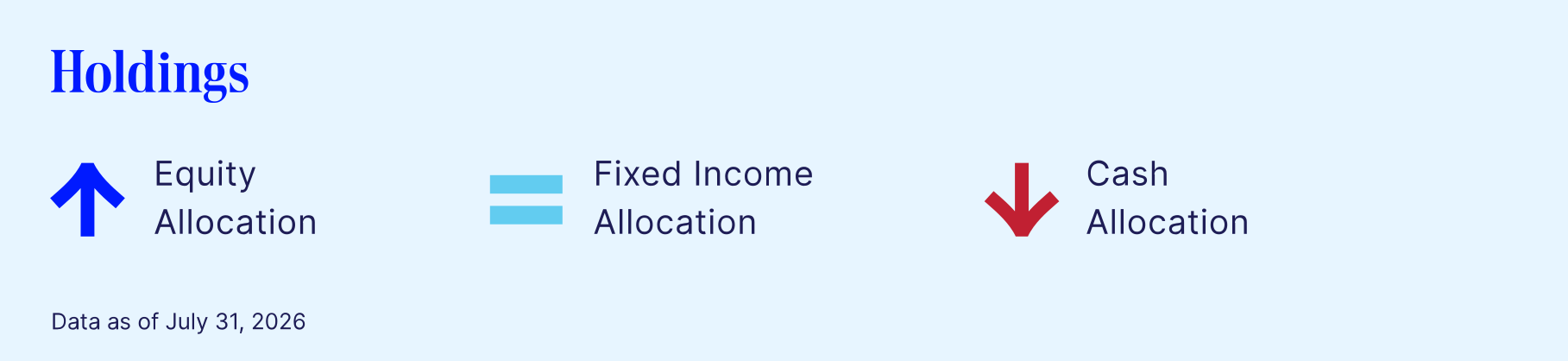
Long-term investor allocations to equities increased by approximately 142 basis points in July, reversing June’s modest decline. Equity allocations ended the month at 58 percent, while allocations to fixed income excluding bills stood at 26 percent and cash at 16 percent. July was characterized less by broad-based risk reduction and more by reallocations within already elevated risk positions.
Read the commentary by Tim Graf, Head of Macro Strategy for Europe, State Street Markets.
Institutional risk appetite moderated in July after surging to an unusually strong level in June. But there is little evidence in our indicators of a generalized retreat from risk. Risk appetite remained comfortably positive, while the portfolio weight allocated to equities actually increased. Institutional investors appear more selective as they navigate elevated valuations, concentrated positions, and uncertainty around the direction of US monetary policy. However, they have not yet responded by shifting decisively into either cash or fixed income.
In similar fashion to market indices, the resilience in aggregate equity allocations masks substantial flow and rotation below the index level. Technology and artificial intelligence (AI)-related exposures entered the summer with elevated ownership levels. Korean equities, increasingly used as exposure to semiconductors and the broader AI theme, had also reached a record overweight. During July, however, some of those most crowded positions experienced a significant rotation. Semiconductor and Korean equity exposures became less crowded, with only limited damage to global equity indices. Software was one of the principal beneficiaries, attracting inflows from previously underweight positions. Financials and health care stocks also saw positions grow. Expectations for technology remained elevated and valuations left little room for disappointment, though investors continued to seek alternative opportunities within the broader equity market instead of reducing overall exposure.
The macro backdrop provides context for greater selectivity and caution. Healthy equity markets, tight credit spreads, and relative stability in longer-term interest rates, mortgage spreads, and the dollar all pointed to easy financial conditions heading into the July Federal Reserve meeting. In terms of the Fed mandate for policy, labor demand has remained above estimates of the pace required to stabilize unemployment, as reduced immigration constrains labor supply. At the same time, the inflation picture remains nuanced but robust. State Street PriceStats showed a more benign trend in core prices and a sizeable June decline in services inflation excluding housing. However, broader measures remained above the Fed’s target, and trimmed-mean inflation was still running at approximately 2.5 percent to 2.6 percent. As a result, markets continued to assess the possibility of further policy tightening.
However, the Fed continues to offer mixed messages, and the scale and timing of any moves remain uncertain. For institutional investors, this has translated into continued caution toward fixed income. Duration-weighted Treasury flows remained negative, although robust buying at the front end pointed to a more complicated curve view than a simple directional short in rates. The combination implied an overall bearish bias in bonds and one expressed through curve steepening rather than flattening – consistent with the outcome of the most recent Fed meeting.
In currencies, the immediate message remained one of persistent dollar selling. Positive market conditions, a stronger inverse relationship between the dollar and equities, and continued institutional accumulation of dollar underweights all pointed toward further near-term softness, particularly against higher-yielding currencies. On the other side of the trade, low-yielding funding currencies remained well owned. The Swiss franc stood out among G10 currencies, while the currencies of Asian exporters including Taiwan, Korea, and China also carried large overweight positions that could potentially fund higher-yielding exposures.
July therefore offered a more balanced message than June. While the decline in the Risk Appetite Index signals that participation in risk-taking became less broad, rising equity allocations and continued rotation within equity markets argue against interpreting the move as an outright risk-off shift. Investors remain committed to equities, but are becoming more selective about where they allocate capital. The principal vulnerability continues to be the concentration of capital in technology and AI-related assets. As long as capital rotates rather than exits the equity complex altogether, institutional behavior remains consistent with a positive, though increasingly selective, risk environment.