
Insights
August 2026
Private markets beyond the underperformance paradox

The changing drivers of value creation
Ramu Thiagarajan
Head of Thought Leadership
Hanbin Im
Global Macro Researcher
Nan R. Zhang, PhD CFA
Head of Product Development, Data Intelligence
James Redgrave
Vice President, Global Thought Leadership
Eric Garulay
Global Head of Content Strategy and Development
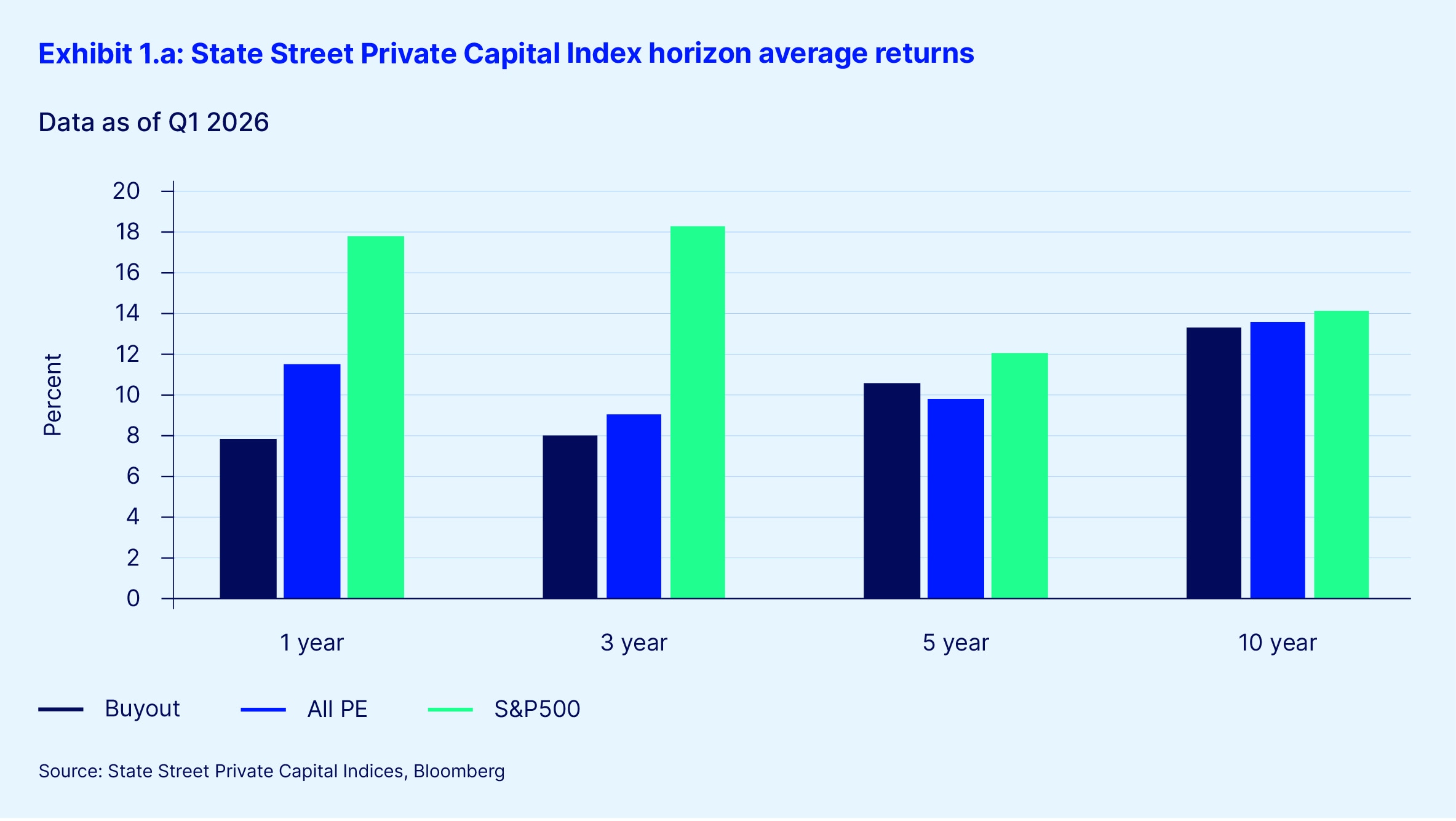
State Street’s Private Capital Index shows that buyout and aggregate private equity underperformed the S&P 500 across every reported horizon through Q1 2026. Yet global private capital assets under management (AUM) continued to expand, while institutional demand has remained resilient. This divergence between persistent relative underperformance and sustained demand presents one of the central puzzles in private markets today.
Our analysis suggests that the performance shortfall primarily reflects cyclical impairment, rather than a fundamental failure of the private equity model. The end of the low rate regime reduced contributions from leverage and multiple expansion, while abundant dry powder intensified competition and difficult exit conditions constrained value realization. These pressures may ease, although structurally higher real rates may keep financial-engineering tailwinds weaker than during the era of quantitative easing (QE). Operational value creation remains the primary avenue through which managers can add value, but that capability is unevenly distributed across managers, making manager and project selection a critical element for asset owners.
Four structural forces nevertheless continue to support selective private market exposure: (a) more companies are remaining private longer; (b) exit outcomes from private investments continue to exhibit wide dispersion increasing the probability of option-like payoffs; (c) given voluminous amounts of dry powder, concentrated ownership has increased and this can facilitate operational change; and (d) finally, as infrastructure, energy transition, and reindustrialization needs are growing globally, demand for patient private capital is rising, creating a structural tailwind and substantial investment opportunities.
Together, these forces support selective private market exposure rather than a pre-determined allocation based on broad asset-class participation alone. Performance outcomes are, however, more likely to depend on manager quality, operational capability, entry discipline, governance, liquidity management, and implementation.
Introduction: The underperformance paradox
Private equity allocations have traditionally been justified by the prospect of an illiquidity premium and access to sources of return that are difficult to replicate in public markets. These expectations supported nearly two decades of asset class growth despite higher fees and multi-year capital lockups.
Recent performance presents a more challenging picture. State Street’s Private Capital Index (SSPCI), which tracks more than 4,200 buyout, venture capital, and private debt funds representing more than US$6 trillion in committed capital, shows that buyout and aggregate private capital lagged1 the S&P 500 at the one-, three-, five-, and ten-year horizons through Q1 2026.
For aggregate private capital, this was the first such result since the series began in 2000 (Financial Times, 2025). First identified using data through Q3 2024, the relative shortfall persisted though Q1 2026, as shown in Exhibit 1.a.
This comparison requires careful interpretation. The reported returns for buyout and aggregate private capital are cash-flow-based and depend partly on reported net asset values, while public market returns are continuously priced and not cash-flow weighted. The difference in performance computation notwithstanding, the underperformance is meaningful. Exhibit 1.a provides an initial indication of the performance gap. To better match the public benchmarks, Exhibit 1.b provides a directly comparable test by matching private market cash flows to public benchmarks.2
Framing the comparison: Benchmark choice and technology exposure
To understand the underperformance, it is instructive to analyze the drivers of returns in public markets. Recent S&P 500 performance has been unusually concentrated in a small cohort of mega cap technology companies commonly referred to as the “Magnificent Seven.” The skewness in returns of public markets raises two related objections to the underperformance thesis. First, the S&P 500 may be an unusually demanding benchmark because of its concentration in mega-cap technology companies. Second, private equity may have insufficient exposure to the technology sector that drove public market returns.3
Exhibit 1.b presents the results using the Kaplan-Schoar Public Market Equivalent (KS-PME) which compares the value of private market cash flows with the value that would have resulted from investing those cash flows in a public benchmark. A value below 1.0 indicates underperformance relative to the selected public benchmark; a value above 1.0 indicates outperformance. Relative to the S&P 500 and Russell 1000, US buyout remains below KS-PME parity at each displayed horizon. Relative to a custom S&P 500 ex-Magnificent Seven benchmark, it remains below parity at one and three years but exceeds parity at five and 10 years, the time horizons over which private equity investors would be typically seeking to hold companies.
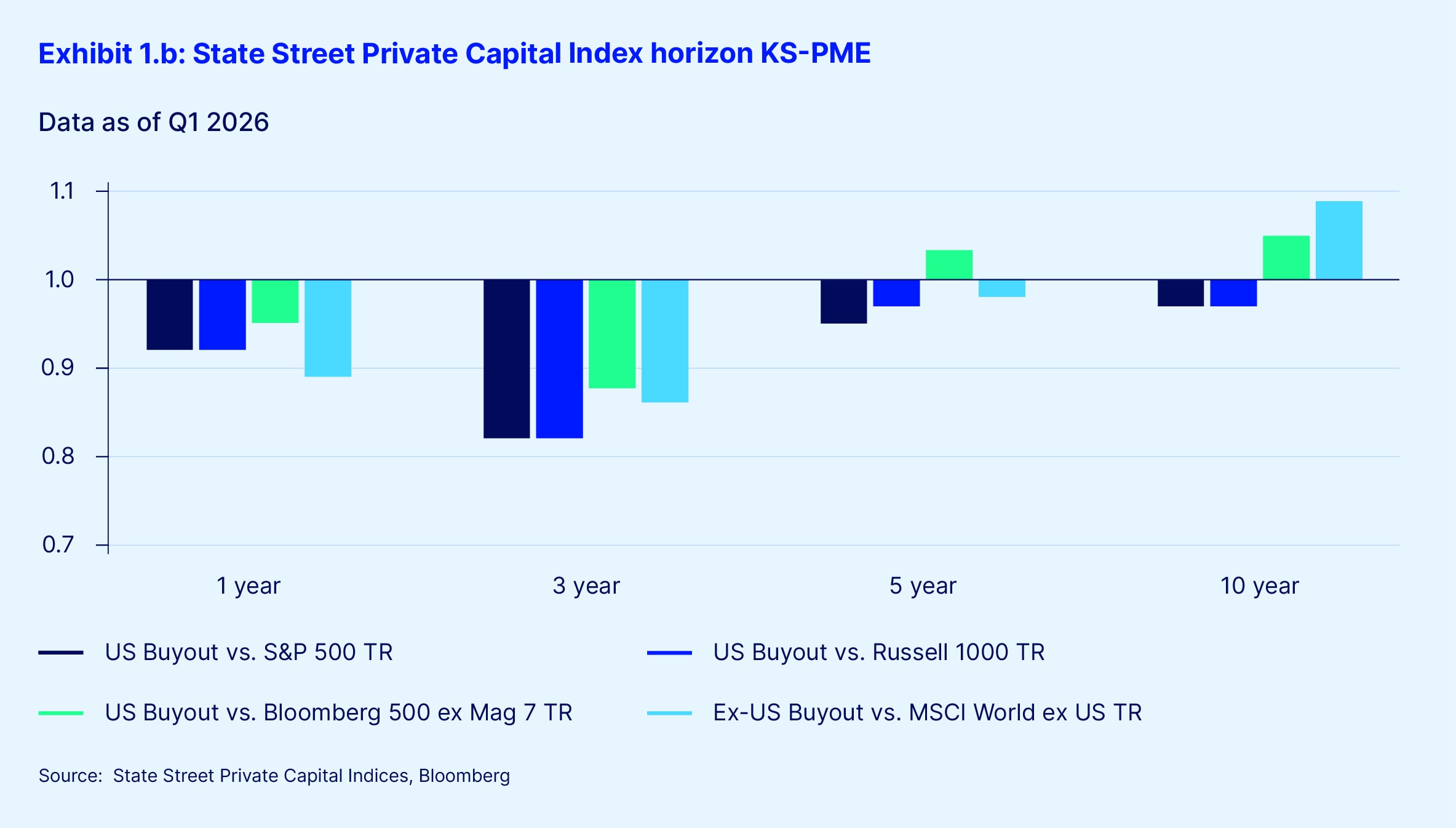
Are these results relevant only for the US? We obtained similar results when comparing ex-US public and private equities from the State Street Private Capital Indices and the MSCI ex-US Index. In this analysis, we found that private assets outperformed the listed ones over 10 years on a KS-PME basis, were at near parity over five years, and underperformed over one and three years.
Thus, broadly speaking, whichever benchmark or geography is chosen for this horse race, private equity, specifically buyout funds, have meaningfully underperformed public benchmarks.4 However, evidence also points to the particular influence of Magnificent Seven on relative returns.
Noting that the S&P 500 has heavy exposure to the technology sector, it is natural to ask if differences in sector exposures contributed to these results. Broad sector exposure does not appear to explain the underperformance either. Data from Cambridge Associates (as year-end 2025) show that its US Private Equity Index — which includes buyout and growth-equity funds — had a 36 percent information-technology weight, compared with 15 percent for the Russell 2000.5 Taken together with SSPCI portfolio company data, this evidence suggests that private equity and venture capital portfolios had substantial technology without matching the returns of the concentrated public market leaders.6
Exhibits 2 provides the corresponding SSPCI sector comparison for buyout portfolio.
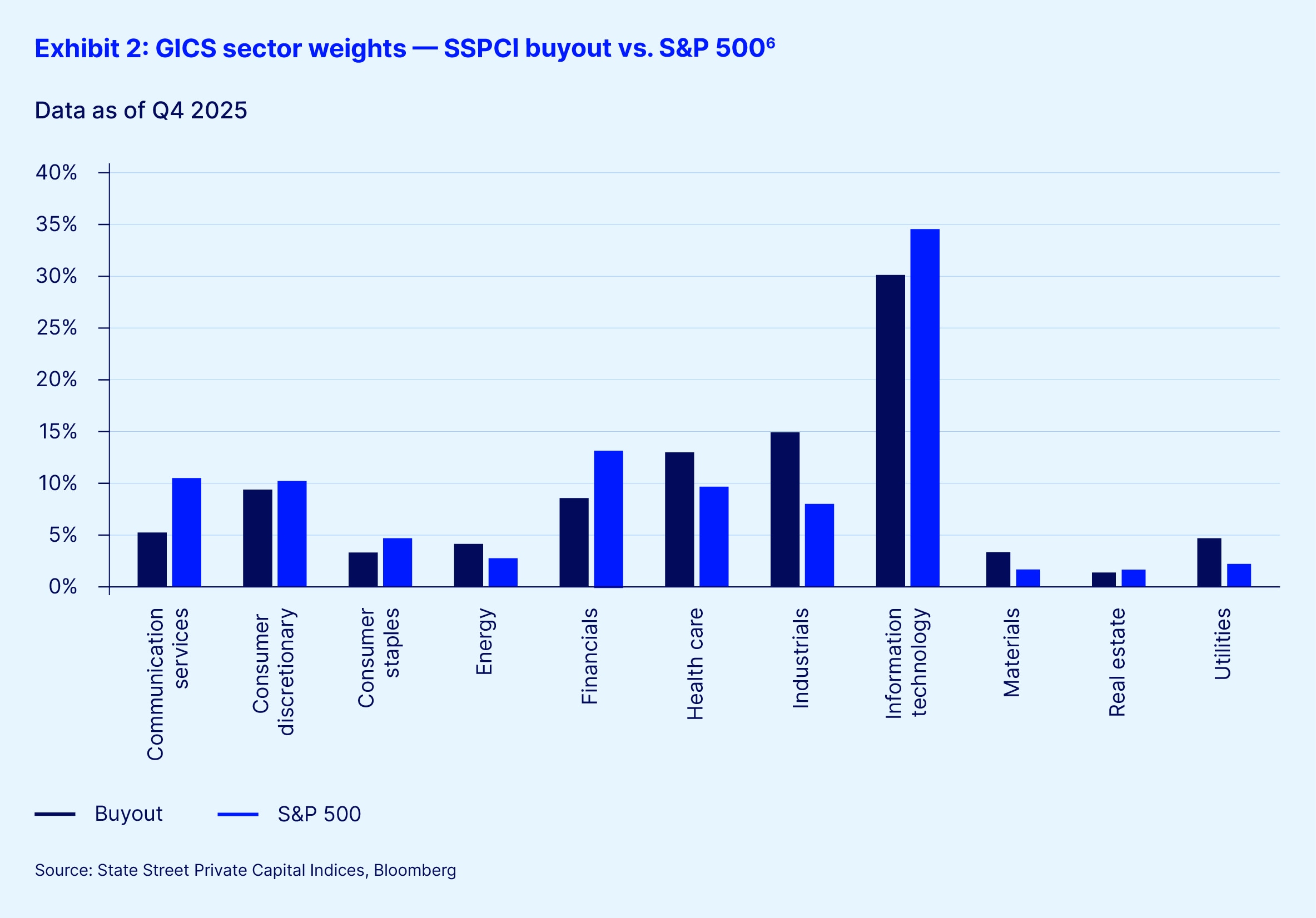
Our analysis indicates that use of a broader benchmark reduces the impact of concentration contributing to outperformance of public markets but does not consistently eliminate the measured shortfall. Broad sector exposure also does not appear to explain the gap.
In short, recent results show that private equity has not delivered an observable premium for bearing illiquidity relative to the public benchmarks examined, although this does not establish that no illiquidity premium exists across all strategies, managers, or vintages.
Persistent allocation demand despite underperformance
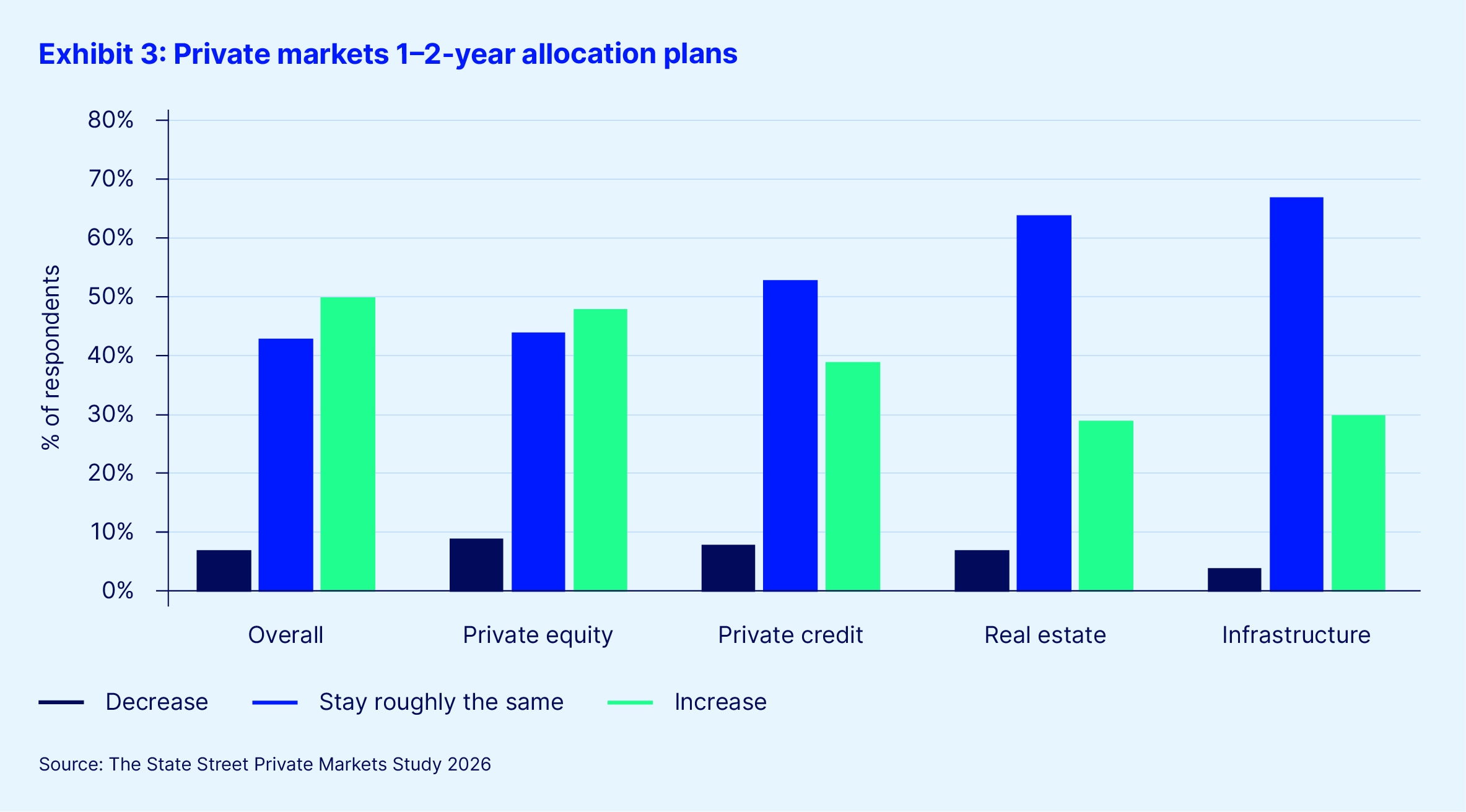
The underperformance notwithstanding, institutional allocation intentions nevertheless remain strong. Global private capital AUM reached approximately US$24 trillion in 2025, up from about US$14 trillion in 2020 (McKinsey & Company, 2026). State Street’s Private Markets 2026 Study found that 50 percent of respondents expected to increase their overall private market allocations over the following one to two years, while only 7 percent expected to reduce them, as shown in Exhibit 3.7 These intentions do not necessarily establish that private markets are attractively valued or that recent underperformance will prove temporary. They may, instead, reflect long-term allocation targets, diversification objectives, commitment pacing, liability structures, access to private companies, and the cost of changing established investment programs.
The analysis that follows assesses whether the recent underperformance is best understood as a cyclical weakening of established return drivers, a structural change in private equity economics, or some convex combination of the two.
The anatomy of underperformance: Decomposing drivers of value creation
Recent private equity underperformance reflects pressure on both underlying return generation and value realization. The drivers of underperformance are best understood by examining the framework for private equity returns which we do next.
A framework for private equity returns
Private equity returns can be understood through four interacting mechanisms:8
- Multiple expansion
- Operational improvement
- Leverage
- Manager selection
Their relative contributions vary with financing, valuation, and operating conditions. Illustrating these contributions, McKinsey, citing an analysis by StepStone, found that leverage and multiple expansion accounted for 59 percent of investment returns across 3,830 global buyout deals entered between 2010 and 2020; revenue growth and EBITDA-margin expansion accounted for the remaining 41 percent, net of dividends and paydown (McKinsey & Company, 2026). Although specific to the transactions and period studied, the results are consistent with our own analysis, which finds that the low-rate environment enabled financing and valuation conditions that supported superior returns.
Reduced contribution from multiple expansion
A primary source of recent underperformance has been the reduced contribution from multiple expansion. Record inflows pushed buyout entry multiples to historic highs in 2020–2022, and valuations remain elevated. Median global buyout entry multiples increased from 11.3x EBITDA in 2024 to a record 11.8x in 2025, edging above the prior 2022 peak, and well above the 2010-2022 average of 9.1x (McKinsey & Company, 2026). By contrast, exit multiples have narrowed.
MSCI data provides additional evidence of a difficult valuation environment. From 2022 through Q3 2024, exited buyout assets were sold at median EBITDA multiples approximately 0.5x to 1.1x below those of assets remaining in portfolios.9 Exit multiples have been broadly resilient in absolute terms, but elevated acquisition prices have narrowed the spread between entry and exit valuations. When a company is acquired at an already high multiple, even a stable exit multiple contributes little to equity appreciation and may represent multiple compression if the entry valuation was higher.
Weaker leverage economics
Leverage has long been central to the private equity model, but its effectiveness depends on the cost of debt (Ilmanen et al., 2020). The Federal Reserve’s tightening cycle increased interest cost and expense, reduced free cash flow, and limited the ability of portfolio companies to invest in growth or make distributions. The impact was particularly pronounced for floating-rate borrowers and companies acquired with limited interest-coverage headroom.
Leverage did have an impact on performance. Default rates for private equity-backed speculative-grade companies reached 17 percent from January 2022 through August 2024, twice the rate of comparable companies without private equity backing.10 Consequently, the average interest-coverage ratio on private credit loans also declined from a peak of 3.2x in 2021 to roughly 1.5x by Q1 2025,11 while debt multiples for US large-corporate LBO loans fell 17 percent from 2022 to 4.9x EBITDA in 2024, their lowest level since 2012 (Bain & Company, 2024, 2025).
The contribution from leverage has therefore weakened through two channels: existing portfolio companies face higher debt service and refinancing burdens, while new transactions generally use less debt at a higher cost.
Greater pressure on selection and underwriting
Private equity firms faced growing deployment pressure as private capital dry powder reached a record US$3.9 trillion in 2023, including approximately US$1.2 trillion held by buyout funds (Bain & Company, 2024), and global buyout fund dry powder remained near record levels at approximately US$1.3 trillion as of Q2 2025 (Bain & Company, 2026). Exhibit 4 shows dry powder levels normalized by average contributions across fund categories, with venture capital displaying the highest relative overhang.
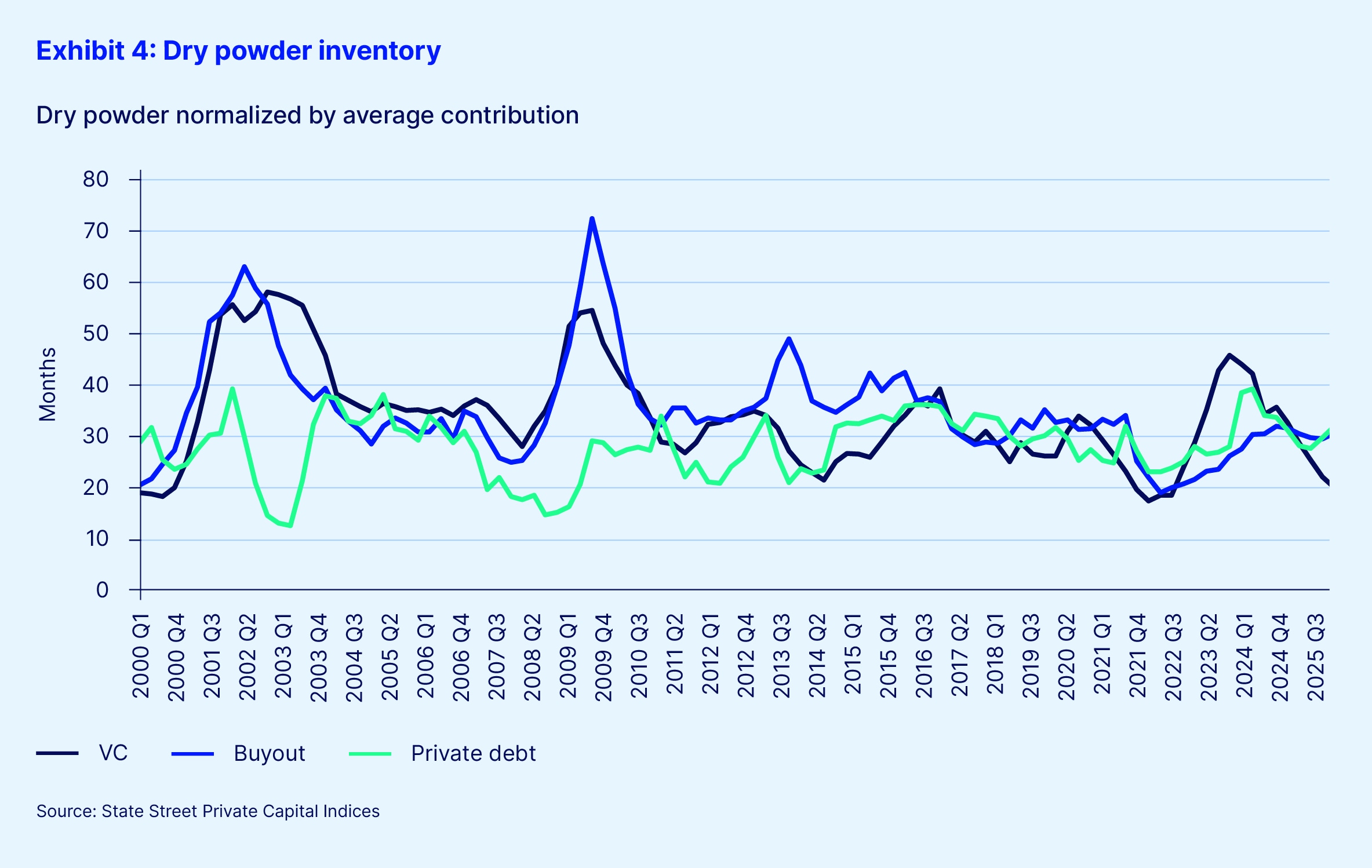
The sharp rise in dry powder between 2022 and 2024 reflects the difficulty general partners (GPs) faced in deploying committed capital amid valuation dislocations and financing constraints. Dry powder does not, by itself, demonstrate weaker selection standards, but it can increase the risk of aggressive pricing, compress expected returns, and reduce underwriting discipline when substantial committed capital competes for a limited supply of suitable investments.
Importantly, the pattern resembles prior cyclical episodes — notably the dotcom bust and the Global Financial Crisis — supporting the interpretation that elevated dry powder is cyclical and not evidence of a structural breakdown in capital deployment. However, more recently, these pressures have begun to ease, consistent with recovering transaction activity.
Operational improvement limitations
Operating performance has long been an important source of value, although the post-pandemic environment made execution more difficult.12 Operational value creation remains one of the return drivers over which managers have the greatest direct influence during the holding period.
Managers with more developed operating capabilities, will, undoubtedly, produce stronger outcomes, and firms with more developed operating models can generate higher internal rates of return (IRRs) than less operationally developed peers.13 That said, operational improvement is not a single, directly observable return component, and revenue or margin gains may also reflect company selection, sector exposure, entry valuation, leverage, and broader economic conditions.
Operational improvement has assumed greater importance as AI expands the range of potential productivity and margin levers available to managers. Pricing optimization, automation, digital transformation, AI-enabled workflows, and supply-chain restructuring may generate productivity gains and margin improvement, but their costs, payback periods, and realized benefits vary materially across companies and use cases depending on organizational readiness and AI maturity.
Constrained value realization
The four drivers above explain pressure on value creation, but what is more important is value realization through proper exit programs.
The exit environment partially explains the disruption to value realization. Weak exit activity through 2024 reflected difficult financing, valuation, and market conditions, rather than necessarily indicating a broad deterioration in GPs’ ability to realize value. Median exit multiples remained elevated in absolute terms but fell below the multiples assigned to held assets from 2021 through 2024. By Q3 2025, that gap between entry and exit values had closed and slightly reversed, while exit value also rebounded.14 As expected, higher-quality assets remained the most likely to exit successfully (McKinsey & Company, 2026).
The constrained exit environment therefore translated pressure on underlying return drivers into weaker realized returns, distributions, and capital recycling. Further improvement in exits may narrow the headline performance gap before those drivers fully recover, although distributions and the backlog of mature assets have yet to normalize.
The structural versus cyclical assessment
As noted above, elevated entry valuations, higher financing costs, reduced leverage, and subdued exit activity are all consistent with a sharp tightening cycle rather than a permanent breakdown of the private equity model. Realized exit multiples have remained broadly resilient in absolute terms, suggesting that the contribution from multiple expansion has weakened rather than disappeared. Thus, the evidence suggests that recent underperformance is primarily cyclical, with an important structural qualification.
The interest rate backdrop, however, may have changed structurally. One reason why rates were low in the United States is the safe-haven premium commanded by US Treasuries. This is often measured by a metric called the “convenience yield.” The convenience yield represents the additional value investors place on the safety, liquidity, and collateral services provided by Treasury securities, allowing them to trade at lower yields than otherwise comparable assets.
Our related research documents a secular decline in the Treasury convenience yield, particularly after 2022, and finds that higher US debt-to-GDP ratios are associated with a lower 10-year convenience yield (Thiagarajan et al., 2025).15 In other words, the attractiveness of US Treasuries has declined in recent years contributing to higher yields. As noted by Krishnamurthy and Vissing Jorgensen (2012), this decline in convenience yield is structural and will contribute to higher rates.
Our research also shows that private equity and private credit have negative and statistically significant sensitivities to increases in long-term real yields (Thiagarajan et al., 2026).16
Future returns are therefore more likely to depend on disciplined entry pricing, operational improvement, and manager selection. Wide manager dispersion and meaningful differences in underwriting, operating capability, access, and execution suggest that implementation will become increasingly important in a structurally less forgiving return environment.
Countervailing forces: The case for continued allocation
If recent underperformance reflects substantial cyclical pressure — with a possible structural overlay from higher real rates — the forward case for private markets must rest on longer-term forces that support the relevance of private market exposure and shape where and how value may be created. Four such forces stand out.
The migration of value creation into private markets
The most compelling argument for maintaining private market exposure may not be historical outperformance alone, but exposure to an opportunity set that may just not be available in public markets. This is because an increasingly large share of company formation, innovation, and corporate growth is taking place outside public markets.
Capital market structure has shifted in ways that make private exposure increasingly important rather than merely opportunistic. A public-only portfolio is likely to miss large segments of the corporate sector due to shifts in capital formation. Since 2000, the number of US private equity-backed companies has increased from approximately 2,000 to more than 11,500, while the number of companies listed on the NYSE or Nasdaq has declined from roughly 7,000 to 4,500.17 By count, approximately 86 percent of US firms generating over US$100 million in revenue are now privately held.18 Abundant private capital, deeper secondary liquidity, and the growing role of intangible assets have reduced the need or incentive for some companies to list (Stulz, 2020; Nadauld et al., 2019; Casella, Lee, and Villalavazo, 2023; NBIM, 2023). As a result, investors seeking access to the full breadth of economic activity may need to include private markets in their opportunity set.
Furthermore, private markets provide exposure to a more complete part of the lifecycle of a company. The median age at IPO has increased from 6.9 years in 2014 to 11 years by the end of 2025, while the global population of venture capital-backed private companies valued at US$1 billion or more grew to over 1,400.19 This dynamic has shifted some company formation and growth into private markets, potentially leaving public market-only portfolios without access to parts of the corporate lifecycle.
A similar migration is evident in credit. Direct lenders provided 90 percent of US middle-market buyout loan issuance in 2024, up from 36 percent a decade earlier, and remained the lender of choice for sub-US$1 billion transactions in 2025 (Bain & Company, 2025, 2026). These shifts broaden the range of corporate ownership and financing opportunities accessible through private markets. Exposure to segments of the market not served by public markets, ex-ante, provides a risk premium as price discovery is different in private markets predominantly driven by limited liquidity (Stulz, 2020). But they do not by themselves guarantee higher realized returns as noted earlier in the paper. Outcomes still depend on manager access, underwriting, fees, illiquidity, and entry terms.
Manager selection as the new source of private market differentiation
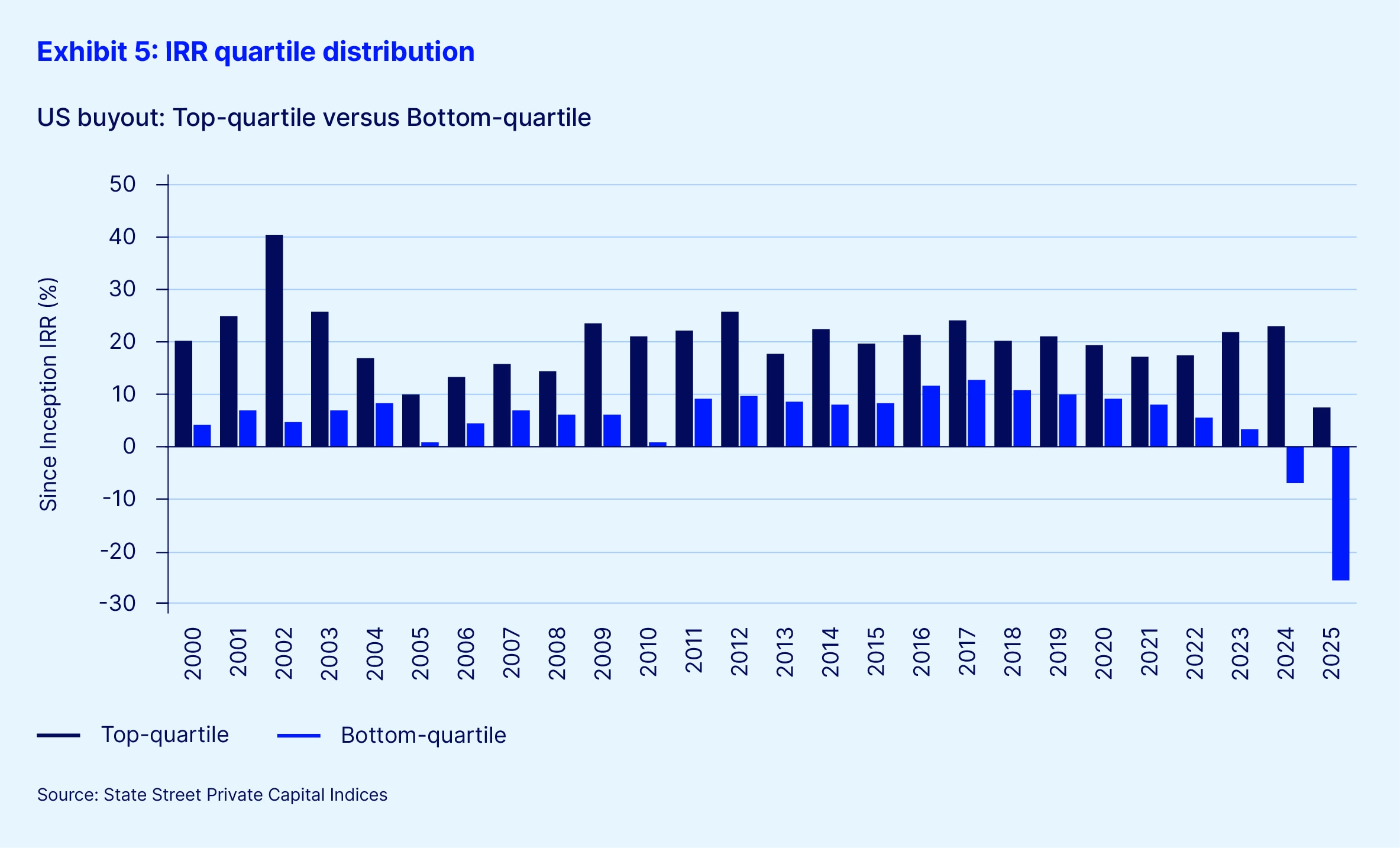
If the changing structure of capital markets argues for maintaining exposure to private assets, manager dispersion is a major determinant of whether that exposure generates attractive outcomes. Median managers have often struggled to outperform public market benchmarks, while top quartile funds have generated materially stronger reported returns. Top to bottom quartile IRR spreads between top and bottom group of managers exceed a very robust 13 percentage points for US buyouts over long horizons, and wide dispersion persists across multiple vintages, as shown in Exhibit 5.20 This creates option-like payoffs for those invested with quartile 1 managers. This payoff cannot be captured unless investors participate in private equity investment.
Pathways for private equity to outperform public markets
As ultra-cheap debt and multiple-expansion tailwinds recede, operational execution and disciplined underwriting are becoming more important sources of differentiation. Under illustrative current deal economics, annual EBITDA growth of approximately 10 percent to 12 percent — compared with about 5 percent a decade ago — may be required to generate 2.5x MOIC21 over a five-year holding period (Bain & Company, 2026).
Building the specialization, operating capabilities, technology, talent, and execution systems needed to achieve such outcomes is costly and difficult to replicate, which may contribute to persistently wide manager dispersion. Capital is increasingly favoring mangers that can demonstrate both strong returns and timely distributions: the funds closing fastest in 2025 tended to be established managers with histories of top-tier IRR and DPI,22 while 91 percent of first-quartile DPI fund series reraised, compared with 61 percent of fourth-quartile series (Bain & Company, 2026).
The challenge is therefore not merely gaining private equity exposure but identifying managers capable of producing attractive net returns consistently. Manager selection and vintage diversification may reduce manager and timing concentration, while co-investments can improve fee efficiency and asset-level selectivity.23
Evolution toward operational value creation in the world of AI
Ironically, the same higher cost of capital environment that has compressed returns is accelerating a shift toward operational value creation. Private equity ownership and governance can facilitate certain forms of operational change more effectively relative to dispersed public ownership, which are anchored on pricing, digitalization and product strategy. Industry surveys show that private ownership is better in effecting operational changes than public entities.24
Concentrated equity and board control may permit rapid changes to management, incentives, and capital allocation. The absence of quarterly earnings pressure faced by public companies can also support multi-year transformation programs — including pricing resets, digital re-platforming, AI deployment, product redesign, and supply chain restructuring — whose benefits may not appear immediately in reported earnings.
Longer holding periods can provide the runaway that complex transformations require, but planned duration should be distinguished from involuntary extension. A longer holding period that supports a deliberate operating plan may create value; one caused by missed targets, weak exit markets, or carrying values above achievable sale prices can reduce IRR, delay distributions, and increase valuation risk.
While liquidity is still a key issue in private markets, the growing secondary market provides additional ways to obtain liquidity, acquire existing fund or asset exposure, and extend ownership of selected companies (PCRI & HBS Private Capital Project, 2021; Lodge et al., 2025).
Together, these developments point to a model that is adapting rather than failing, with returns increasingly tied to execution and operational capability.
Geopolitical reconfiguration and infrastructure requirements may provide tactical tailwinds to private equity
Geopolitical fragmentation, supply-chain reconfiguration, the energy transition, and growing digital and power demand are creating substantial infrastructure capital requirements, some of which may be well suited to private market ownership and financing. Investment in clean energy physical assets and enabling infrastructure could reach approximately US$6.5 trillion annually by 2050. Capturing these opportunities will place increasing weight on active ownership capabilities, including project planning, capital deployment, labor and technology management, navigation of development and regulatory constraints, and asset-level operational improvement (McKinsey, 2025). All of these are better facilitated within the private capital environment rather than public markets.
These forces define a private market opportunity set that is larger, more operationally intensive, and more outcome dispersed than in the prior cycle. They do not invalidate the cyclical headwinds outlined earlier or establish an unconditional case for allocation; rather, they shift the emphasis toward selective implementation. The investment case is strongest where investors can assess differentiated managers and assets, assess expected returns net of fees and leverage, tolerate uncertain cashflow timing, and manage liquidity and governance requirements effectively.
Implications for institutional investors
Avoid broad class exposure
The preceding private equity analysis does not support a universal allocation conclusion. It does not imply that all investors should increase their private market exposure. Nor does it imply that recent underperformance justifies broad retreat. Instead, it suggests that the questions investors ask are changing. The debate is becoming less about whether to allocate to private markets and more about how that exposure is obtained.
For limited partners (LPs), the changing return environment makes the managers, strategies, vintages, structures, and prices through which private equity exposure is obtained more important than broad asset class exposure alone.
Allocation size
Integrated allocation approaches can improve comparability between market-priced public assets and cash-flow-based, appraisal-dependent private assets by adjusting for valuation smoothing, leverage, concentration, and long-horizon risk, but their results remain sensitive to model assumptions (Rudin and Farley, 2025). Model outputs should therefore inform rather than determine allocation decisions, which must also reflect liabilities, liquidity needs, governance constraints, concentration limits, and confidence in the underlying return and risk estimates.
Access and manager selection
Access to private equity managers with credible operational value-creation capabilities is not uniform. As financing and valuation tailwinds weaken, differences in sourcing, underwriting, portfolio company governance, operating execution, financing, and exit discipline may account for a larger share of fund outcome dispersion.
For GPs, this will mean that they need to concentrate resources on the capabilities most closely connected to investment performance while maintaining the infrastructure required to support increasingly complex private equity programs.
For LPs, wide dispersion creates the possibility of differentiated returns but also raises the cost of selection error. Stronger outcomes require the ability to identify, access, and monitor managers; assess team and strategy continuity; evaluate entry price and leverage discipline; and determine whether prior performance is likely to remain reproducible as market conditions, personnel, and fund size change. Historical dispersion does not establish that future outperformers can be identified in advance, and restricted access does not justify accepting unattractive terms or expected returns.
Governance and data
Data, risk management, liquidity planning, and governance are central to private market implementation. LPs require integrated cross-asset data and monitoring standards that recognize the reporting frequency, valuation uncertainty, cash flow structure, and liquidity characteristics of private investments. More frequent reporting cannot create contemporaneous market prices, but it can improve exposure mapping, commitment forecasting, scenario analysis, concentration monitoring, and oversight.
Institutions must also evaluate private investments within the total portfolio rather than as an isolated allocation. This requires governance capable of assessing expected net returns, manager and strategy concentration, leverage, valuation uncertainty, capital-call risk, and the interaction between private market cash flows and public market liquidity.
Where external service providers or technology platforms are used, institutions and managers must retain effective oversight of data quality, third-party dependencies, and operational-resilience risks. Institutions without sufficient access, data, liquidity, or governance capacity may reasonably conclude that expected returns do not compensate for the associated costs, risks, illiquidity, and implementation complexity.
Conclusion: The changing economics of private market investing
The paradox at the heart of private equity market is increasingly clear. Recent performance has challenged many of the assumptions that originally justified the asset class, yet investor demand remains resilient. Reconciling those facts requires distinguishing between a cyclical weakening of traditional return drivers and a structural evolution in where and how value is created.
Private equity’s recent relative-return shortfall is economically meaningful and is not fully explained by S&P 500 concentration or differences in broad technology exposure, although its magnitude and persistence vary by benchmark and investment horizon. This evidence points primarily to cyclical impairment: elevated entry valuations reduced the contribution from multiple expansion, higher financing cost weakened leverage economics, and difficult operating and exit conditions constrained cash flow, distributions, and capital recycling. A structurally higher real-rate environment may nevertheless keep leverage and valuation tailwinds weaker than during the QE era.
At the same time, private markets remain relevant because more companies are staying private for longer, manager outcomes remain widely dispersed, concentrated ownership can support operational change, and infrastructure and reindustrialization require substantial capital. These forces may create attractive opportunities, but they do not establish attractive expected returns independently of price, fees, leverage, risk, and illiquidity. Nor does historical manager dispersion establish that future outperformers can be identified and accessed in advance.
The central conclusion is therefore not that private markets have become universally more attractive or less attractive. Rather, the economics of success are changing. The era in which broad exposure alone could drive outcomes appears less certain. In its place is a more selective environment in which manager quality, operational capability, governance, liquidity management, and implementation increasingly determine results.
For GPs, success will depend increasingly on sourcing, underwriting, portfolio-company governance, operating execution, financing, and exit discipline. For LPs, it will depend on manager access and selection, commitment pacing, liquidity management, governance, and expected net returns relative to investable alternatives. The principal conclusion is therefore not that private markets have become uniformly more or less attractive, but that the drivers of success — and the capabilities required to capture them — are evolving.
Acknowledgement
The authors thank William Kinlaw, Dave Turkington, Jayne Rice, Jennifer Bender, Susan Doyle, James Jefski, Jesse Cole, Sven Eggers, Erich Chng, Scott Carpenter, Nicolas Clapham, Elliot Hentov, and Anna Bernasek for their invaluable contributions to the development of this paper. Their thoughtful critiques, constructive feedback, and engaging discussions on earlier drafts significantly enriched the clarity, depth, and rigor of our work.


