
Insights
June 2026
Market calm, policy noise, and the risk of volatility repricing

This paper examines why equity market volatility has remained subdued despite historically elevated levels of policy uncertainty — a disconnect that has become increasingly pronounced since 2016.
Ramu Thiagarajan
Head of Thought Leadership
Hanbin Im
Global Macro Researcher
Prashant Parab
Macro Research Analyst
To analyze this trend, we introduce a precision ratio to measure how effectively markets translate policy uncertainty into volatility. In simple terms, the ratio captures how informative and credible markets perceive policy signals to be. Taking the 2000-2016 period as a benchmark, we find signal precision has declined across post-2016 regimes, despite a partial normalization during 2020-2024. Robustness checks confirm this trend does not appear to arise from distortions in the uncertainty measure itself but instead reflects a broader weakening in how markets process policy information.
Key insights
1. Markets respond less when policy signals are noisy or ambiguous. Even with elevated policy uncertainty, volatility may remain subdued if investors view policy signals as inconsistent, unclear, or lacking predictive value.
2. Latent volatility may still be building beneath the surface. The gap between observed and benchmark-implied volatility suggests that markets may not be fully pricing policy-related risks. If policy signals regain clarity or credibility, volatility could adjust sharply.
3. Low volatility should not automatically be interpreted as low risk. For long-horizon investors, subdued volatility may increasingly reflect weakening signal quality rather than improving fundamentals, potentially obscuring underlying vulnerabilities in the market environment.
Overall, our findings suggest that calm markets amid elevated policy uncertainty may reflect rational investor behavior rather than market complacency. More broadly, they highlight the importance of evaluating signal quality in interpreting policy-related risks. For institutional investors and asset managers, low-volatility environments may therefore warrant greater caution than headline market conditions imply, particularly when deteriorating signal quality has the potential to mask latent risks and contribute to abrupt volatility repricing.
Introduction
In early 2026, the United States entered a military conflict with Iran, disrupting traffic through the Strait of Hormuz — a crucial shipping corridor for roughly 20 percent of global oil supply — and pushing crude prices above $100 per barrel.1 By traditional measures, this would typically represent a major escalation in geopolitical risk. Yet, equity market volatility has remained relatively subdued: the Central Bank of England Volatility Index (VIX) closed at 17.44 on May 20, 2026, near its pre-conflict level and well within the range that has prevailed for much of the past decade (see Exhibit 1).
This apparent disconnect between elevated policy uncertainty and muted market volatility has puzzled observers.
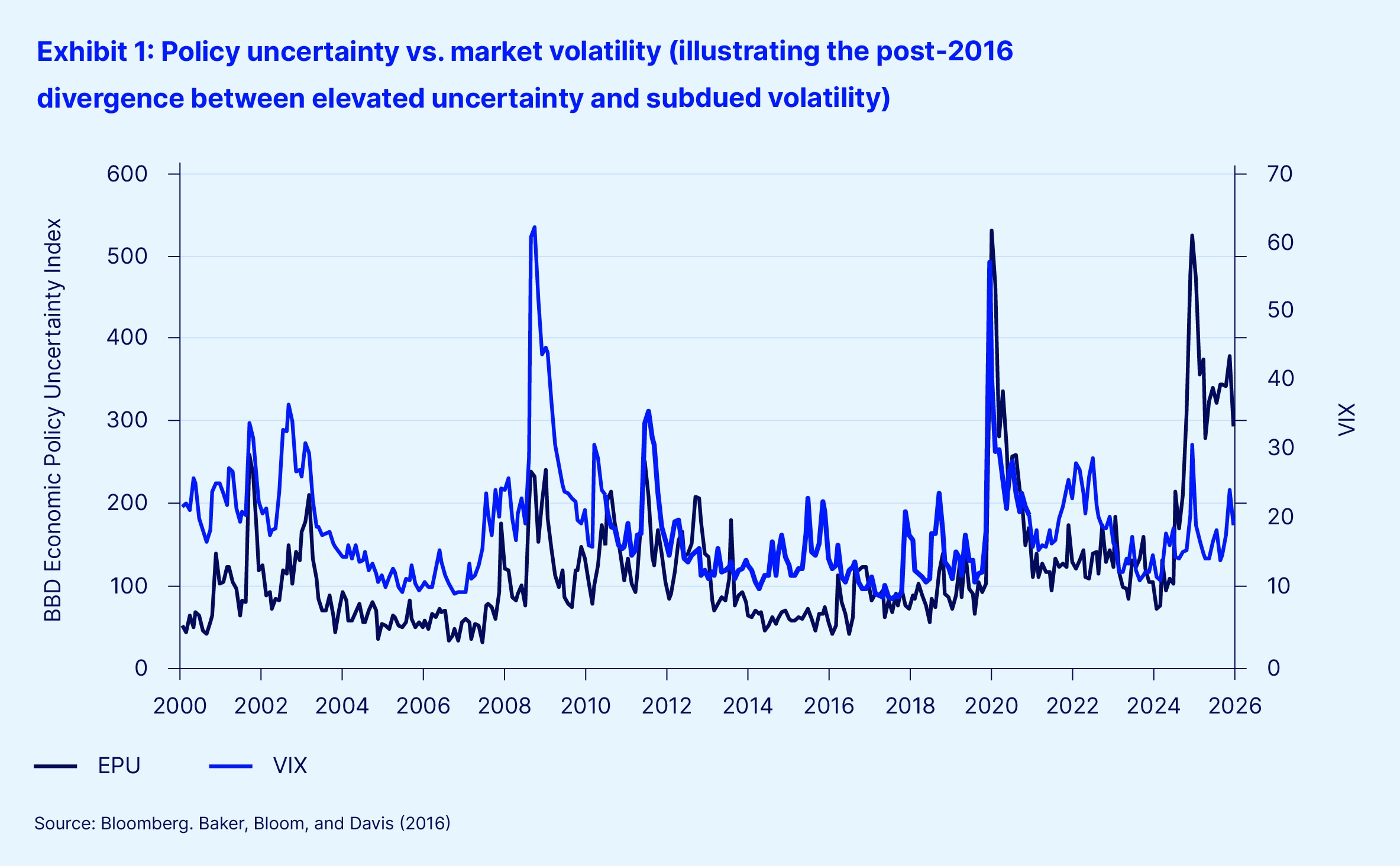
This divergence is not entirely new, however. Since late 2016, the relationship between policy uncertainty and implied market volatility has weakened markedly. Pástor and Veronesi (2012) were the first to establish a clear link between policy uncertainty and equity market volatility. Using the Baker-Bloom-Davis (BBD) Economic Policy Uncertainty (EPU) index, they documented a strong positive relationship between policy uncertainty and equity volatility from 1985 through 2010.
In their framework, stock prices respond to political news through Bayesian learning, where investors continuously update expectations as new policy information becomes available. In this framework, market volatility depends not only on the level of policy uncertainty, but also on the quality and credibility of policy signals. When policy signals are clear and informative, higher uncertainty tends to produce higher volatility. But when signals become noisy, inconsistent, or difficult to interpret, that relationship weakens. Pástor and Veronesi (2017) later used this framework to explain the coexistence of elevated EPU and low VIX in early 2017.
This article extends their framework empirically. We estimate the historical elasticity of the VIX2 with respect to the EPU index from January 2000 to October 2016, using this period as a benchmark for relatively stable signal quality. Deviations from this benchmark allow us to construct a market-implied measure of how informative investors perceive policy signals to be, which we refer to as the precision ratio. When policy signals become less credible or informative, the precision ratio declines, weakening the transmission of policy uncertainty into market volatility.
Using this framework, we examine how the market’s interpretation of policy signals has evolved across four political regimes. Our findings suggest that the post-2016 decline in volatility responsiveness is consistent with a broader deterioration in signal precision rather than a disappearance of underlying policy risk.
The remainder of this paper is organized as follows: Section II reviews the Pástor–Veronesi framework; Section III presents the benchmark regression and its application across regimes; Section IV introduces the implied VIX and derives the precision ratio; Section V discusses robustness using the Equity Market Volatility (EMV) tracker; Section VI highlights methodological limitations; and Section VII concludes with implications for investors and markets.
Overview of the Pástor-Veronesi framework
The analytical foundation of this paper is the general equilibrium framework developed by Pástor and Veronesi (2012, 2013), which formalizes a straightforward but important idea — financial markets respond to policy developments only to the extent they provide meaningful information about future policy outcomes.
The model framework assumes investors update their expectation as new policy signals emerge — including announcements, legislation negotiations, regulatory actions, and other forms of policy communications. Because government policy can materially affect corporate earnings, economic growth, and financial conditions, asset prices respond as investors reassess likely outcomes.
The strength of that market response depends on two key factors:
- Policy uncertainty — the degree of uncertainty investors have about future policy outcomes.
- Signal precision — the degree to which policy signals provide reliable information about future policy outcomes.
In this framework, market volatility reflects the interaction between these two forces. Policy uncertainty alone is not enough to generate elevated volatility. Markets react only when incoming signals meaningfully change investor expectations. If political signals are weakly informative — i.e., poorly correlated with realized policy outcomes — investors update their views less aggressively, and volatility remains more subdued even as uncertainty rises. In effect, the transmission mechanism between uncertainty and volatility weakens as signal precision declines.
In their original model, Pástor and Veronesi (2012) assume that signal precision is relatively stable over time, meaning markets consistently assign similar informational value to policy communications. Under that assumption, the relationship between policy uncertainty and market volatility is predictable — higher uncertainty always corresponds to higher volatility. Empirically, this relationship held reasonably well during the 2000–2016 period. The unconditional correlation between the BBD EPU index and the VIX is approximately 0.48, and regressions of implied volatility on policy uncertainty produce positive and statistically significant coefficients.
Pástor and Veronesi (2017) later relaxed the assumption of constant signal precision to explain the post-2016 environment, where policy uncertainty remained elevated while equity volatility stayed comparatively muted. They argued that a decline in the informativeness of political signals reduced the sensitivity of market volatility to measured uncertainty. Under this interpretation, the coexistence of high EPU and low VIX reflects a rational response to declining signal quality, not necessarily investor complacency or market mispricing.
Empirical results
We model the relationship between policy uncertainty and equity volatility using a log–log regression:

This specification is motivated by both theory and practical considerations. The Pástor–Veronesi framework implies that market volatility reflects the interaction between policy uncertainty and signal precision. Taking logarithms simplifies this relationship and allows it to be estimated using ordinary least squares (OLS). The log transformation also scales the data, reduces the impact of extreme observations, helps stabilize variability in the data, and produces an economically intuitive coefficient (β), which measures the elasticity of implied volatility with respect to policy uncertainty (in other words, the percentage change in VIX associated with one percent change in policy EPU).
We estimate the model using monthly data from January 2000 through October 2016, constructed from the average of daily VIX and EPU observations. This period serves as the benchmark regime (see Table 1), representing an environment in which signal precision appeared relatively stable. Importantly, this was far from a calm period for markets. The sample includes the dot-com recession, the Iraq War, the Global Financial Crisis, the European sovereign debt crisis, and repeated US debt-ceiling confrontations. Despite these events, the relationship between policy uncertainty and market volatility remained comparatively steady throughout this period.
At the same time, policy uncertainty during the benchmark period was materially lower than in recent years. For example, the average EPU between 2000 and 2016 was 99.81, compared with 339.73 over the past 2 years (see Table 2).
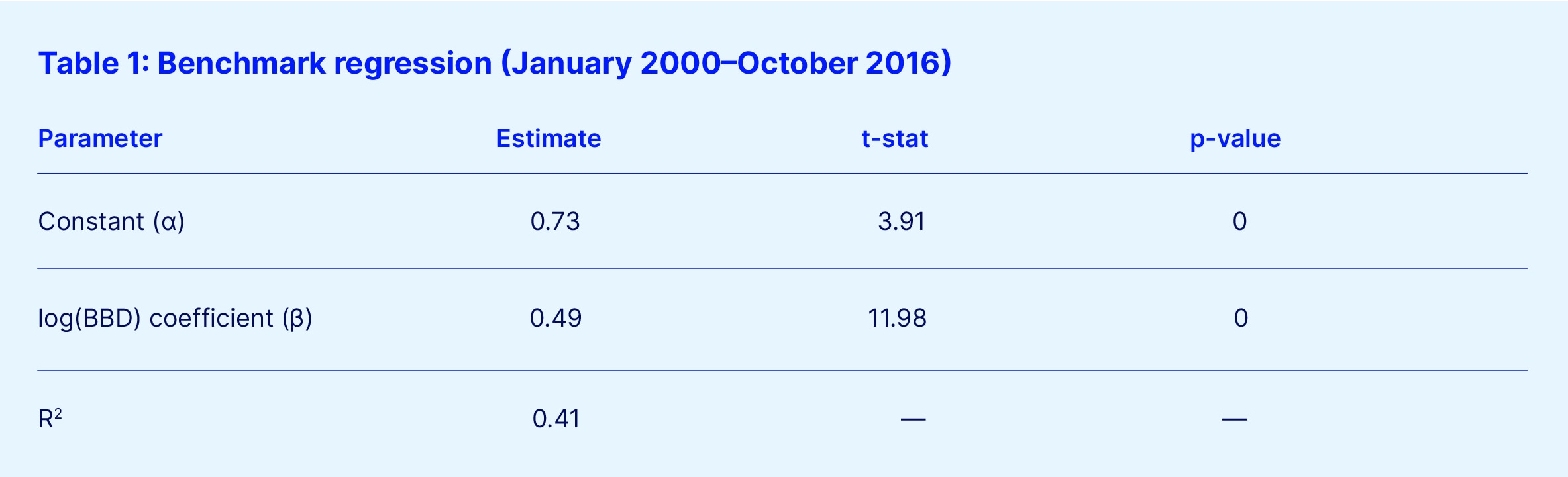
The estimated elasticity of 0.49 implies that a 10 percent increase in policy uncertainty is associated with roughly a 5 percent increase in implied equity volatility. While the relationship is economically and statistically meaningful, the regression explains 41 percent of the variation in log-transformed VIX, reflecting that market volatility is also influenced by a broad range of factors beyond policy uncertainty alone.
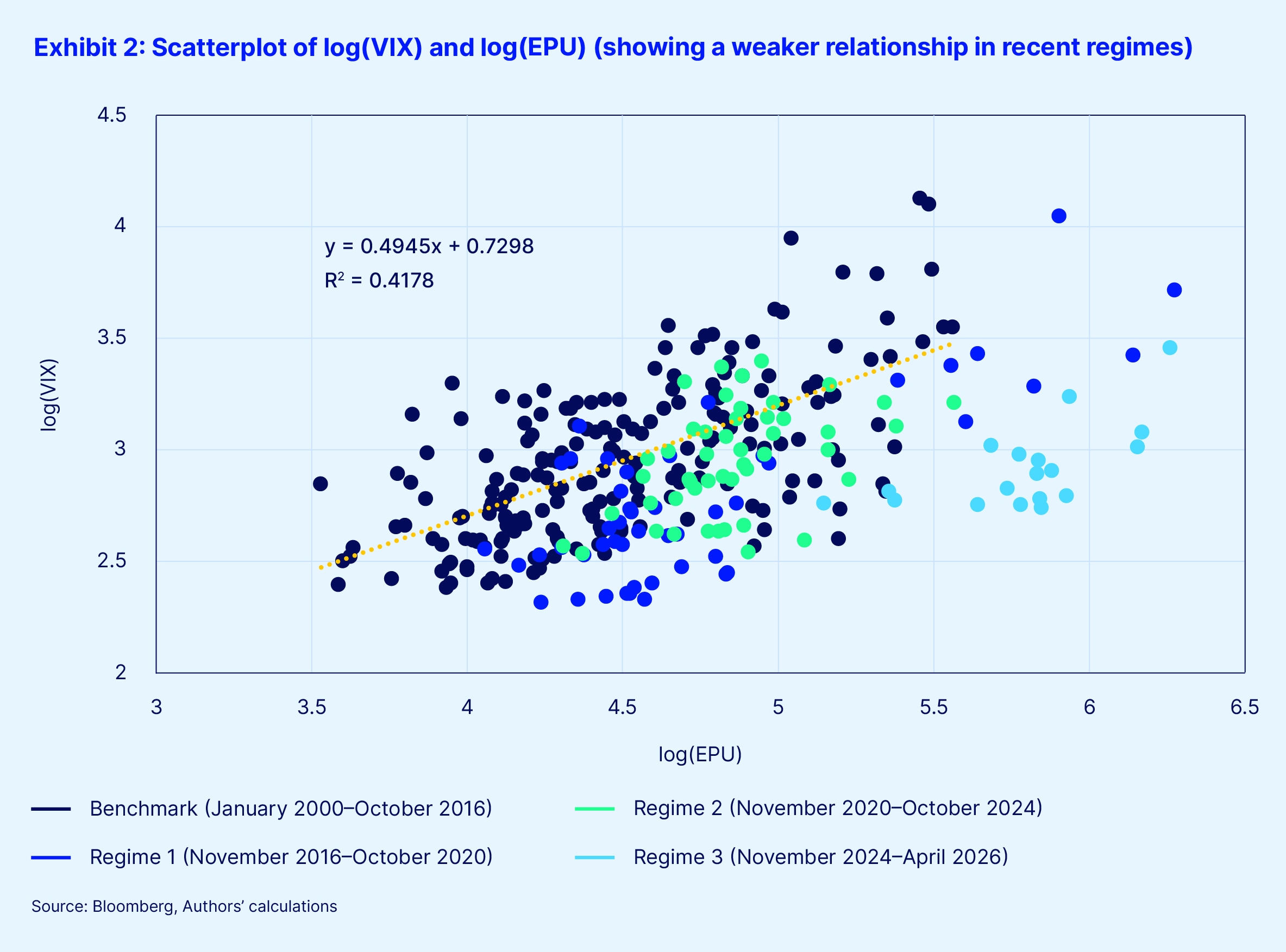
Exhibit 2 illustrates the fitted relationship between the VIX and EPU. The more recent periods (shown as orange dots) suggest that this relationship has weakened over time, consistent with declining signal precision and a reduced sensitivity of market volatility to policy uncertainty.
Implied VIX and the market pricing of policy signals
Using the benchmark relationship established in the previous section, we construct a counterfactual measure of volatility under alternative policy regimes, which we refer to as the implied VIX. For each regime, we evaluate the benchmark regression at the average EPU level observed during that period to estimate the level of volatility that would have prevailed if signal precision had remained at its 2000-2016 benchmark level.
We then define the precision ratio as the ratio of the observed average VIX to the implied VIX. This ratio provides a simple way to assess how effectively markets are translating policy uncertainty into realized volatility. A precision ratio near one suggests that markets are responding to policy uncertainty much as they did during the benchmark period. A precision ratio below one implies that policy signals are less informative and the noise-to-signal ratio of policy communications has increased.
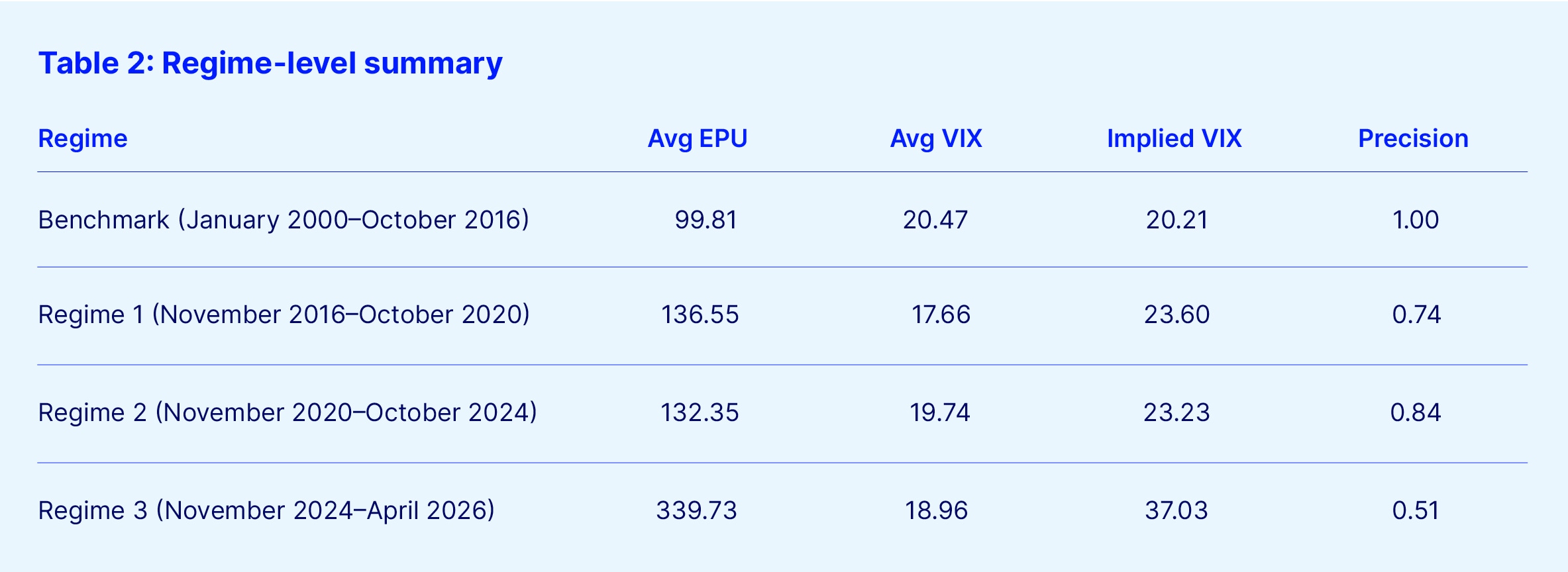
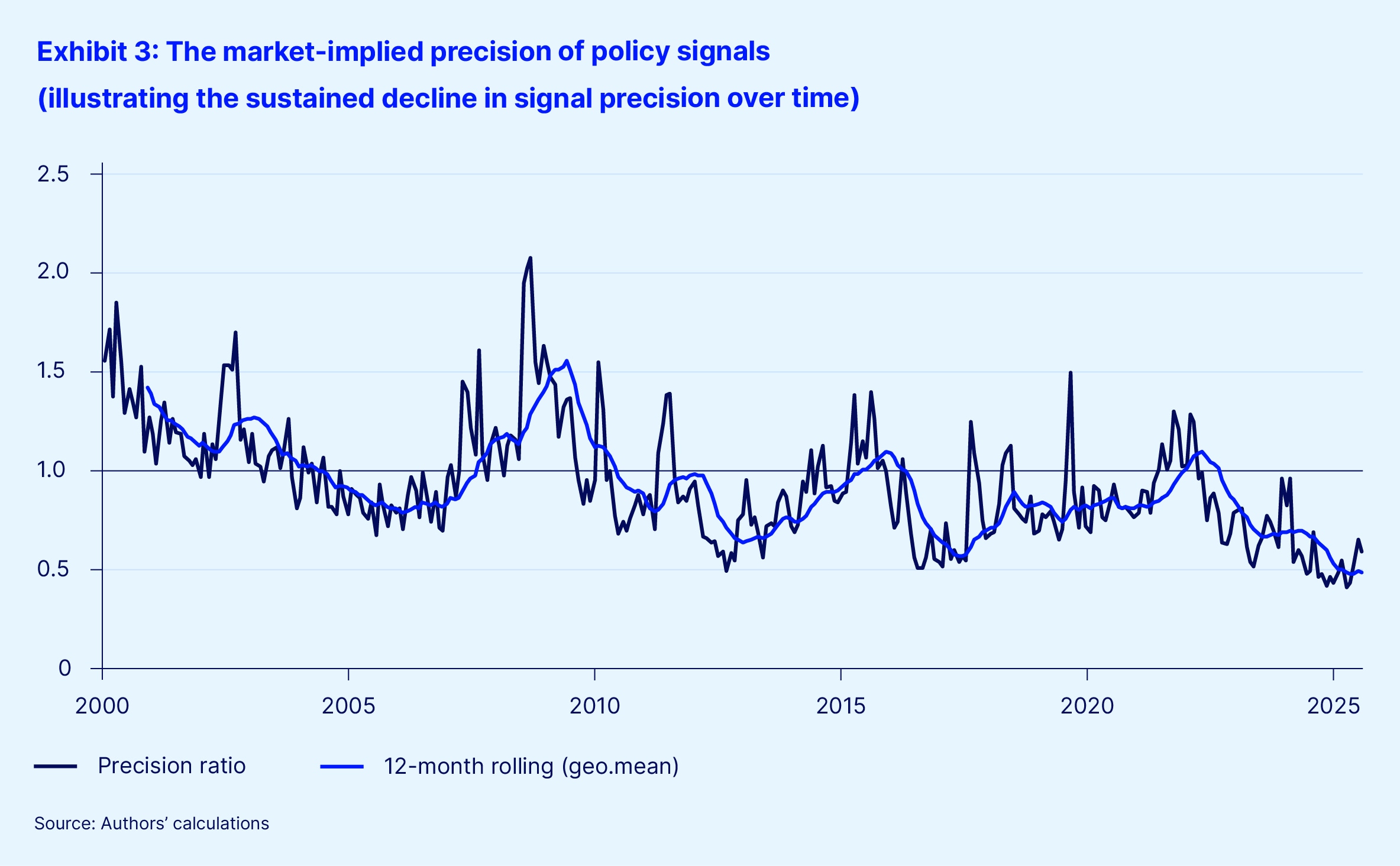
The results reveal clear shifts across policy regimes (Table 2). During the benchmark period, actual and implied volatility are nearly identical (20.40 versus 20.21), confirming strong in-sample fit. By construction, the precision ratio equals one during this period.The first post-benchmark regime (November 2016–October 2020) marks a notable structural shift. Although higher average EPU levels raise the benchmark-implied VIX, realized volatility increases by far less. The resulting precision ratio of 0.74 suggests that the informational value markets assigned to policy signals declined by roughly 26 percent relative to the benchmark period.
A partial recovery occurs during the subsequent regime (November 2020–October 2024). Despite only a modest decline in EPU, the precision ratio rises to 0.84, implying improved, but still sub-benchmark, signal informativeness. This pattern is consistent with “sticky” Bayesian priors, where investors do not fully reverse prior skepticism even as signal quality improves.
The most recent regime (November 2024 onward) exhibits the lowest estimated precision ratio in the sample. Average EPU rises to 339.73, implying a benchmark VIX of 37.03, yet realized volatility averages only 18.96. The resulting precision ratio of 0.51 suggests that markets are currently transmitting roughly only about half of the policy-related information embedded during the benchmark period.
A rolling 12-month precision ratio, calculated using geometric means, reinforces this regime-level pattern (see Exhibit 3).
Testing signal precision with an augmented EMV-EPU framework
One potential limitation of the baseline analysis is the use of the EPU index as the primary measure of uncertainty. While the EPU captures broad range of policy-related uncertainty across fiscal, monetary, regulatory, and trade domains (Baker, Bloom, and Davis, 2016), not all such sources of uncertainty necessarily matter for equity markets. The index may, at times, overweight policy areas that attract media attention but have limited implications for corporate earnings, cash flows, or discount rates.
To assess the robustness of our findings, we replicate the analysis using the Equity Market Volatility (EMV) tracker developed by Baker, Bloom, Davis, and Kost (2019). The EMV tracker is built from the same newspaper database as the EPU index, but applies a narrower filter, selecting articles specifically focused on stock market volatility rather than policy uncertainty more broadly. By design, the EMV index captures news that is directly relevant to equity markets. Baker et al. (2019) show that EMV closely tracks both the VIX and realized S&P 500 volatility.
This distinction is important when interpreting the precision ratio. If our baseline findings were primarily driven by measurement noise in the EPU index — for example, an increase in media coverage of politically contentious issues with limited market relevance — then incorporating EMV should reduce the explanatory power of EPU. Conversely, if the results remain broadly consistent after controlling for EMV, this suggests that the decline in policy precision reflects a genuine weakening in how markets process policy signals, rather than a limitation of the uncertainty measure itself.
To test this, we estimate an augmented regression specification that includes an interaction term between EPU and EMV:

In this augmented model, EMV acts as a conditioning variable, helping distinguish changes in the overall level of uncertainty from changes in how markets interpret and price that uncertainty. Conditioning EPU on EMV allows us to test whether policy uncertainty affects volatility more strongly when it is directly relevant to equity markets.
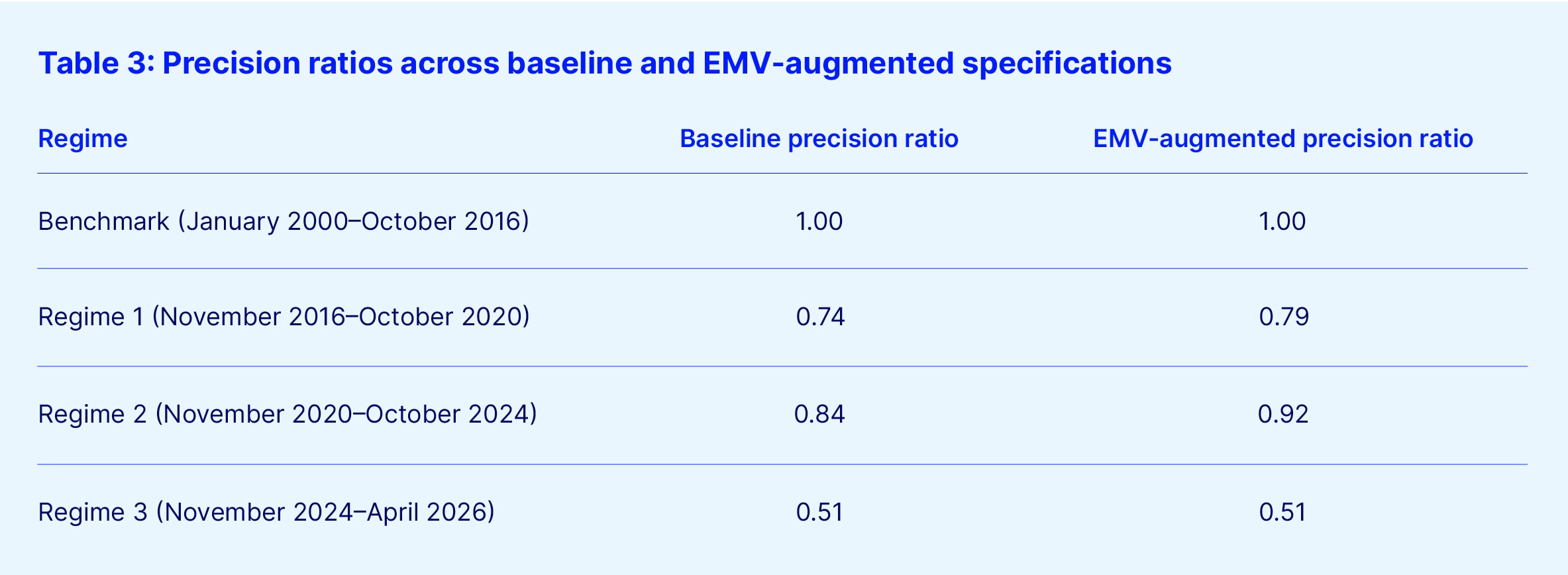
Using the same methodology as in Section 4, we compute the implied VIX and precision ratio for each regime under this augmented specification. The results are shown in Table 3.
The results remain broadly consistent across specifications. Precision‑ratio estimates derived from the EMV–adjusted model are similar in both magnitude and direction to those from the baseline analysis. This suggests that the observed decline in policy precision — particularly in the most recent regime — is not simply an artifact of the uncertainty proxy but reflects a genuine weakening in the transmission of policy signals to equity market volatility.
Overall, the robustness checks3 reinforce the central conclusion of this paper — policy signal precision has declined in recent years, contributing to the observed disconnect between elevated policy uncertainty and muted market volatility.
Limitations of our analysis
Despite the robustness checks, the findings of this paper should be viewed as directionally informative rather than strictly causal. Several methodological limitations are worth noting:
Omitted variables: The benchmark regression explains approximately 41 percent of the variation in log-transformed VIX, implying that a substantial portion of equity market volatility is driven by factors beyond policy uncertainty alone. These include the business cycle, corporate earnings dynamics, monetary policy, liquidity conditions, and broader financial market stress. As a result, the implied VIX should be interpreted as a conditional expectation operating through the policy-uncertainty channel rather than a complete model of market volatility. That said, the broader macroeconomic and geopolitical backdrop in 2025–2026 provides little evidence that volatility should be structurally compressed (at 49 percent) relative to the benchmark-implied level. If anything, contemporaneous risks — including trade tensions, legal and institutional shocks, and geopolitical tail risks — would ordinarily be expected to increase, rather than suppress, volatility.
Reverse causality: Because the EPU index is derived from news coverage, policy uncertainty may rise endogenously during periods when markets are already volatile. This introduces the possibility that volatility itself contributes to higher measured uncertainty, potentially biasing the estimated elasticity upward during the benchmark period. Such bias would mechanically inflate the implied VIX in later regimes and depress the estimated precision ratio. However, the benchmark spans 16 years and includes multiple economic cycles, financial crises, and geopolitical shocks. This breadth helps to mitigate concerns that the results are driven primarily by short-term feedback effects or isolated episodes.
Conclusion
The divergence between elevated policy uncertainty and subdued equity market volatility is now a structural feature of the post 2016 market environment. Under the pre-2016 benchmark relationship between EPU and VIX, current policy uncertainty would imply a VIX near 37, yet observed volatility remains close to 19 — even amid a Middle East military conflict, disruption to a critical global shipping corridor, and elevated oil prices. Within the Pástor–Veronesi framework, this pattern can be interpretated coherently — markets are filtering policy-related information through a low-precision signal-extraction process.
This paper extends the Pástor–Veronesi framework empirically by estimating the historical relationship between policy uncertainty and implied volatility during the pre-November 2016 period, when signal precision appeared relatively stable. Across specifications, our findings suggest that markets are currently discounting roughly one third to one half of the informational content embedded in prevailing policy signals relative to the benchmark period.
Two broad implications follow from this analysis:
- Subdued volatility may reflect rational investor behavior rather than market complacency. Elevated policy uncertainty does not necessarily translate into higher volatility when investors perceive policy signals as noisy, inconsistent, or difficult to interpret. In low-precision environments, markets may become less responsive to uncertainty even as policy risks accumulate.
- The current market environment may contain significant repricing risk. The persistent gap between observed and benchmark-implied VIX suggests that policy-related risks may not be fully reflected in current market pricing. If policy signals become clearer, more credible, or more consequential, investors could reassess risk rapidly, resulting in sharp volatility repricing.
As Pástor and Veronesi (2017) emphasize, declining signal precision weakens — but does not eliminate — the transmission mechanism between policy uncertainty and market volatility. When signal quality recovers, the market adjustment can be abrupt. The current environment — characterized by historically elevated policy uncertainty, historically low estimated signal precision, and a VIX near its long-run average — therefore may contain considerable scope for sharp volatility repricing should the informational quality of policy signals improve.
For long-horizon investors, these findings underscore the importance of assessing not only the level of policy uncertainty, but also the informativeness of policy signals themselves, as low-precision environments can mask significant latent risk. Markets may remain calm even under high uncertainty, but low precision creates the potential for sudden repricing when signals regain clarity.
Acknowledgements
The authors thank Eric Garulay, Michael Metcalfe, David Turkington, Jennifer Bender, and Elliot Hentov for their invaluable contributions to the development of this paper. Their thoughtful critiques, constructive feedback and engaging discussions on earlier drafts significantly enriched the clarity, depth, and rigor of our work.


