Insights
Market Signals and Shifts: Midyear update
What’s inside

Our midyear update leverages insights from our award‑winning research team — powered by State Street’s proprietary data — to revisit the most pressing questions shaping global markets in the second half of 2026.

Will Kinlaw
Head of Data Intelligence and Markets Research
Our annual outlook, Market Signals and Shifts: What to watch in 2026, set out to challenge consensus by focusing on how investor behavior and market signals evolve when conditions move away from historical norms. At midyear, many of the themes we highlighted have not only persisted but have also intensified and, in some cases, taken unexpected turns.
Since January, headline market strength has masked growing divergence beneath the surface. A first-quarter drawdown across both equities and bonds, followed by a swift recovery, has left equities in double-digit positive territory year-to-date, with fixed income broadly flat. At the same time, a geopolitical shock from the Iran conflict reversed the early disinflation narrative, pushing inflation higher, and reshaping the trajectory for interest rates and policy.
State Street’s proprietary indicators bring this growing imbalance into focus. Our measures of institutional investor behavior show that equity allocations — already elevated at the start of the year — have risen further and now sit at their most optimistic levels since the lead-up to the Global Financial Crisis (GFC), exceeding bonds by more than 30 percent. This reinforces a core message from our January analysis: When positioning becomes this stretched, outcomes tend to cluster at extremes, not the average.
Our Relevance-Based Prediction (RBP) framework underscores that risk. The most relevant historical analogues to today’s positioning remain concentrated in the late-cycle periods preceding past crises. The signal has strengthened since January: The balance of probabilities now points to a greater likelihood of equity underperformance versus bonds over the coming year, even as the dispersion of outcomes remains unusually wide. In short, uncertainty has increased — not diminished — as markets have rallied.
Beyond positioning, what stands out most at midyear is the narrowness of market leadership and the persistence of structural divergence. The equity rally has been highly concentrated — what we describe as a “Rally in Name Only (RINO)” market, a term we examine further below — driven primarily by United States large-cap equities and a small number of sectors, notably technology and energy. At the same time, inflation dynamics and policy expectations are shifting, contributing to a “higher-for-longer” rate environment even as cross-market differences widen.
Taken together, these developments reinforce the central premise of this series. In an environment where traditional frameworks struggle to explain market behavior, forward-looking insight depends on tracking real-time signals — from investor flows and positioning to high-frequency inflation measures and artificial intelligence (AI)-enabled policy analysis.
We hope these insights help you navigate an increasingly complex market landscape in the months ahead.
Equity optimism versus troubling precedents
Megan Czasonis, head of Portfolio Management Research, State Street Associates and Michael Metcalfe, head of Macro Strategy, State Street Markets
In our January edition of Market Signals and Shifts: What to watch in 2026, we highlighted the unusually optimistic asset allocation of institutional investors as a potential inflection point for markets. As we noted at the time, such optimism is binary — typically followed by either very strong or very weak market returns, but never average.
Six months later, 2026 is bearing out that view. March brought sharp declines across both equities and bonds, followed by even sharper recoveries. Year-to-date, this leaves bond aggregates unchanged, but equities are up double digits. As we explore in the following articles, this may be a case of RINO but it leaves the challenge for asset allocation even more acute than in January, as investors now hold an even higher percentage of their overall portfolios in equities relative to bonds.
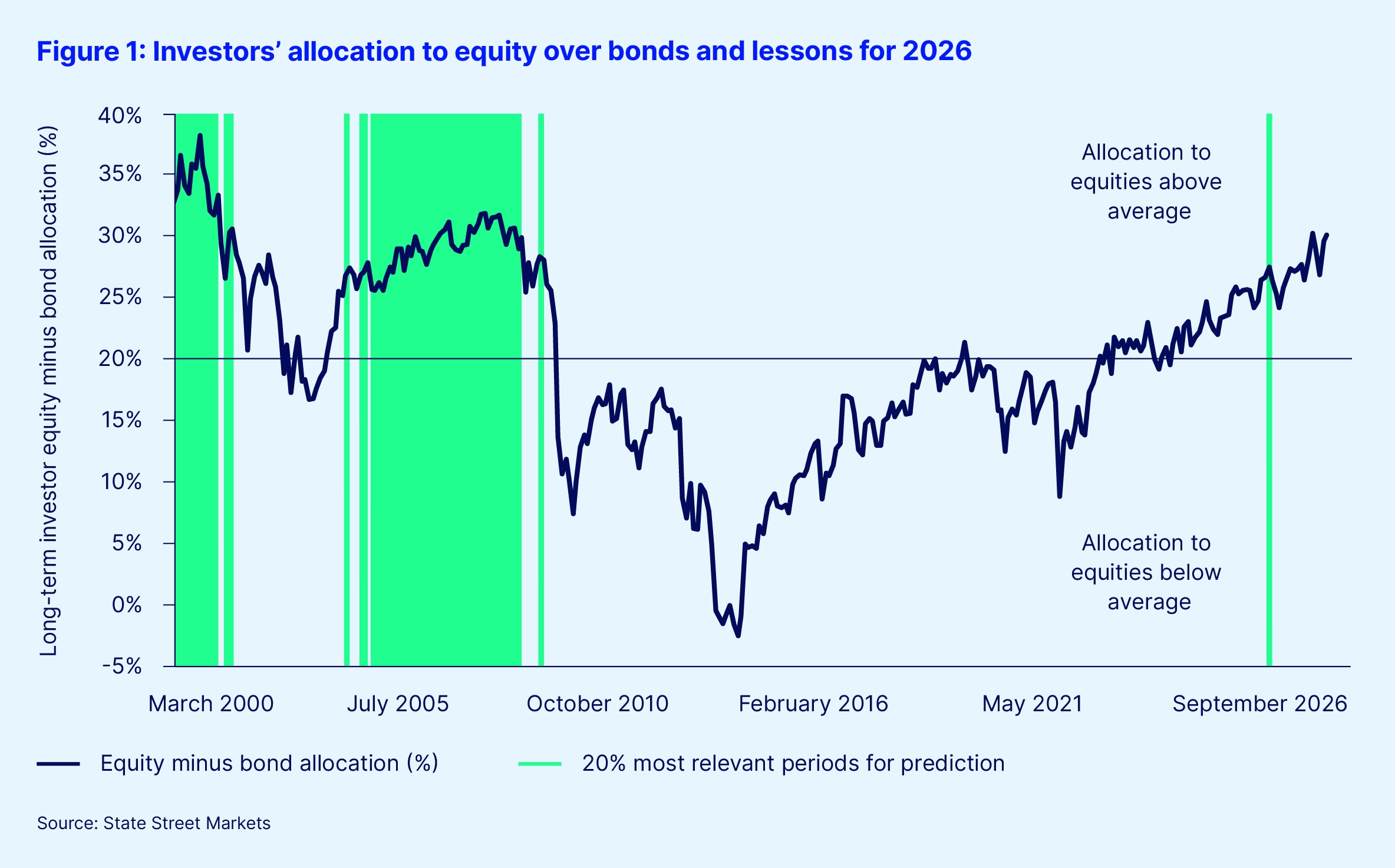
According to our indicators of institutional investor behavior, the average allocation to equities over the past 25 years has been about 20 percent higher than fixed income. This is in line with the traditional portfolio theory of 60/40 equity/bond allocation. However, by mid-2026, that 20 percent over-allocation to equities has risen to over 30 percent — 2 percent above where it was in January — and now stands at the most optimistic allocation to equities since November 2007, the beginning of the GFC when large banks began to write down significant credit losses.
As troubling as this precedent may be, the path of markets in 2026 so far has reinforced notions of resilience. The war in Iran has brought with it significant inflation and potential supply shock. As we’ll explore in more detail in the article, “What AI and alternative data reveal about interest rate markets” the outlook for inflation and interest rates has shifted dramatically. But equity optimism quickly passed the stress tests of 2025 and having learned that lesson, investors are positioned for a similar result in 2026. Nevertheless, the risks that this year’s shock may be different remain, while episodes of equity market volatility with such elevated levels of equity holdings add to market vulnerability.
What do high equity allocations mean for returns in 2026?
Back in January, we used our novel RBP technology1 to explore what typically happens to relative equity-bond returns following time periods with such high equity-to-bond portfolio allocations. By analyzing and extrapolating from the most relevant past experiences, RBP generates a future projection. In the process, it can capture complex relationships in a transparent way.
The results closely mirror January, only even more pronounced. What is striking and troubling about the top 20 percent of periods that were selected as most relevant to investors’ current equity overweight is that the majority are clustered between July 1999 and May 2001, the peak of the dot-com bubble, and then again between August 2004 and June 2008, during the housing bubble and the GFC (see Figure 1).
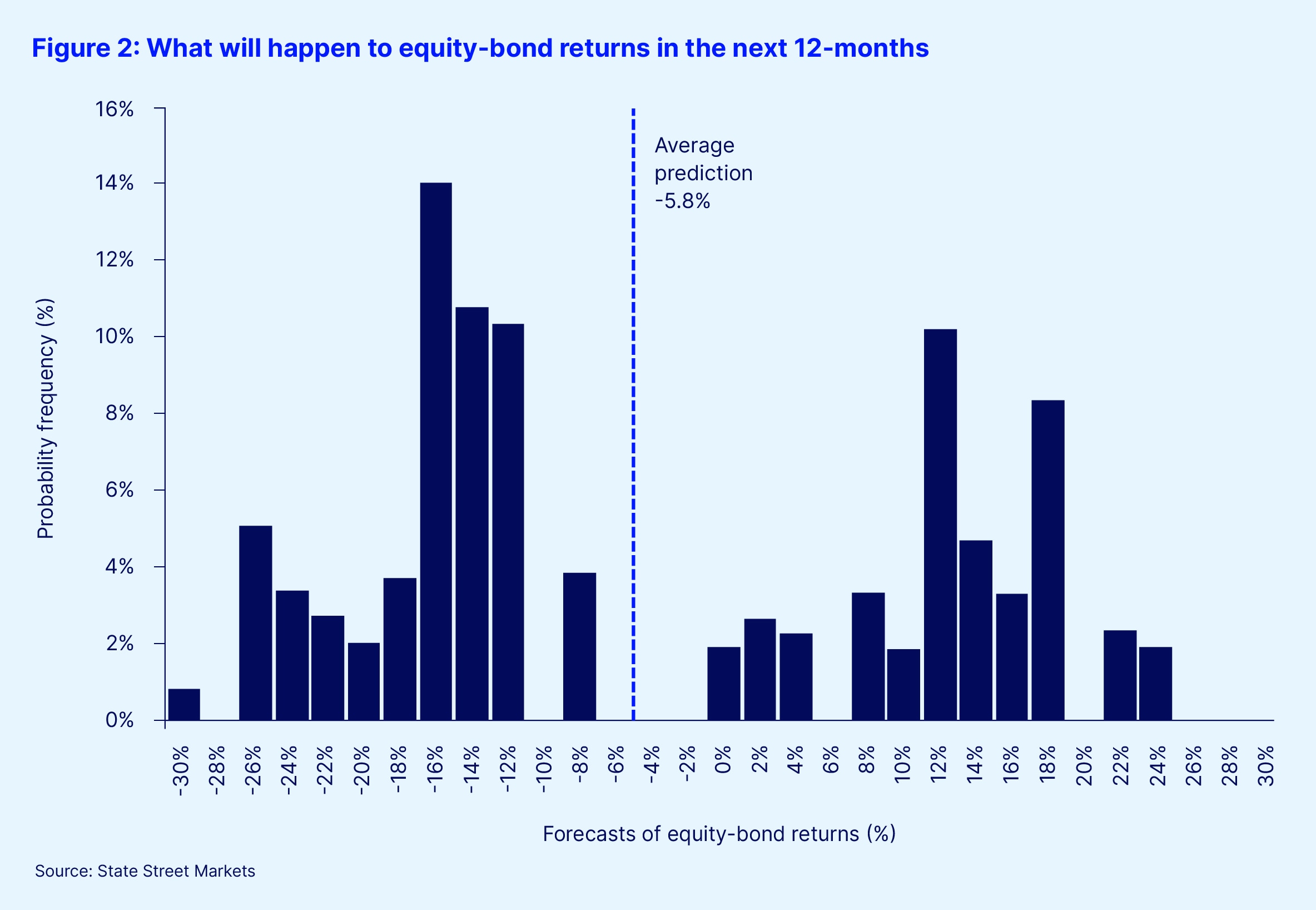
This leaves us with a familiar takeaway: The most relevant periods for predicting the next twelve months of equity-bond returns tend to be either the build-up to a crisis – when equity returns are strong – or market crashes. Once again this is reflected in the range of equity-bond return predictions generated by RBP each month in these relevant time periods. These individual or "solo" predictions represent each month’s ‘vote’ for how equities will perform next year. An average of all these forecasts suggests that equities may underperform bonds by 6 percent in the coming 12 months (see Figure 2).
In January, the average forecast was for a 3 percent underperformance, so the forecast for equities has become riskier. But once again, the “good news” is that the solo predictions — or votes — are even more split between very negative and very positive, indicating a high degree of uncertainty.
Don’t expect business as usual (yet again!)
Our conclusion hasn’t changed since January. The bimodal outcome is the statistical equivalent of the famed “two-handed economist” and reinforces the main takeaway from our analysis six months ago: When allocations to equities are so high, what follows is never average. The implications are profound. More than any year in recent history, investors in 2026 need to prepare for a wider range of outcomes and be ready to hedge accordingly to boost portfolio resilience, whether it be through country, sector, asset, foreign exchange (FX) tilts or by employing multi-asset and alternative strategies.
We’ll explore some of these options in the articles that follow, covering the outlook for equities, fixed income, currencies, and emerging markets (EM).
RINO markets: One horn, one sector, one trade
Marija Veitmane, head of Equity Strategy, State Street Markets
The equity rally in the first half of 2026 was nothing short of spectacular — global stocks are approaching all-time highs after gaining nearly 10 percent. A 10 percent return would be considered very healthy in “normal times,” with robust economic and earnings growth, stable inflation, and moderate valuation and positioning risks. But these are not normal times. The Iran conflict has dampened both economic and earnings outlooks, inflation is proving stubbornly high, and central banks are running out of room to cushion demand destruction. Yet equity markets appear largely unfazed. Institutional investors continue to pile into equities, pushing already stretched valuations further into expensive territory.
This apparent contradiction can be explained by what has actually been driving the rally. Since the start of the war, market performance has been anything but uniform, and that divergence helps explain both the strength and the fragility of the rally. This is a RINO. US equities have done the heavy lifting (MSCI US up close to 10 percent), while much of the rest of the world has gone backwards. Europe and the Pacific (ex-Japan) have taken the brunt of the losses, while EM tells a familiar story of winners and laggards, with South Korea and Taiwan surging, and everyone else struggling to keep up.
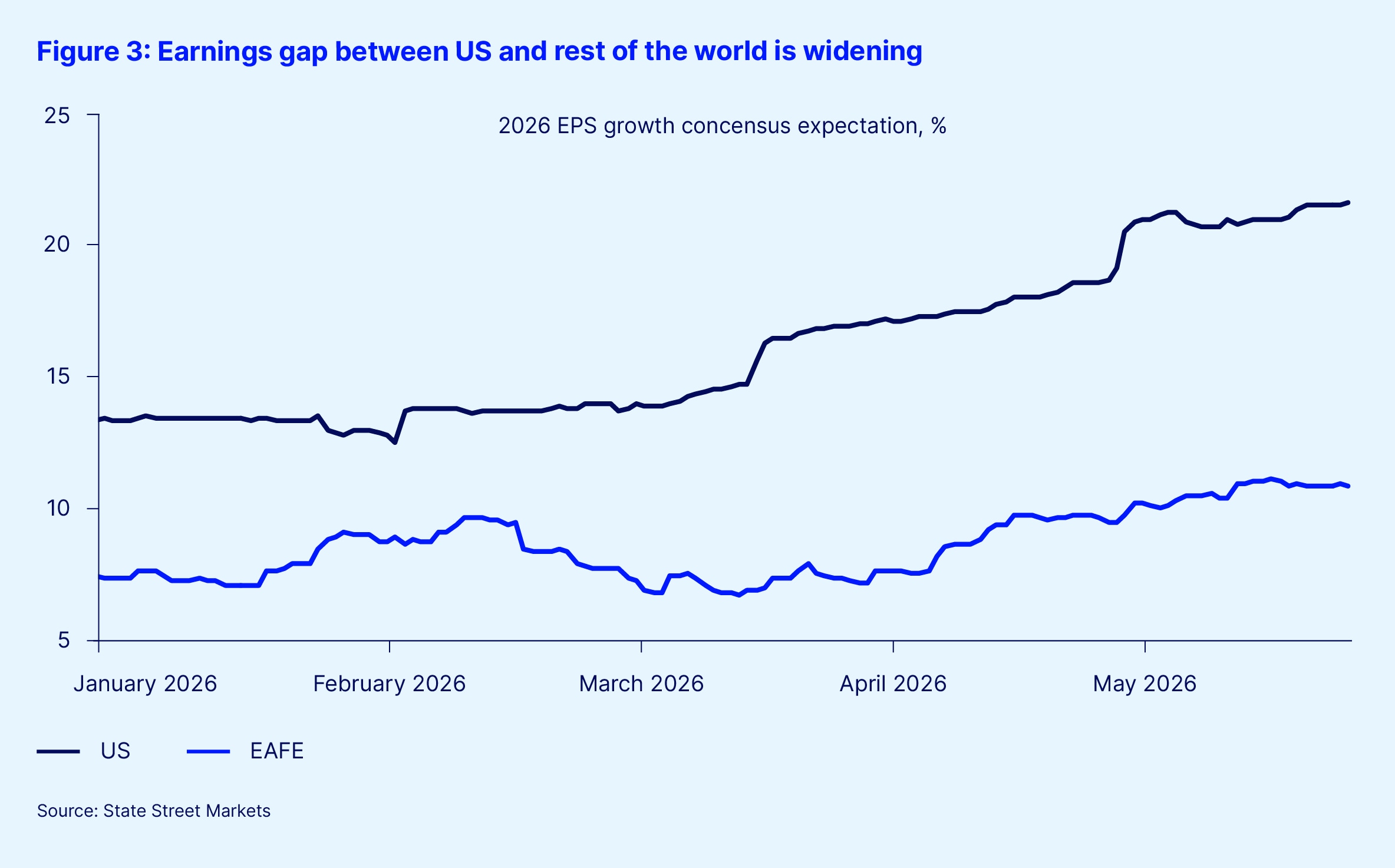
Corporate earnings are the key to the RINO narrative. They have been remarkably resilient, with 2026 consensus expectations revised higher since the war began. It sounds impressive — until you look closer.
The upgrades are coming from exactly two places: Energy and information technology (IT). Everything else is, at best, standing still. Consumer discretionary is leading the downgrades as demand destruction fears creep in, while defensives aren’t offering much shelter either. Thin margins in health care and staples make it hard to pass through rising costs, so even the “safe” parts of the market are feeling the squeeze. The result is a widening earnings gap between the IT-heavy US market and the rest of the world (see Figure 3).
Institutional investors are responding exactly as you would expect. They are doubling down on what is working, significantly increasing their off-benchmark positions in IT stocks since the start of the war while reducing positions in cyclicals and defensives. Regionally it means US equities are getting more crowded, Europe and the developed markets of Asia are being cut – again (see Figure 4). South Korea and Taiwan stand out as the only real exception — for the same reason: Their front-row seat to the IT story.
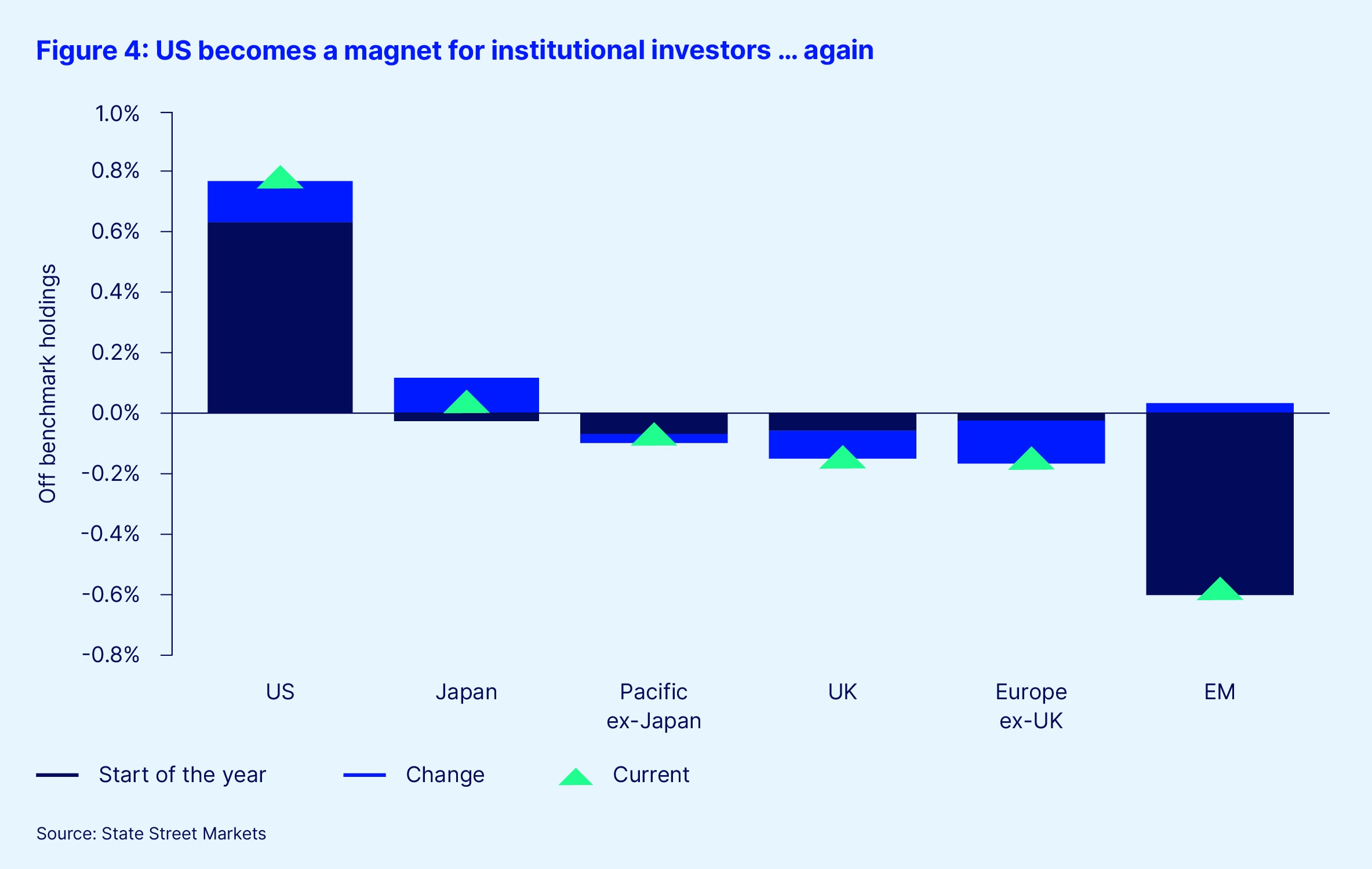
So yes, the rally is narrow — painfully so —and that’s exactly why we call it RINO. Until earnings start improving outside of technology, it is hard to see it broadening meaningfully. For now, the market remains narrowly driven, with investors continuing to support this trend. This leaves our stance unchanged from the January edition of this piece. At the time, we asked whether US equity (and technology) dominance was coming to an end. A turbulent six-months later, the answer is still no. We stick with US large-cap technology, with a selective tilt toward Asian technology. Not due to valuation or positioning, but because alternatives remain limited.
What AI and alternative data reveal about interest rate markets
Michael Guidi, head of Alternative Data, State Street Associates
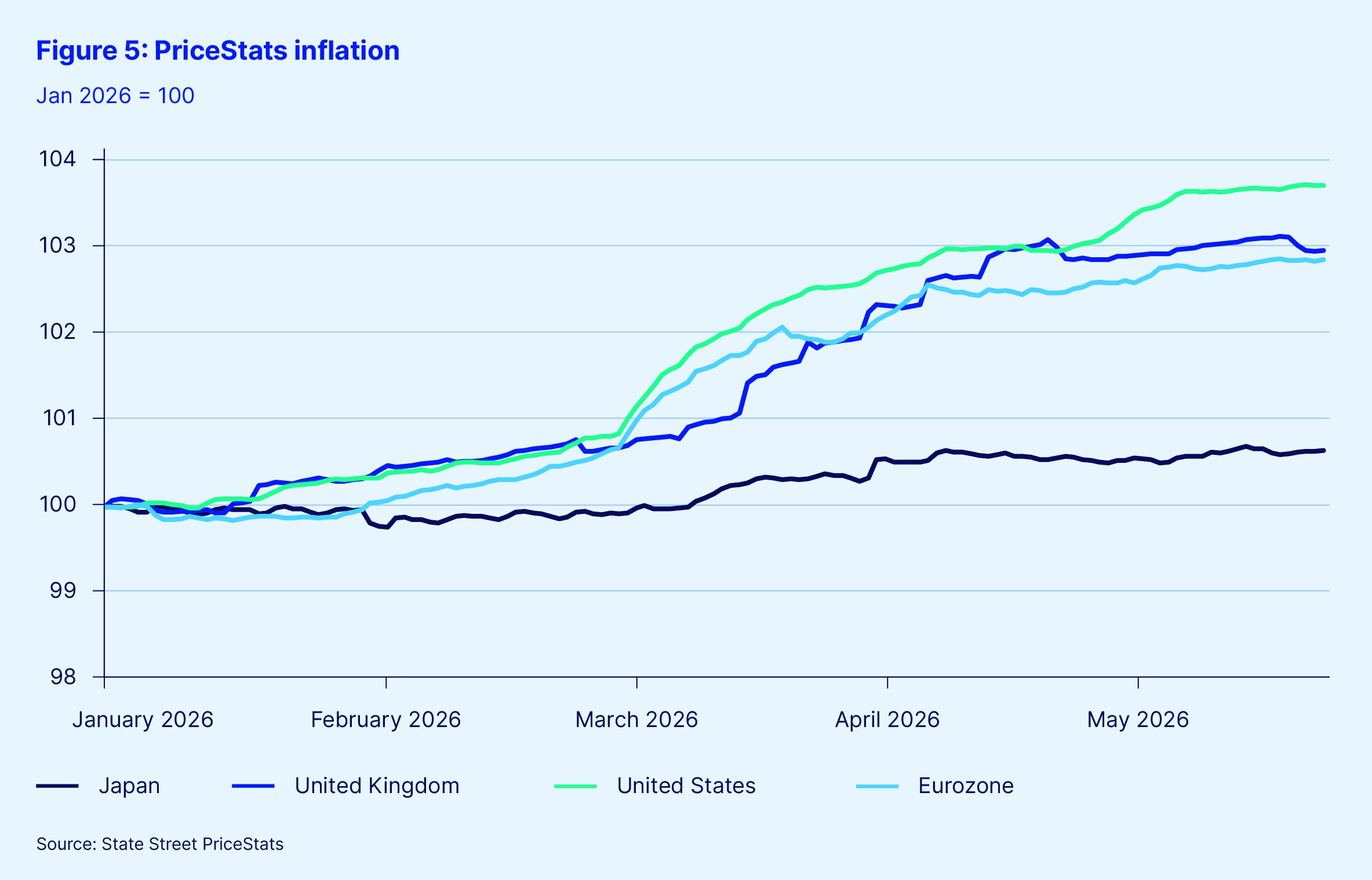
Hopeful signs of a disinflation trend at the start of the year quickly turned into renewed fears of inflationary pressures from the Iran conflict and the associated oil-price shock. The US already sits at just over 5 percent year-to-date inflation as measured by State Street PriceStats, our high-frequency inflation tracker, with the Eurozone and the United Kingdom not far behind (see Figure 5). Japan remains the clear outlier as the combination of energy subsidies and corporate cost absorption have limited the impact on consumer prices for now.
With a continued eye on the evolution of core inflation pass-through — which has yet to materialize as strongly as initially feared — the transitory narrative is again making the rounds. However, the scars of 2021-2022 have heightened market skepticism as energy prices remain elevated. Even if oil prices retrace, we’ve passed the point of the 2026 disinflation story. Instead, we’ve moved to a regime of stabilized, moderately elevated inflation across most developed markets, with Japan remaining the exception — sustaining rate differentials and reinforcing cross market divergence.
The impact of the AI revolution continues to blur the view for central bank’s inflationary response and, specifically, the Federal Reserve’s dual mandate. Near-term inflationary pressures of investment surges have raised additional concerns, especially alongside higher energy costs, while AI’s impact on the labor market has thus far been more geared towards reallocation rather than outright workforce reduction and labor market deterioration.
Higher for longer, but still diverging
Against this backdrop, it may come as little surprise that our large language model (LLM)-driven gauges of central bank policy have mostly all moved sharply hawkish since the start of the year, with the exception of the Bank of Japan, which is mildly dovish in light of core inflation softening (see Figure 6). Policy-response expectations from the Federal Reserve have been much more elastic in 2026 compared to 2021-2022 inflation. The Federal Reserve only hit this same hawkishness level in October of 2021 when inflation was close to 6 percent year-over-year.
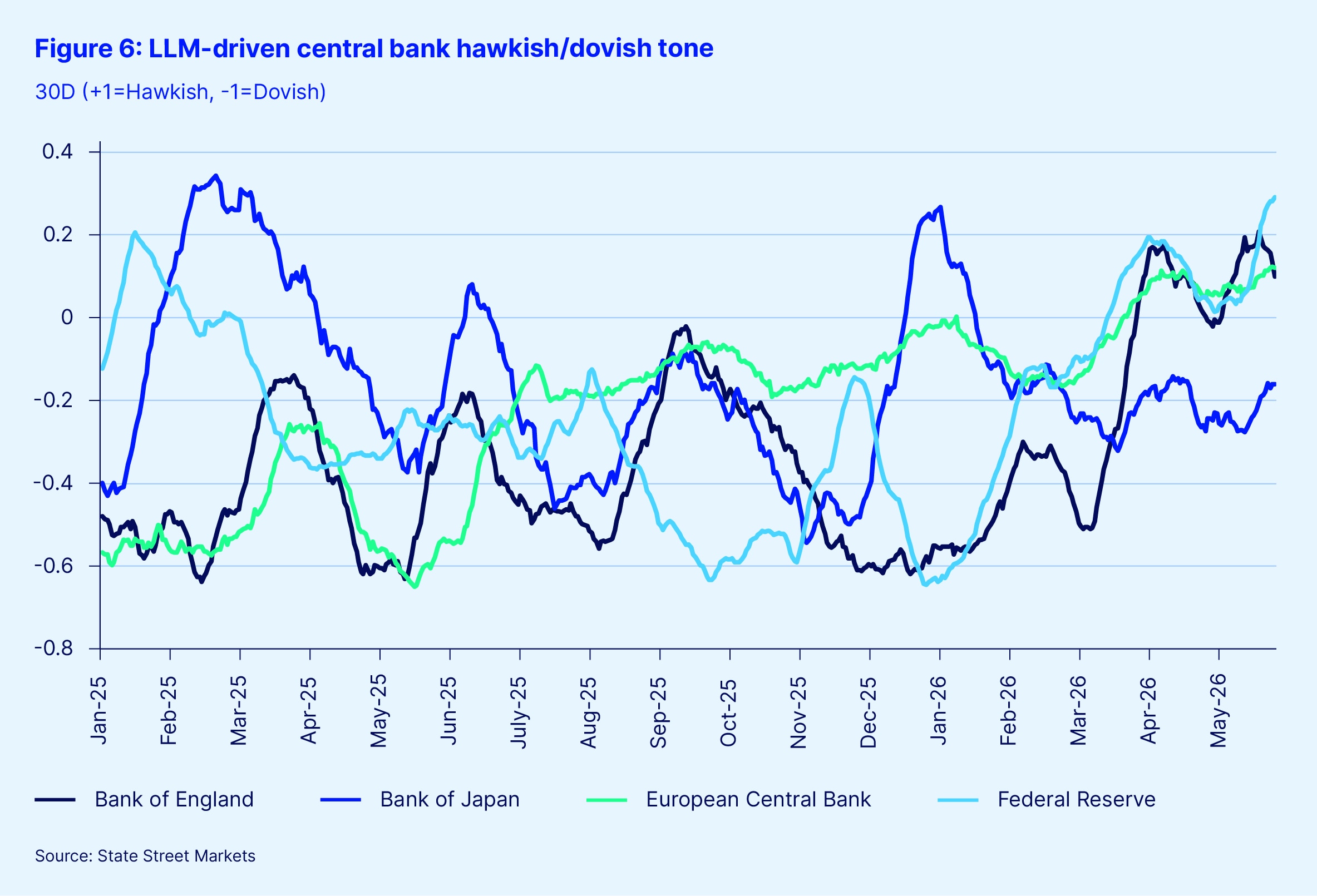
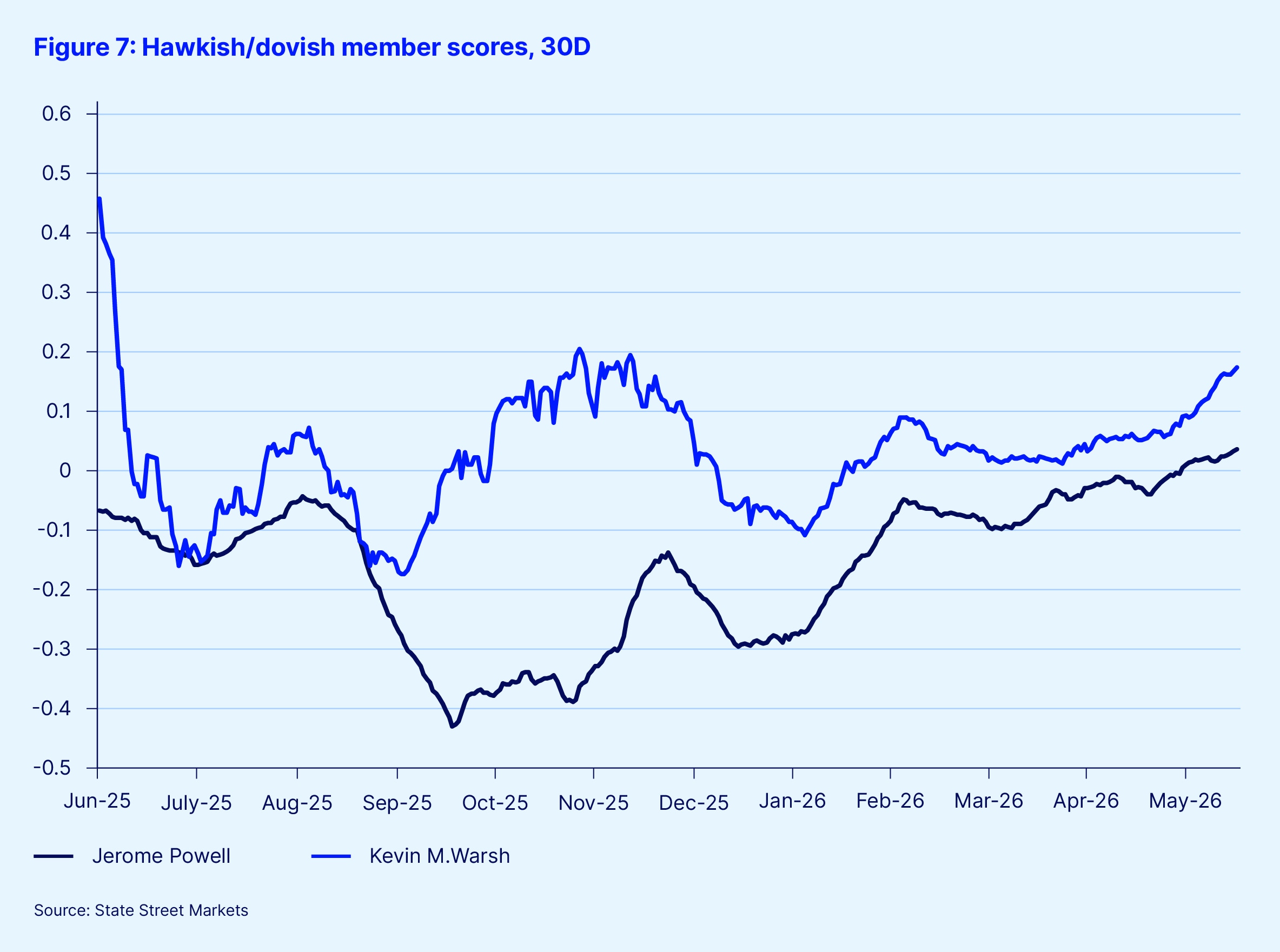
Central bank policy is entering a more cautious and reactive phase, with a clear bias toward holding rates higher for longer. This is particularly relevant for the Federal Reserve under its new leadership, where the transition to Kevin Warsh as Chair reinforces expectations of a policy framework that places greater weight on inflation credibility and forward-looking risks rather than pre-emptive easing. And while Warsh has softened his tone, our measures still point to a more hawkish stance than his predecessor (see Figure 7).
With US inflation still leading peers, the Federal Reserve is likely to remain the most constrained among G4 central banks, sustaining a relatively restrictive stance. Structural factors such as AI further complicate policy by blurring the distinction between cyclical and structural inflation pressures, increasing the risk of miscalibration. However, these effects reinforce rather than change the near-term policy stance, which remains focused on anchoring inflation expectations and avoiding premature easing.
Sentiment shifts unchanged
This higher-for-longer policy expectation is feeding directly into sustained weakness for fixed income and duration, as measured by our institutional investor flow metrics. Duration-weighted flows into US Treasuries remain weak after a brief bounce, and cross-border flows have been anchored in the bottom quintile all year. The UK and Eurozone have fared slightly better, but with inflation remaining above target and fiscal issuance elevated, demand is still constrained. Even in Japan, where policy remains more accommodative, gradual normalization has reduced the willingness of investors to absorb duration risk.
The result is a structural weakening in bond demand across the G4, reinforcing tighter financial conditions beyond policy rates alone. This dynamic increases the sensitivity of yields to both inflation surprises and issuance trends, and raises the likelihood that term premia remain elevated, limiting the scope for sustained rallies in duration.
Despite the shifts — the surge in inflation and dramatic changes in central bank tone — our conclusion remains broadly unchanged from January. Central banks still look likely to respond differently in 2026, even as a renewed inflation shock builds on the first. Meanwhile, risks at the long-end of fixed income curves remain elevated.
Dollar bounce or more of the same?
Tim Graf, European head of Macro Strategy, State Street Markets
The 2026 consensus outlook for modest, continued weakness in the US dollar (USD) had its moments but mostly proved frustrating. The US Dollar Index (DXY) held a 4.5 percent range through the end of May, much narrower than its six-month rolling average of 7.5 percent. And in a sharper challenge to consensus, June brought a range-breakout following a more hawkish tone from the Federal Reserve at its latest policy meeting. The additional carry cost of 0.75-1.00 percent for those who might have sold it at the turn of the year and held through today only compounds the misery for USD bears.
The outbreak of hostilities between the US and Iran in late February marked a shift in the USD’s trend and brought a return of USD correlations to risky assets and volatility that more resembled its safe haven regime of 2020-2024. These relationships weakened last year – especially around April’s “Liberation Day” tariffs – but now a return to the status quo ex ante looks to be in place (see Figure 8).
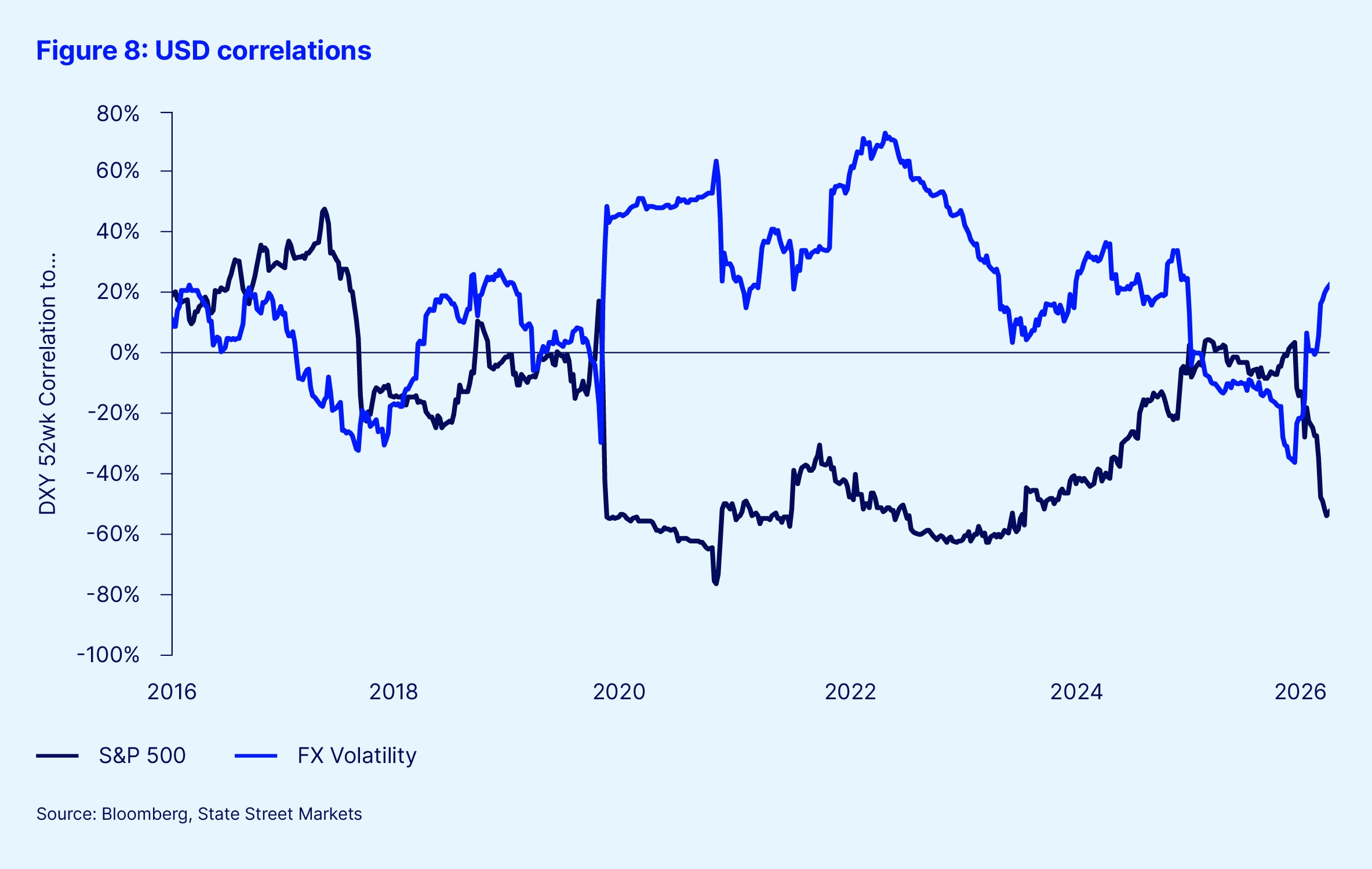
Last year’s correlations formed the basis for why foreign owners of US assets might hedge away their USD risk more aggressively in 2026. If a stronger USD no longer reliably offsets losses on risky assets during drawdowns and volatility spikes – and if hedging costs were to fall amid expectations of the Federal Reserve easing rates more than other central banks – USD exposure becomes less appealing.
In fact, changes observed in our estimates of hedge ratios derived from custodial holdings suggest US-based investors made just that calculation last year, lowering FX hedges back to dollars to their lowest levels in a decade (see Figure 9). We also saw the foreign hedging of US assets trough at 53 percent of assets under management at the start of December.
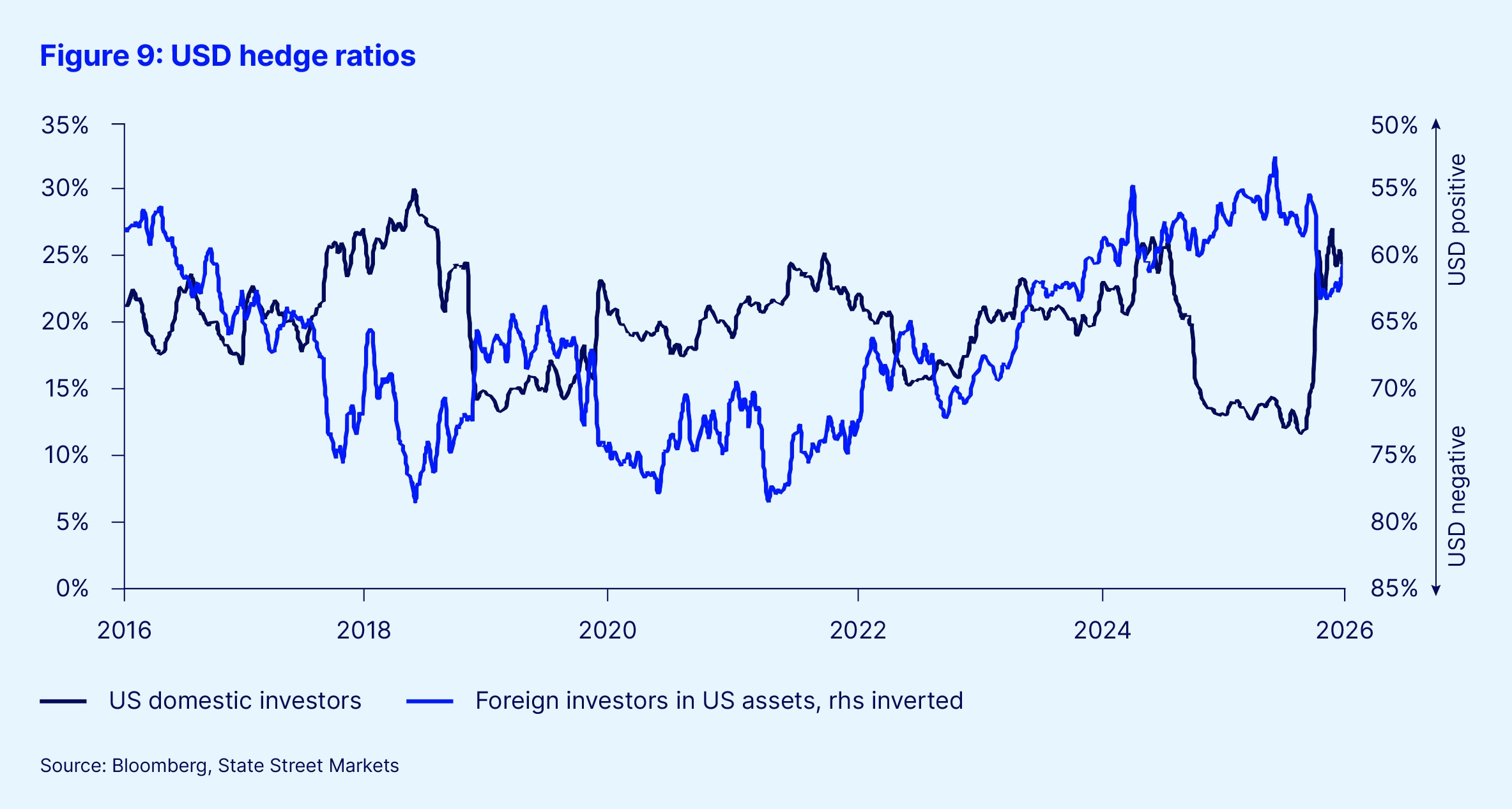
But today, both sets of investors have reversed course. US domestic investors are now hedging foreign asset exposure back into USD at their highest level in eight years. The hedge ratio of foreign investors against USD-denominated assets is higher than it was, but is starting to reverse. A sustained return to the correlation regime in place prior to 2025 will likely limit USD losses, all other factors equal.
The dollar’s medium-term fortunes also hinge in no small part on the cost of these hedging decisions, which ultimately boil down to relative central bank policies. At the start of 2026, the USD was projected to lose 0.60 percent of yield advantage versus the Euro (EUR) and 1.05 percent versus the Japanese yen (JPY) this year, reflecting expectations the Federal Reserve would continue a modest easing cycle as other central banks either held or raised rates. As we explored in the previous article, “What AI and alternative data reveal about interest rate markets,” our media-based sentiment indicators used in articles written about central banks showed the Federal Reserve receiving the most dovish coverage, consistent with these dynamics.
Thanks to inflationary pressures from the Iran conflict, market projections for central bank policy paths have changed, narrowing rate gaps in the USD’s favor. Our measures of central bank coverage tone have also flipped, with the Federal Reserve now seen as having the most hawkish coverage of any major institution – typically a harbinger of even higher rates. Incoming Federal Reserve Chair Kevin Warsh has an unenviable challenge on his hands. A stated desire to continue the easing policies of recent years to support the economy may not see the light of day should inflationary pressures persist. The dollar’s fortunes lie very much in the balance.
Emerging markets: Shaking, not breaking
Dwyfor Evans, Emerging Markets strategist, State Street Markets
If 2025 marked a stellar year for EM — delivering double digit gains across FX carry, sovereign fixed income, and equities — the first half of 2026 has proven considerably more mixed. This reflects the impact of a major geopolitical shock in the Middle East, which drove USD strength and elevated cross asset volatility. That said, risk sentiment rebounded quickly following a broad based sell off in March, allowing EM assets to participate in the recovery — albeit one increasingly defined by a premium on strong external balances, adequate reserves, and credible inflation frameworks. Subsequent performance has been characterized less by direction and more by divergence — across and within asset classes — shaped by two dominant narratives: Sensitivity to energy markets and the ongoing AI- and technology-driven growth cycle.
The energy price shock has a more direct bearing on prospective policy adjustments — both monetary and fiscal. As we move into the second half of 2026, the key policy uncertainty is whether higher energy costs feed through into broader inflation dynamics, particularly via food prices, where many EMs exhibit significant inflation basket sensitivities. This potential pass through is critical for a range of EM macro narratives. It shapes expectations for interest rate paths, tests the durability of FX carry, and heightens vulnerability to fiscal pressures, especially in economies with limited policy buffers.
The State Street PriceStats series provides a high frequency gauge of inflation pressures across a universe of thirteen EM economies. A daily online aggregate of EM fuel prices enables us to address two key questions: First, the magnitude of the energy price shock stemming from the Middle East conflict — both in absolute terms and relative to the Ukraine conflict four years ago — and second, the extent of pass through into other inflation components. The contrast in online price dynamics between the Middle East and Ukraine conflicts is stark (see Figure 10), underscoring differences in the scale and transmission of the shock.
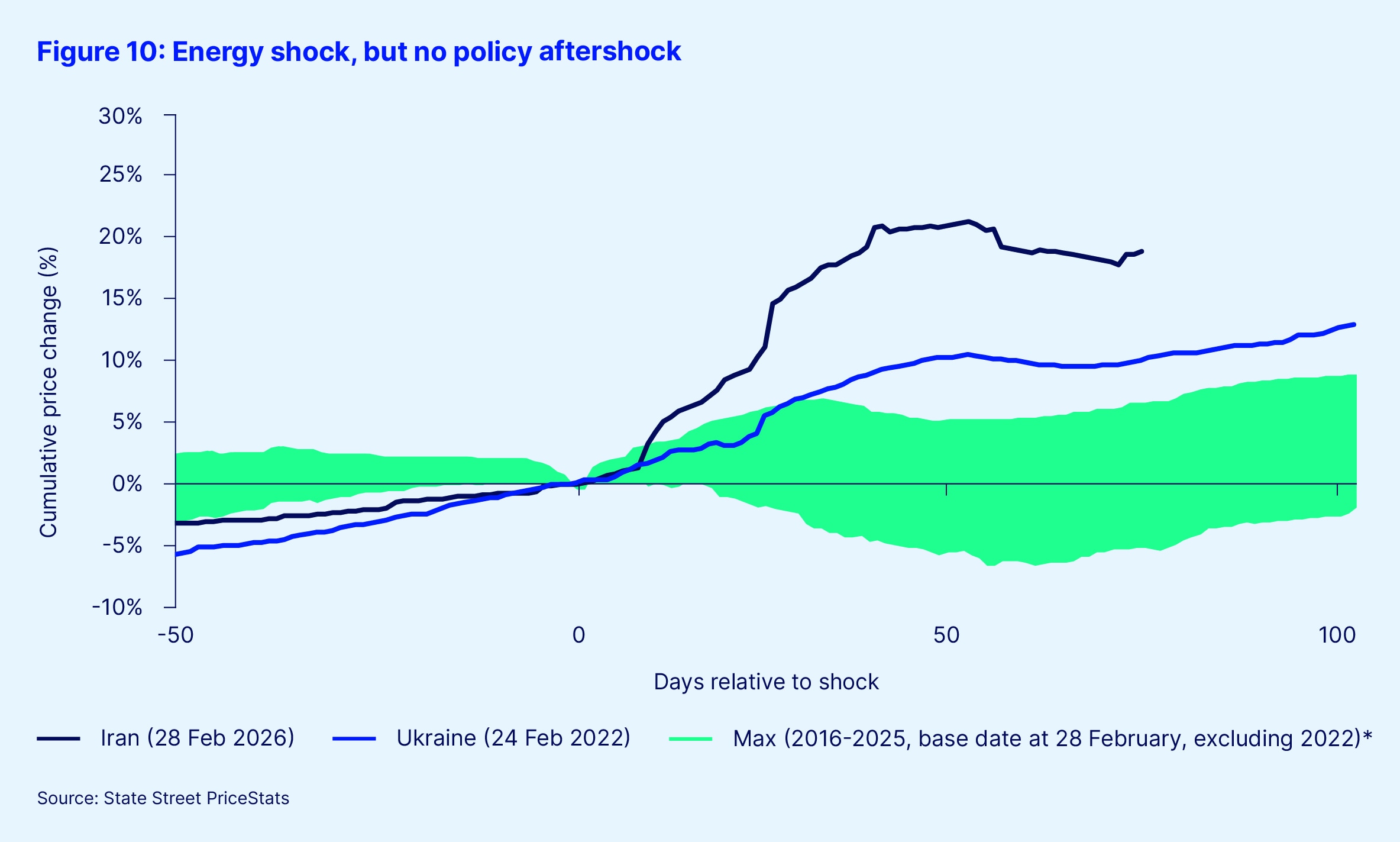
While both episodes, unsurprisingly, drove higher fuel prices, the increase following the strikes in Iran and elsewhere in the Middle East has been sharper and more pronounced. This likely reflects the region’s role as a global energy hub and carries implications for EMs with large fuel and transport weights in their consumer price index (CPI) baskets, such as Brazil, Hungary, Mexico, and South Africa. However, a key contrast with the Ukraine conflict is the limited evidence of pass through into food and other inflation categories — an important distinction given the relatively high weight of food in EM CPI baskets. Indeed, the EM Food index for 2026 year to date remains below levels seen in recent years and below longer term averages.
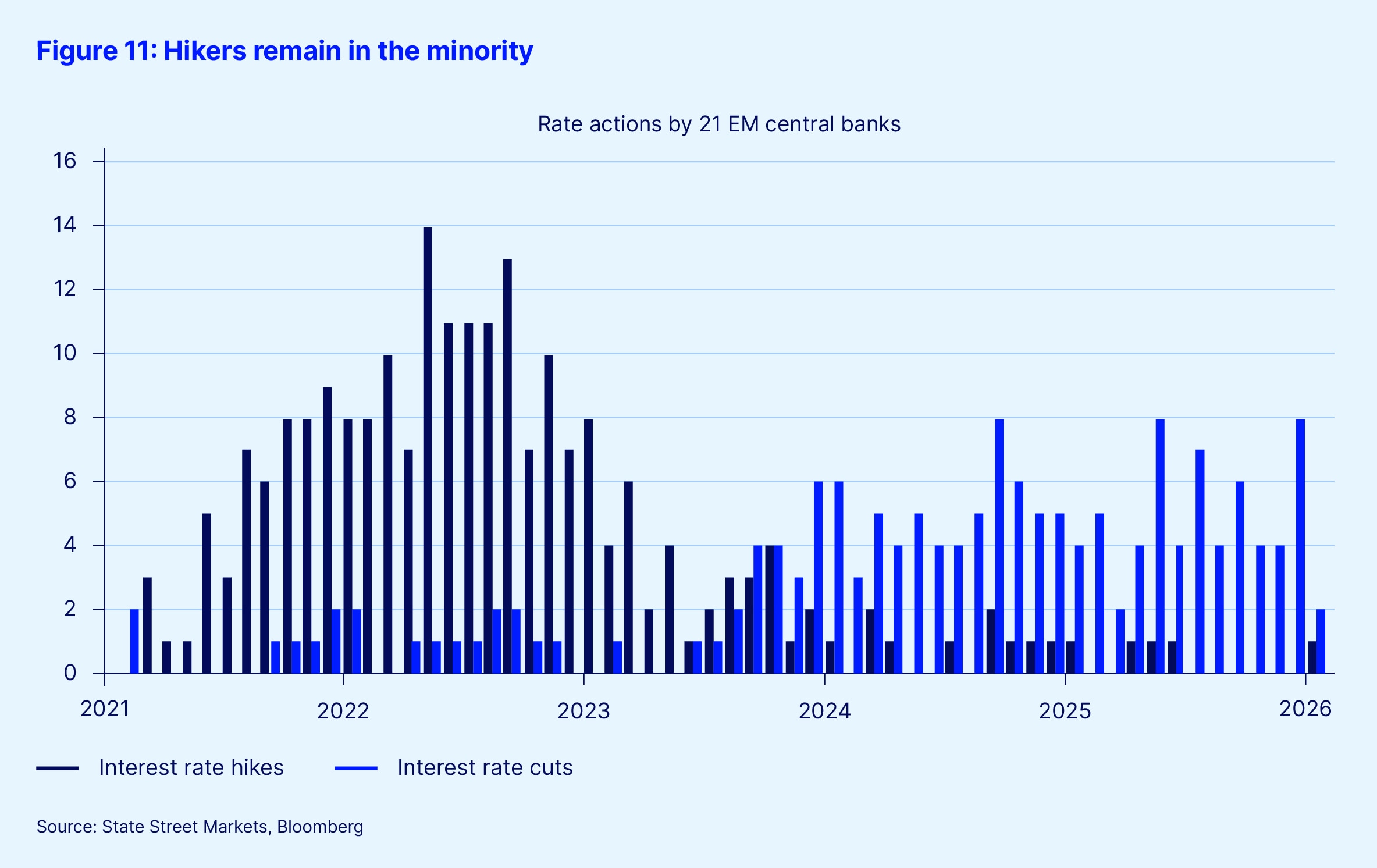
The upshot is that EM inflation appears broadly contained — for now. While developed market expectations have shifted toward more aggressive rate hikes to offset inflation pressures, the EM policy narrative is notably more nuanced. Even as of April, with higher oil prices increasingly entrenched, a greater number of EM central banks continued to ease rather than tighten policy (see Figure 11). This points to a clear policy divergence between economies with sufficient fiscal space, subsidy capacity and well anchored inflation expectations, and those forced into defensive tightening to stabilize inflation or support their currencies.
For the former group, the ability to ease underscores both elevated nominal (and real) rates and enhanced policy credibility. More broadly, the tempered pace of adjustment suggests that selective real yield opportunities remain attractive across EM — even as sovereign bond inflows from real money investors remain subdued, in line with generally softer cross asset flows.
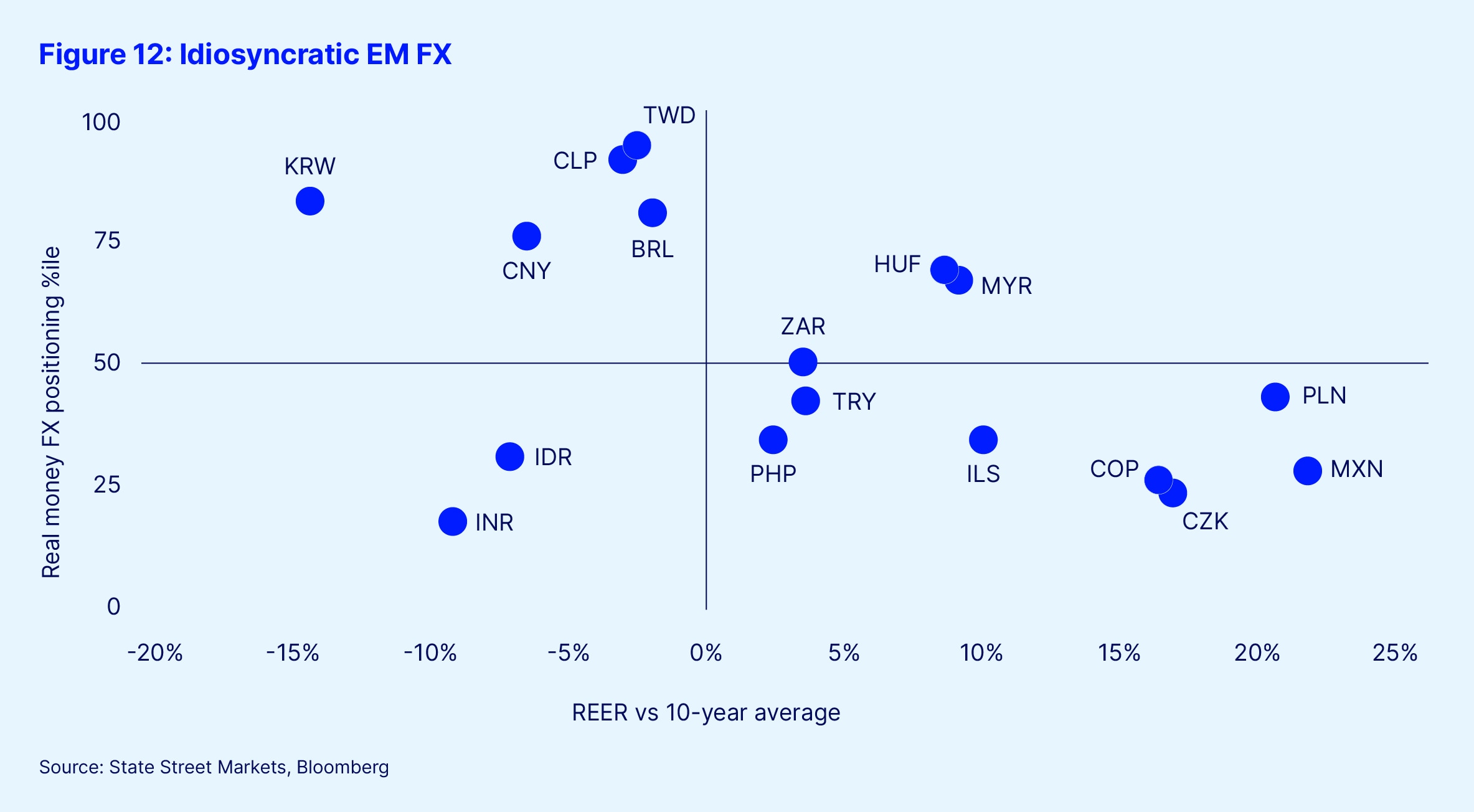
The divergence narrative is increasingly reflected in regional allocation within EM. Three groupings stand out in 2026: (1) Latin America’s high yield, disinflationary economies; (2) Southeast Asia’s fiscally constrained net energy importers, forming a distinct intra regional bloc; and (3) North Asia’s AI- and technology oriented economies, whose performance — particularly with regards to external trade dynamics — is more leveraged to the global technology cycle. The prominence for this third grouping is notable given the continued focus on tariffs and protectionism.
This regional divergence is increasingly visible in real money positioning across EM FX (see Figure 12). Investors are overweight high‑yielding and AI- and technology‑exposed markets, combining Latin America and North Asia, reflecting both carry appeal and structural growth narratives. By contrast, Southeast Asian FX remains under-owned amid fiscal constraints and energy import dependence, while currencies perceived as overvalued on long-term real effective exchange rate (REER) metrics are also being avoided.