Insights
Institutional Investor Indicators: August 2026

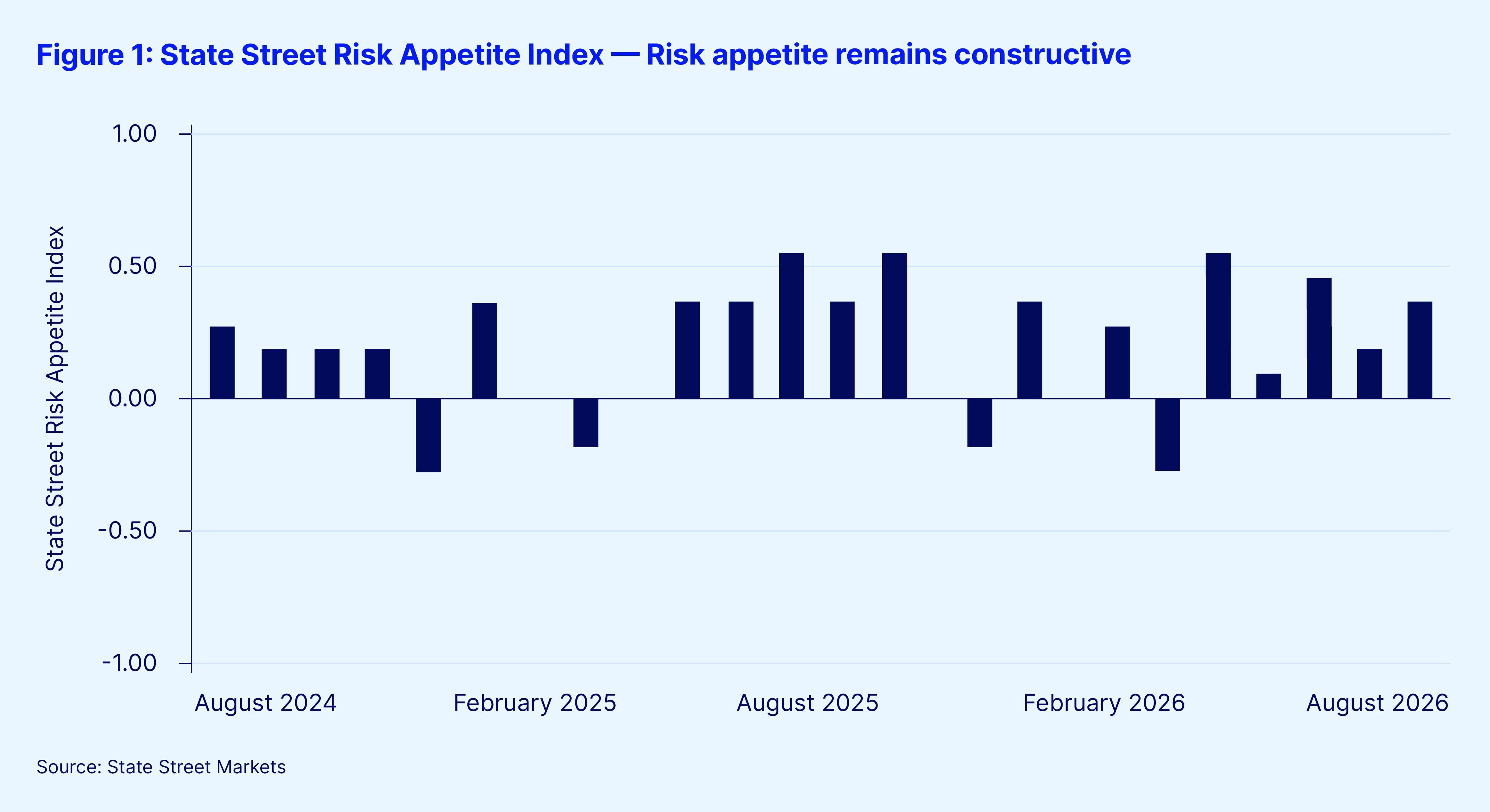
The State Street Risk Appetite Index rose to 0.36 in August from 0.18 in July, its third-strongest reading of 2026 and fifth consecutive positive month, reflecting continued institutional risk appetite.
August 2026
Our monthly series offers an updated analysis of our institutional investor indicators.
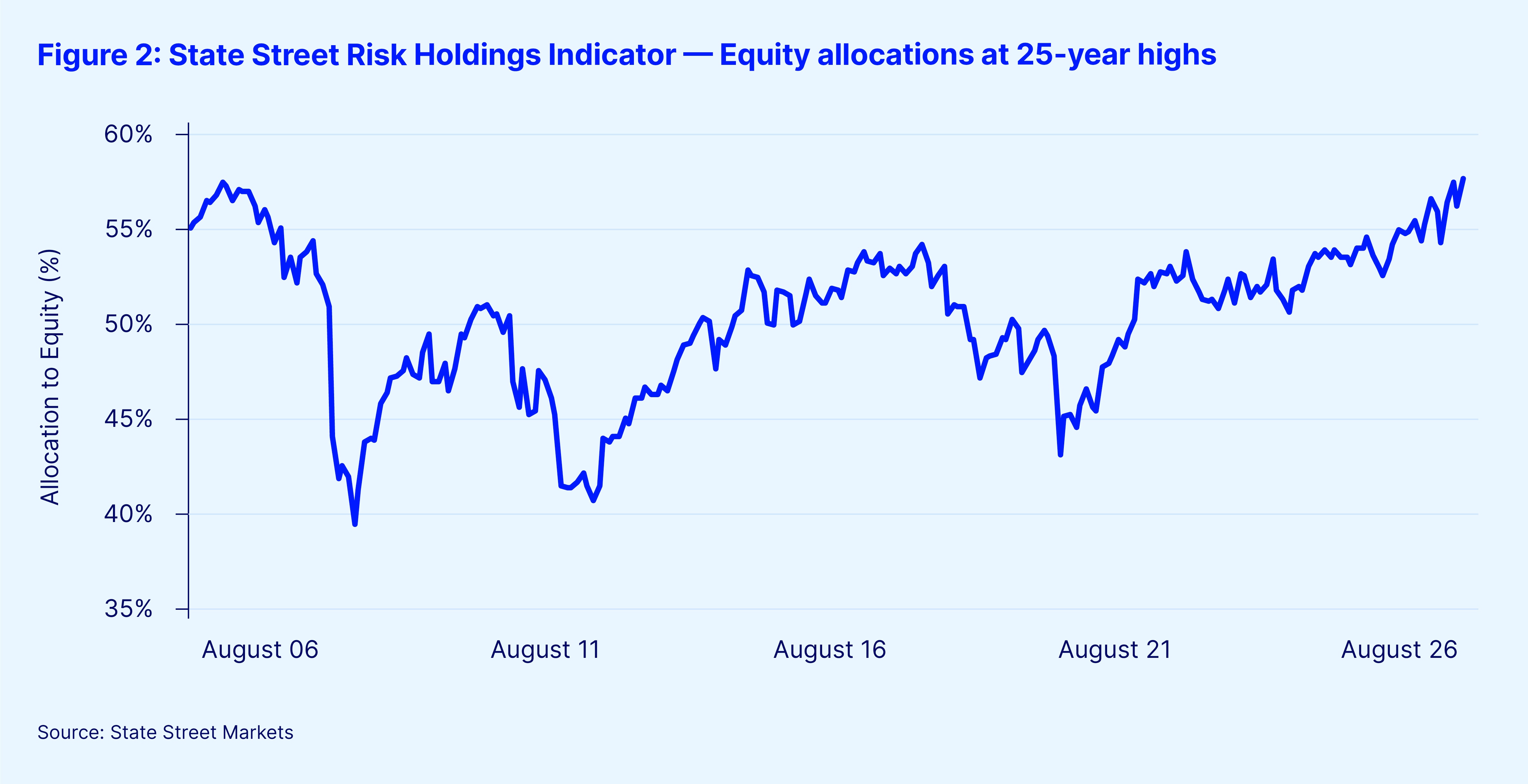
- Our Institutional Investor Holdings Indicator shows the aggregate holdings of institutional investors across three asset classes: stocks, bonds, and cash. This simple information can tell us a lot about how investors view the economy and markets.
- Our Institutional Investor Risk Appetite Indicator is based on flows — buying and selling activity — rather than portfolio positions. It reveals whether investors, in aggregate, are buying risk or selling it. While the Holdings Indicator tells us about the current location, the Risk Appetite Indicator tells us about the direction of travel.
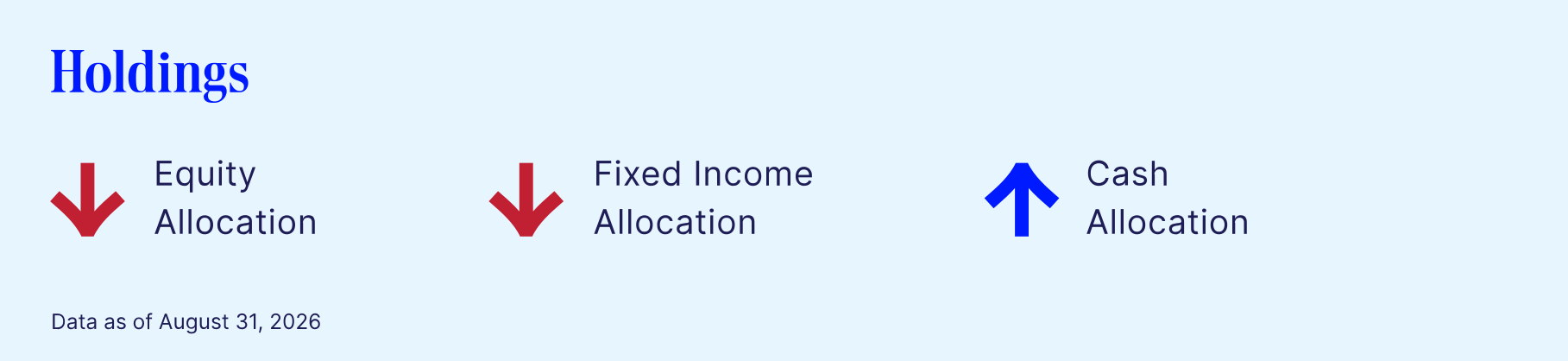
Despite this stronger index reading, investor allocations across assets indicate a continued rise in cash holdings, ostensibly from fixed income. Long-term investor allocations to equities fell by around 13 basis points during the month and followed a large increase in July. Equity allocations remain at around 25-year highs at 57.4 percent. Allocations to fixed income stood at 24.9 percent and cash at 17.6 percent. August can be characterized as continued high equity holdings but a continued rotation from fixed income to cash.
Read the commentary from Dwyfor Evans, Head of Macro Strategy for APAC, State Street Markets.
Institutional risk appetite recovered in August from its more moderate July reading. Investor demand for risk assets remains remarkably resilient, recording its fifth successive positive reading. Portfolio weight allocated to equities fell very modestly in the month but remains close to 25-year highs. The most notable allocation change during the month is out of fixed income and into cash, as concerns around inflation, fiscal policy, and rising term premia undermine investor sentiment in bonds. The upshot is that by the end of August, equity holdings were 32.5 percent above bonds against a long-term average of 20 percent and, somewhat ominously, at levels last seen in the run-up to the global financial crisis in 2008.
The resilience in aggregate equity allocations centers around continued strong earnings growth, a close historical gauge of investor allocation to the asset class. However, this continues to mask substantial flow and positioning variations below the aggregate level. Sectoral flows towards month-end gravitated once again toward information technology (IT) sector while virtually every sector was sold. A positioning overweight in IT also remains extreme coupled with underweights elsewhere. Similarly, by geography, flows remain robust in the United States and emerging markets (EM), albeit highly selective in the latter in tech-heavy Asian markets, while aggregate EM positioning remains a substantial underweight.
Macro risks continue to explain selectivity and rekindled caution around fixed income. Renewed concerns around the Middle East have driven a resurgence in global energy prices and pose further risks to inflation targets. Oil prices are 20 percent above their levels at the start of July, and consequently, State Street PriceStats show renewed headline inflation pressures. Specifically in terms of the Fed mandate for policy, labor data has also remained robust, and expectations on rate hikes continue to be repriced.
Fears around the conduct of fiscal policy embedded within rising term premia have also put upward pressures on yields, particularly at the long-end and undermine investor sentiment in duration. Most notably at this juncture, rising yields have not (yet) adversely impacted demand for equities, but the rotation from fixed income into cash warrants caution.
In currencies, the message remains one of persistent US dollar selling – despite already bearish positioning – amid continued investor preference for risk assets, carry, and EM foreign exchange (FX). Positioning metrics in the latter centred around high nominal carry currencies or those linked to a structural tech/export narrative. Across G10, demand for the Japanese yen weakened despite an extreme underweight, with investors seeing value across commodity-related currencies.
August therefore provides a continued strong backdrop for risk, but one encompassed in a nuanced series of narratives below the surface. Flow and positioning indicators point to a continued pro-risk rotation stance with investors favoring cyclicals, EM, carry, and selected artificial intelligence (AI)-linked markets, while reducing exposure to certain defensives and traditional duration. This exit from duration remains a trigger for weaker fixed income flows more generally.