Insights
Institutional Investor Indicators: June 2026

Risk appetite climbed sharply in June to one of its highest levels in four years, as investors largely looked past near-term challenges and maintained strong exposure to US equities, technology, and currency carry trades.
July 2026
Our monthly series offers an updated analysis of our institutional investor indicators.
- Our Institutional Investor Holdings Indicator shows the aggregate holdings of institutional investors across three asset classes: stocks, bonds, and cash. This simple information can tell us a lot about how investors view the economy and markets.
- Our Institutional Investor Risk Appetite Indicator is based on flows — buying and selling activity — rather than portfolio positions. It reveals whether investors, in aggregate, are buying risk or selling it. While the Holdings Indicator tells us about the current location, the Risk Appetite Indicator tells us about the direction of travel.
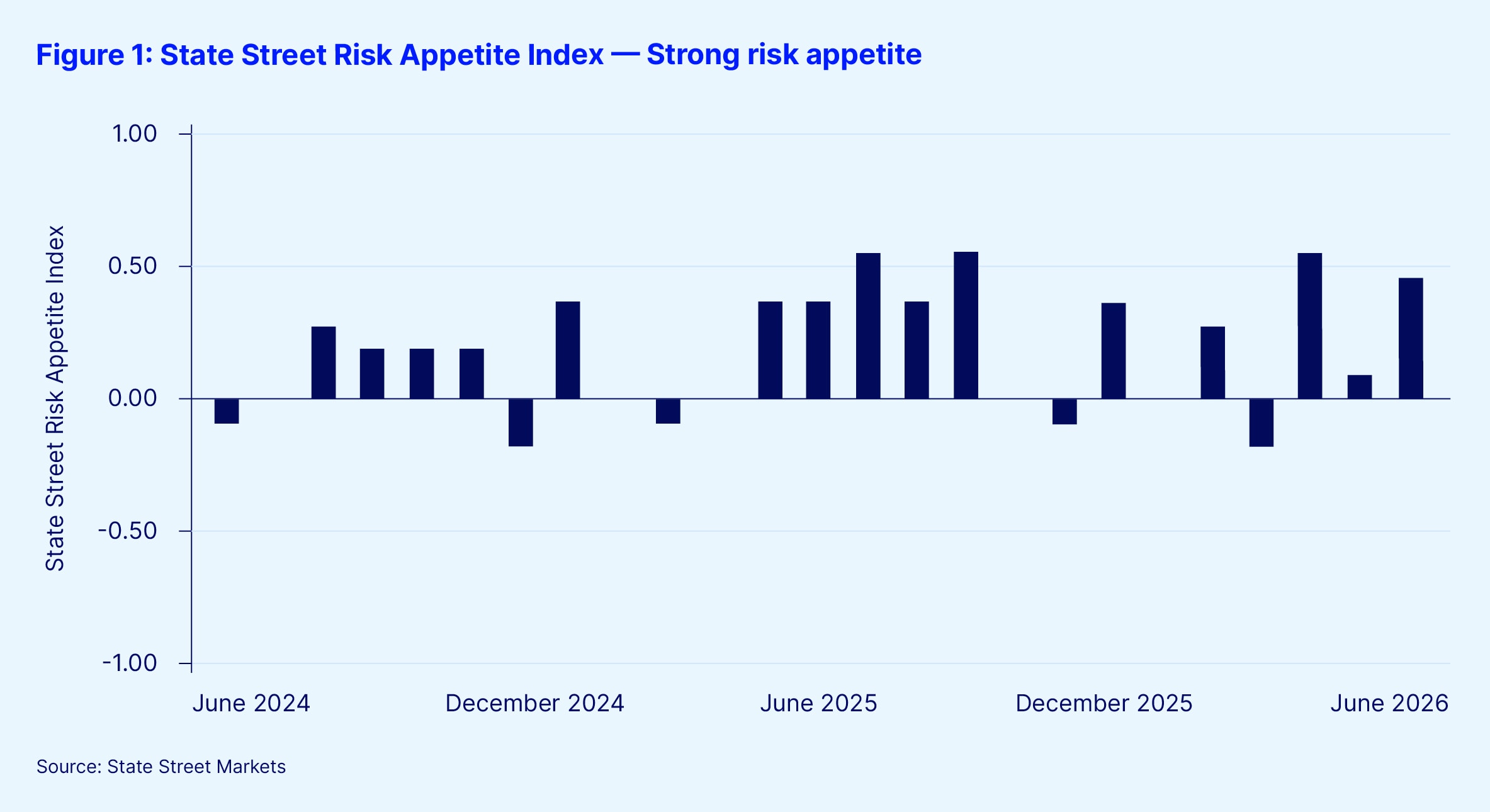
The State Street Risk Appetite Index surged to 0.45 in June from 0.09 in April, indicating investors continued to look past near-term challenges. The June reading was one of the highest recorded in the past four years. While investors modestly reduced equity allocations and increased cash holdings, the shift appears to reflect profit-taking rather than a broader change in sentiment. Positioning continued to favor United States equities, technology, and currency carry strategies.
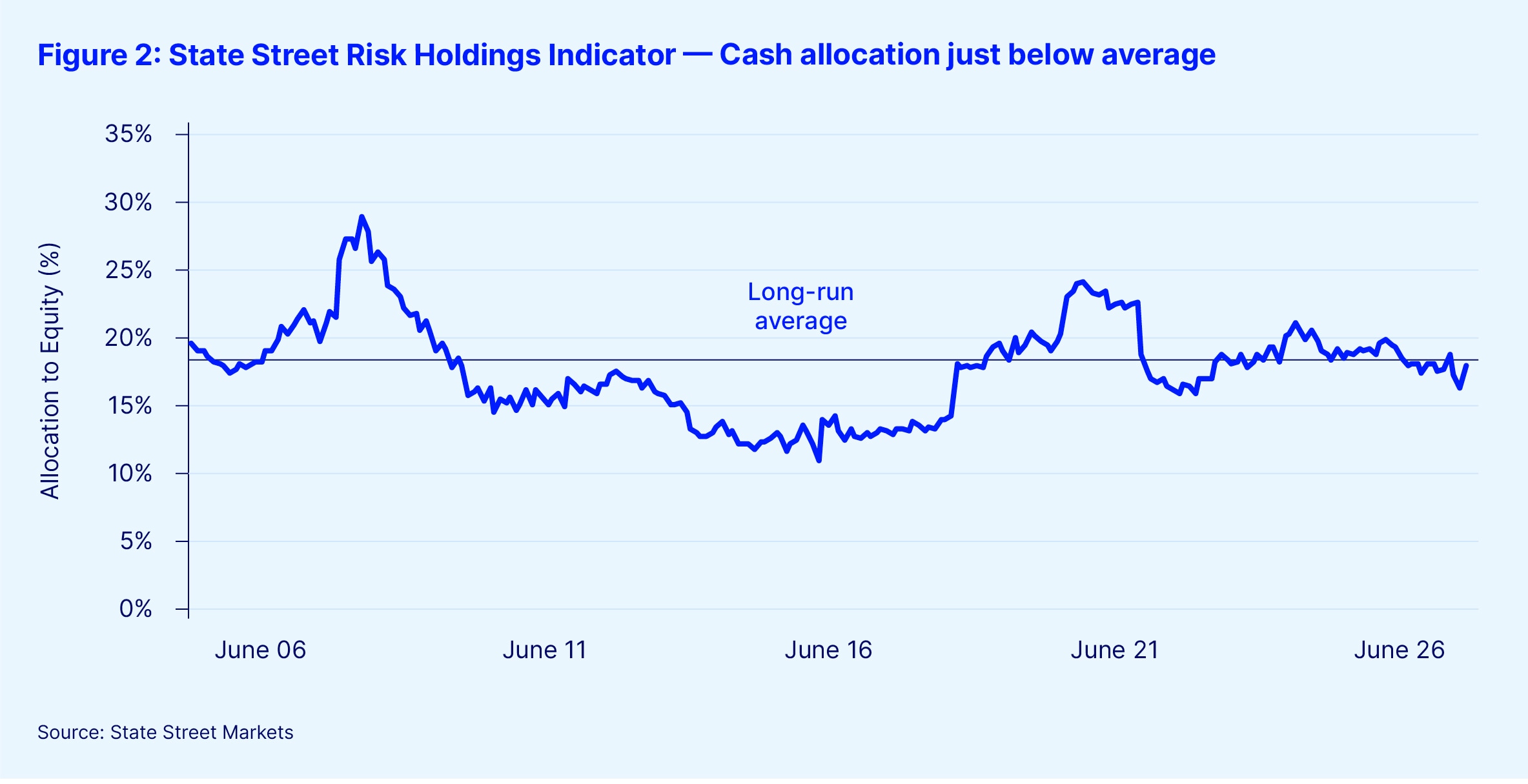
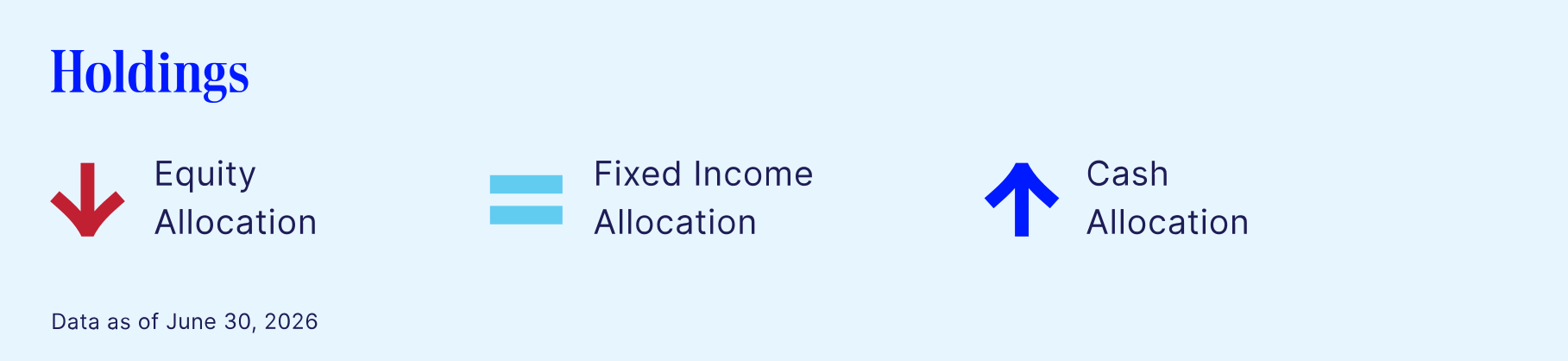
Equity allocations declined by 12 basis points in June, while cash allocations rose by 16 basis points and fixed income exposure remained broadly unchanged. This suggests that rising volatility continues to drive shifts between cash and equities as investors remain cautious about extending duration amid ongoing rate uncertainty.
Read the commentary by Daniel Gerard, Senior Multi-Asset Strategist, State Street Markets.
The first half of 2026 has come to a close, marked by powerful cross currents shaping market performance. Institutional investors have been weighing the impact of war, global trade, the return of inflation, unprecedented market concentration, and the uncertainty surrounding the Federal Reserve's new leadership. June was no exception to this.
Equity markets declined by less than one percent in June. However, this headline performance masked significantly larger intra-month moves as investors responded to evolving market conditions. Despite ongoing volatility, there have been few signs of panic. Institutional investors have generally maintained exposure to risk assets. June saw a strong rebound in State Street’s Behavioral Risk Score, indicating that asset managers continue to look beyond near-term challenges and remain focused on longer-term earnings and interest rate expectations.
Even as equity allocations retreated slightly in June, roughly in line with aggregate performance, managers’ equity allocations remain near 20-year highs. Interest rate expectations have come under greater scrutiny as volatile inflation continues to challenge global central banks, including the Federal Reserve and newly confirmed chair, Kevin Warsh. Institutional funds continue to maintain historically low fixed income allocations. Resilient growth and accelerating consumer prices have challenged the assumption that rates have already peaked for this cycle. The modest decline in equity positions was accompanied by a slightly higher allocation to the shortest end of the curve. June provided further evidence that investors are hedging equity positions with cash, rather than longer duration instruments.
Within equities, investor behavior shifted modestly during June. Institutional investors entered the month with strong demand for US equities, particularly technology stocks, despite their large overweight positions. Yet we saw this strong sentiment fade as the month progressed, with buying continuing at lower levels.
European equity sentiment improved in June as the first half came to a close, with most buying activity concentrated in the financial sector. Notably, Denmark with its significant pharmaceutical exposure, saw a reversal in sentiment as we observed strong buying from an underweight position. Germany and France, both held significant underweights, saw diverging fortunes in June. Fund managers continued to sell German equities while beginning to increase allocations to France.
For the major index weights in Asia, investors maintained selling of their overweight positions in Korea, while continuing to buy in Taiwan despite their large overweight. China remains a market to watch. Institutional funds have been underweight China for years, yet June saw a continuation of the trend of inflows as managers continued to reduce underweight positions suggesting further scope for that to continue.
Foreign exchange trends remained broadly consistent in June. With still-solid risk appetite, selling of the US dollar remained persistent, with higher yields on the short end likely contributing to investors paring their selling, if only marginally. Selling of the euro also persisted through the month with institutions preference showing for Great Britain pound. Commodity-linked currencies attracted renewed interest with Canadian dollar, Australian dollar, and New Zealand dollar all experiencing strong buying. For Asian currencies, June did see a bout of buying for Japanese yen, but overall institutions have remained neutral. The strongest buying was in Korean won and Chinese yuan, while Taiwan dollar saw outflows throughout the month.
In the fixed income space, US Treasuries continued to see sharp selling. This trend has persisted for much of 2026, except for the period immediately following the start of the conflict in Iran. Institutions continued to favor US Treasury Inflation-Protected Securities (TIPS) over nominal Treasuries as inflation uncertainty increased. Sentiment toward gilts continued to be negative, as selling was among the strongest we’ve seen in the last three years. Investors also reassessed their positioning in Bunds amid Germany’s increasing funding needs, driven by increased spending and lower tax revenue.