
Insights
March 2026
Rethinking the AI dividend: A framework for institutional investors

The global financial services industry is at an inflection point. After decades of robust growth driven by low interest rates and stable macroeconomic conditions, the industry is grappling with increasing competition and narrowing margins while rising real interest rates threaten to increase costs.
Ramu Thiagarajan
Head of Thought Leadership
Anna Bernasek
Head of Insights
Hanbin Im
Global Macro Researcher
Priyaam Roy
Thought Leadership Research Analyst
The investment industry is no exception to the structural transformations affecting global financial markets. A persistent shift toward passive investment vehicles reflects cost efficiency through lower expense ratios and tax advantages. However, this trend simultaneously accelerates fee compression and heightens volatility in revenue streams.1 This revenue compression coincides with persistently higher post-COVID labor costs, putting additional pressure on financial services firms globally. Together, these developments underscore an imperative for industry participants to pursue further operational efficiency and rationalization strategies to preserve margins and sustain competitive positioning.
Artificial Intelligence (AI) emerges not merely as another technological advancement, but as a foundational capability with the potential to reshape cost structures, operating leverage, and competitive dynamics across global financial services. Through the automation of operational workflows, augmentation of client engagement, enhancement of risk management and regulatory compliance, and the redefinition of core processes — from research and portfolio construction to trade execution — AI introduces a transformative capability set for the industry. Yet the critical question confronting firms is not whether AI can deliver value, but rather how to effectively capture and operationalize the so-called “AI dividend.”
Against this backdrop, State Street’s 2025 industry survey of data use and management is a useful starting point for understanding how firms can capture the “AI dividend.” Based on responses from more than 900 institutional investors globally, the survey highlights the importance of a holistic data strategy that emphasizes data quality, integration, and governance. In this article, we build on those findings to explore how AI, when deployed strategically, can become both a beneficiary and an enabler of data maturity. We examine the relationship between AI and data strategy and discuss why micro-level AI deployments may offer the most effective path to capturing the full AI dividend.
The AI dividend: Why a holistic data strategy is foundational
The prevailing discourse around the “AI dividend” often centers on automation, cost savings, or productivity gains. While these outcomes are important, they represent only part of the picture for institutional investors. In practice, the most transformative and sustainable dividend from AI lies in its ability to catalyze a holistic data strategy (HDS). An HDS is “a strategy for managing data technology and systems, and data use strategies, with a view to enhancing efficiency, generating data insights, and/or improving operational outcomes within and across all or several front-, back- and middle-office operations areas.”2
A defining feature of an HDS is that it anticipates future data needs while deliberately building the architecture required to support them. While this approach often entails higher upfront investment than fragmented, point-solution models, it creates the foundation for scalability, reuse, and lower marginal costs over time. Given this attribute, HDS is increasingly reflected in the way industry leaders are structuring their digital transformation agendas. “If your data isn’t ready for generative AI, your business isn’t ready for generative AI,” notes McKinsey’s “the data dividend” study.3
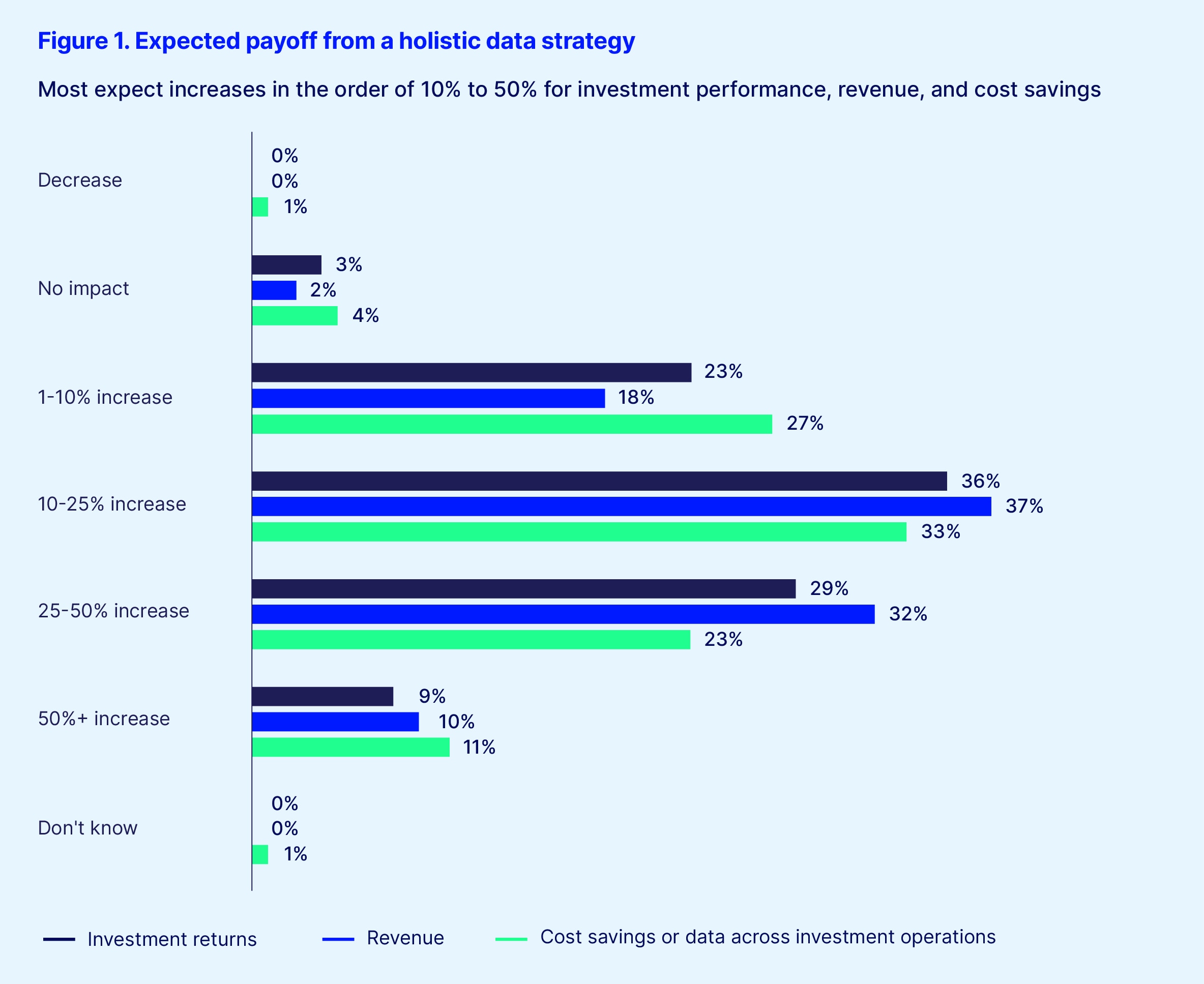
Drawing on the same survey, State Street finds that in the Americas, 26 percent of firms have already implemented an HDS, while another 55 percent are in the process of doing so. Firms also expect material economic benefit from an HDS. As depicted in Figure 1, nearly 75 percent of respondents anticipate more than 10 percent growth in investment returns, 94 percent expect cost savings across investment operations, and 97 percent expect positive revenue growth.
The survey also provides insights on how these firms see value in generative AI (GenAI). 55 percent of front-office respondents see immediate value in defining investment objectives using GenAI, while 52 percent see value in strategic asset allocation using GenAI over the next two-to-five years (see Figure 2).
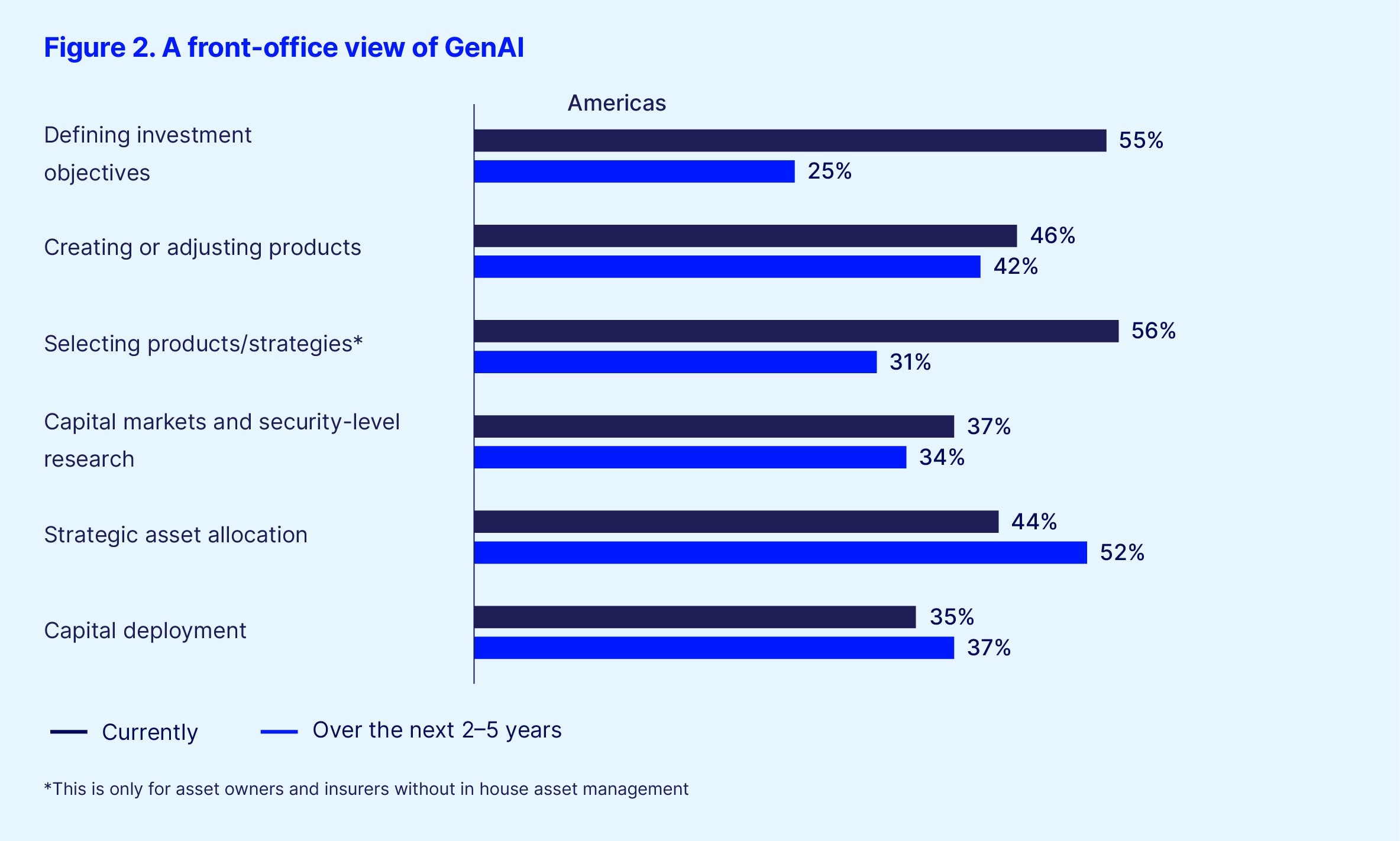
However, GenAI is currently underutilized in back-office processes, with only 20–30 percent of respondents reporting measurable value. This pattern is consistent with the relative novelty of GenAI in production environments and suggests that firms are prioritizing high-impact commercial use cases before scaling more broadly. Similar patterns are emerging in the Asia-Pacific region.
We next explore how these two results are connected both conceptually and empirically.
The virtuous cycle between AI and data
The relationship between AI and data is mutually reinforcing. High-quality data is a prerequisite for reliable model behavior, while modern learning systems can improve how data is organized, governed, and used. Evidence from OpenAI and Johns Hopkins University shows that large language model (LLM) capability depends strongly on data, model capacity, and compute, underscoring the tight linkage between performance, and the coverage, provenance, and governance of underlying data assets.4
In enterprise deployments, retrieval-augmented generation (RAG) conditions model outputs on external knowledge stores. As a result, end-to-end performance depends not only on the foundation model, but also on the quality of the retrieval and data infrastructure, including indexing, freshness, access controls, and curation. Retrieval errors in these systems can propagate directly into generated outputs.5 Conversely, AI can strengthen data strategy by supporting metadata enrichment, data cleaning, and integration — longstanding bottlenecks in large-scale data environments. For example, a 2025 study found that LLM-based metadata enrichment increased dataset discoverability by more than threefold in large enterprise data lakes.6
This bidirectional dynamic is echoed in a 2023 McKinsey study, which estimates that while GenAI could unlock US$2.6 to US$4.4 trillion in annual value, its scalability depends heavily on the maturity of the underlying data infrastructure.7 The survey finds that 72 percent of companies struggle to scale AI initiatives due to poor data quality and fragmented architecture. In contrast, leading firms treat data architecture as a core strategic asset — deploying modular pipelines, integrating diverse data sources, and embedding governance directly into workflows. These are the hallmarks of a holistic data strategy.
AI-enabled data stewardship is especially powerful in regulated sectors such as financial services, where trust, traceability, and auditability are critical. AI can help institutions continuously monitor and improve data quality, closing the loop between ingestion, usage, and governance. It also supports federated data models — such as data cloud architectures — where domain teams curate datasets locally using AI tools while contributing to enterprise-wide data cohesion. In this way, AI does not merely consume data, it actively improves and harmonizes it, making data more reliable, more discoverable, and more governable.
Empirical evidence of a symbiotic relationship between AI and data
Building on this mutual reinforcement, the relationship between GenAI and an HDS is best understood as bidirectional. A mature data strategy provides the conditions GenAI needs to operate reliably at scale — well-governed, discoverable, and interoperable data spanning front-, middle-, and back-office domains — while GenAI adoption, in turn, creates organizational urgency to modernize the very data foundations that such a strategy requires.
This dynamic is visible in State Street’s 2025 data study. The survey data shows that GenAI adoption aligns most clearly with the concrete enablers of an HDS. In North America, adoption shows its strongest association with technology and data investment (correlation of 0.23) and closeness to HDS completion (correlation of 0.11).
At the same time, adoption shows a comparatively weaker relationship with anticipated investment returns, expected revenue, and cost-saving payoffs. Taken together, these correlations and expectations suggest that firms are positioning GenAI less as an immediate earnings lever and more as a catalyst for modernizing data platforms, operating models, and workforce capabilities.
Notably, the same data indicates that as GenAI adoption increases, firms materially intensify the very investments that make HDS outcomes more achievable and repeatable. In quartile comparisons, the share of firms investing in technology rises sharply from 56 percent among the lowest-adoption cohort to 80 percent among the highest-adoption cohort. Across the same adoption cohorts, investment in staff training increases from 42 percent to 50 percent, while new employment rises from 29 percent to 46 percent. This suggests that GenAI is acting as a “pull” signal for platform consolidation, better data engineering, and capability building — the inputs that reduce time-to-integration and lower the marginal cost of adding new data domains, new analytics, and new client-facing innovations over time. In effect, AI-enabled HDS boosts the benefit of HDS by improving the engine of HDS — more robust pipelines, stronger governance, and a more AI-literate workforce.
These figures reflect expectations rather than realized outcomes. Where the incremental uplift becomes most visible is not in investment-return expectations — which remain comparatively modest — but on operational and commercial outcomes tied to efficiency and monetization. Among the highest-adoption cohort, expected revenue and cost-savings impacts average 4.5 and 4.6 on a 6-point payoff scale (corresponding to 25-50 percent increase), while investment returns average 4.2 (10-25 percent increase). By comparison, the lowest adoption cohort averages 4.2 for revenue and 4.3 for cost savings (both roughly 10-25 percent), with returns at 3.9. While these are expectations rather than realized outcomes, the direction is coherent. AI-enabled HDS is being valued primarily as a mechanism to industrialize operating leverage through better data reuse, fewer manual breaks, faster reconciliation and reporting cycles, and more scalable client customization. These gains strengthen revenue growth and cost efficiency before materially shifting investment performance.
These findings imply that the “AI dividend” is not an automatic consequence of deploying GenAI, but rather an organizational rent that accrues when AI capabilities are co-designed with a coherent data strategy and embedded into operating processes. As GenAI reshapes investment toward modern platforms and scarce technical talent, performance dispersion is likely to be driven less by access to models than by implementation choices. These include the target operating model (centralized versus federated), the governance architecture (risk, compliance, model oversight), the sequencing through which firms industrialize reusable data products, and the explicit trade-offs they make between local autonomy and enterprise control. In this framing, the AI dividend is best understood as a structural advantage arising from disciplined integration — turning experimentation into repeatable, controlled, and scalable workflows rather than isolated point solutions.
The next section explores the implementation patterns, controls, and organizational design choices that allow institutional investors to optimize the AI adoption.
Optimizing AI adoption: Where holistic data strategy meets micro-level implementation
The central strategic question is not the decision to adopt AI, but the determination of an implementation architecture that ensures sustainable value creation. For firms aiming to unlock the full potential of an HDS, the implementation model becomes a critical differentiator. Competing models have emerged — a top-down approach characterized by enterprise-wide platforms and stringent oversight, and a bottom-up paradigm privileging localized experimentation and team-driven innovation. Increasingly, a hybrid approach — federated governance that combines centralized oversight with distributed creativity — is gaining traction.
The power of micro-level AI deployment
Evidence suggests that the most meaningful gains from AI often come from micro-level deployments embedded directly into operational workflows. Targeted applications — such as chatbots fine-tuned for sales, GenAI-powered research tools for synthesizing earnings calls, or AI tools for compliance — can deliver localized value while reinforcing enterprise-wide coherence. This hybrid approach allows organizations to manage risk centrally while empowering domain-specific teams to own performance outcomes.8
While large-scale platforms may promise transformation, in financial services the real dividends often come from stitching together hundreds of small, compounding efficiencies. Early, localized AI deployments are already driving measurable performance gains,9 and decentralized strategies enable teams to build tailored solutions quickly and safely, fostering innovation while avoiding bottlenecks.10 By distributing ownership and encouraging experimentation, firms can create a culture of agile innovation.
Role of humans in the loop: Special relevance for regulated entities
To complement decentralized AI deployment, governance must evolve alongside innovation. Embedding human-in-the-loop oversight — expert validation and refinement of AI outputs — at the micro-level mitigates hallucination risk, strengthens trust, and aligns with regulatory expectations. Industry frameworks (CFA Institute, BIS)11 underscore that automation alone cannot guarantee resilience. By embedding expert oversight into localized workflows, firms create a governance model that balances agility with accountability, enabling sustainable AI adoption.
For institutional investors operating in a high-stakes, tightly regulated environment, embedding human-in-the-loop governance at the micro-AI level ensures efficient automation while preserving oversight and compliance — a risk control layer that investors can trust. The key benefits are:
- Auditability and explainability: AI outputs are validated or overridden by human reviewers
- Regulatory alignment: Ensures adherence to standards and satisfies regulatory expectations around model risk and operational resilience
- Trust and risk mitigation: Minimizes the chance of unvalidated automation errors
In this way, decentralized AI deployment supported by a holistic data strategy becomes not just a technical strategy, but a governance model that aligns with both operational realities and regulatory demands. In the end, the path to AI value is not paved with sweeping deployments — it is built through precision, governance, and trust. By embedding AI at the micro-level and reinforcing it with human oversight, firms can scale innovation without compromising control.
At the same time, responsible scaling requires controls beyond model oversight, including safeguards for data rights and privacy, management of third‑party and vendor dependencies, and operational resilience across AI‑enabled workflows.
Enabling a virtuous cycle: The critical role of front-to-back architecture
While decentralized AI deployment supported by a holistic data strategy can deliver substantial AI dividends, this approach is not without limitations. High-quality data often resides within individual business functions; however, such data is frequently siloed, leading to fragmentation across the organization. This challenge becomes more pronounced when business units develop and implement separate AI models based on isolated and sometimes opaque data sources. This resulting fragmentation could undermine effective governance, making it difficult for centralized model risk management and compliance teams to maintain oversight and enforce standards.
Thus, for institutional investors, front-to-back visibility is essential for mitigating these risks and ultimately maximizing the impact of a holistic data strategy and realizing the full potential of the AI dividend. For example, a cloud-native data backbone consolidates reference, benchmark, transactional, and position data into a governed “gold copy” that flows continuously across front, middle, and back-office functions.
When one process improves — such as real-time NAV calculation — the benefits cascade across the organization. Pre- and post-trade risk models recalibrate in near real time; liquidity, collateral, and financing decisions incorporate the latest cash, corporate actions, and tax data, and regulatory and client reporting stays synchronized without manual touch. Breaking down data silos, standardizing models for seamless interoperability, ensuring transparency through integrated governance, and leveraging strategic partnerships to enrich insights all contribute to an interconnected operating environment. This approach supports a total portfolio view across public and private assets, enabling firms to realize the full value of AI across the investment ecosystem.
Conclusion: Capturing the AI dividend through disciplined integration
The AI dividend is not a one-time gain, but a structural advantage that emerges when AI and data strategy evolve in tandem. Institutional investors that embed AI within a holistic data framework are not only achieving better outcomes — they are building the foundations for long-term resilience, agility, and insight. At the same time, AI is proving to be a powerful tool for enhancing data quality, governance, and discoverability. This mutual reinforcement creates a feedback loop where one strengthens the other.
Adopting a holistic data strategy, enabled by a hybrid approach to AI implementation grounded in domain-specific needs and supported by expert human oversight, offers a scalable and pragmatic approach to realizing this vision. Those who strategically invest in scalable front-to-back data infrastructure and AI capabilities today will position themselves at the forefront of a transformed industry. As firms navigate the complexities of their data transformation, the path to sustainable AI value lies not in scale alone, but in disciplined integration and strategic alignment.
As the pace of technological change accelerates, institutional investors should recognize that the journey toward realizing the AI dividend is dynamic, not static. Success will hinge on a willingness to continuously adapt data strategies, governance models, and AI deployment architectures in response to evolving market dynamics and regulatory landscapes. Those who foster a culture of learning and agility, where experimentation is encouraged and lessons are rapidly integrated, will be best positioned to capture emerging opportunities and mitigate risks in an increasingly complex financial ecosystem.
Acknowledgements
The authors thank Chris Rowland and Eric Garulay for their invaluable contributions to the development of this paper. Their thoughtful critiques, constructive feedback and engaging discussions on earlier drafts significantly enriched the clarity, depth, and rigor of our work.


