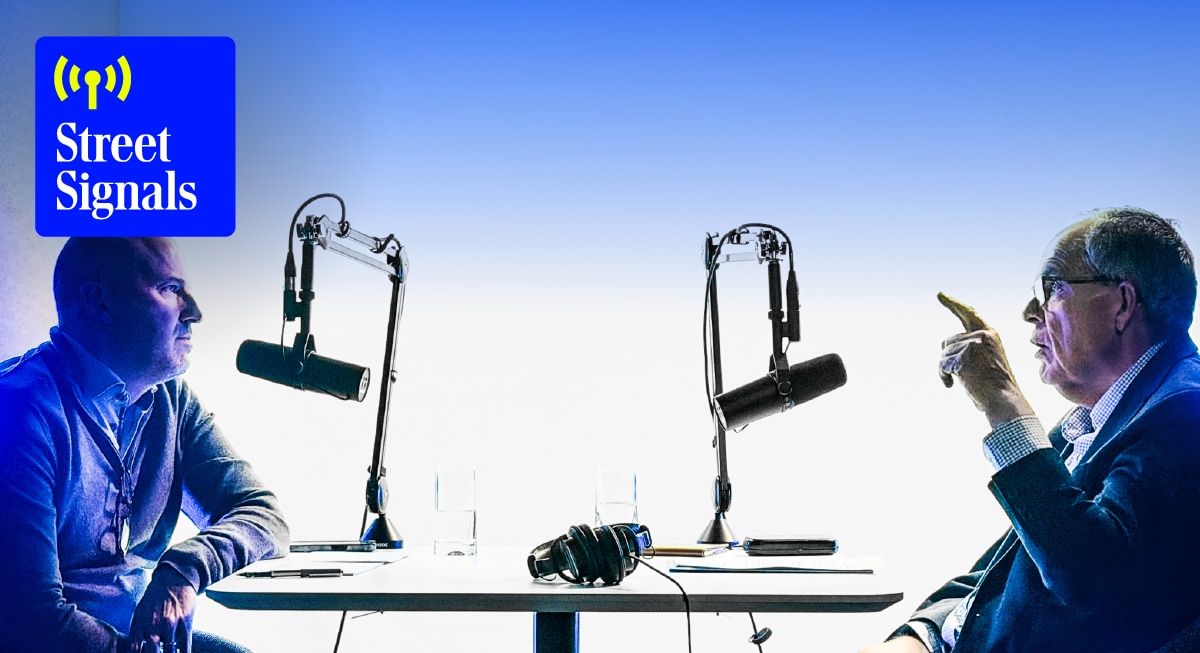
Tim Graf: This is Street Signals, a weekly conversation about markets and macro brought to you by State Street Markets. I'm your host, Tim Graf, Head of Macro Strategy for Europe.
Each week we talk about the latest insights from our award winning research as well as the current thinking from our strategists, traders, business leaders, clients and other experts from financial markets.
If you listen to us and like what you're hearing, please subscribe, Leave us a good review, get in touch. It all helps us to improve what we offer.
With that, here's what's on our minds this week.
One year ago this week I sat down with this week's returning guest, Ron O'Hanley, chairman and CEO of State Street.
We focused on what 2025 might hold in store for the global political economy and financial markets. We covered a really wide range of topics, whether it was de globalization, demographics, sovereign debt dynamics, and of course, at what the time was, some very timely commentary on the global trading system and how it was poised to change.
But that pace of change never slows. It's a new year, so I'm thrilled and grateful that Ron can give us another hour of his time to continue that conversation. Today we'll talk about how things panned out, but really we want to focus on the future for the global macro economy, for markets and of course for State Street.
Many of these topics will also overlap with a new publication on our website, state street.com called Market Signals and Shifts. What to watch in 2026.
So do have a lookout for that.
Ron. Last year we had to have this conversation via a zoom call. So I'm thrilled to be able to do it in person, get a chance to meet face to face.
Thank you so much for joining me Tim.
Ron O'Hanley: It's good to see you and I'm looking forward to the conversation.
TG: Excellent. Well, just as an opening question, thinking back to our conversation last year, across any of the levels that we talked about, whether it was the global economy or financial markets or State street itself, what surprised you the most about last year and why?
ROH: So putting myself back to a year ago, I think probably the biggest surprise would have been just the extraordinary ongoing strength and resilience of the US economy.
You know the numbers, 3.8% GDP growth in Q2, 4.3% in Q3. Most of the whisper numbers, if you will, suggest it'll even be higher for Q4.
ROH: And that was fairly broad based.
ROH: I mean yes, AI investment is driving a lot of it, but consumer spending remained very strong and I think much more than maybe we talked about along that line. I think last year I did express some misgivings about what might be coming down the road on trade.
For all my misgivings, it was worse in terms of what we saw on so called Liberation Day. Yet equity market performance was remarkably robust. Yes, we saw some volatility, but the recovery was fast and we, we saw markets continue to grow.
And finally, I think the, the big surprise was that one would have thought that non US markets who, you know, more or less, if you will, are the, if you will, the victims of US trade policy, they still were remarkably robust also.
So I think that all in all, economic and associated market performance was the biggest.
ROH: Yeah, yeah.
ROH: In terms of State Street, I'm actually not surprised. I'm in a bit of a quiet period now, so my words are focused on the first three quarters of the year, but we saw remarkable fee growth, some of it, but hardly the majority of it relates to equity market performance. I mean it's, it's a lot of the things, a lot of the technology investments that we put in place, we're, we're starting to reap those benefits. And you're seeing now we will have completed a second year of accelerating the revenue growth and that really has to do as much with capability.
TG: You mentioned how bad Liberation Day was in terms of being worse than we expected. What you and I talked about, and actually I wanted, I don't want to go over too much old ground, but tariffs are where I wanted to start. The kind of the look back period and thinking about where we are now after Liberation Day, after the back and forth with the US and China. Was this a kind of strategic nudge to just change the playing field and now we can move past it?
Or do you see this as a kind of sustained and fluid, ongoing risky situation we're still going to have to deal with?
ROH: It's a good question, Tim, because if you listen to some of the policy justifications, it sounds like a strategic nudge. Yet the way tariffs are being employed and deployed, it's, it feels more like a sustained fluid wind. In some respects are being used strategically, in other respects are being used quite tactically and even in third respects are being used almost in a retaliatory.
So there is not really a consistent policy underpinning to tariffs, which means that I think we have to look on it as a bit of a fluid headwind with a fair amount of uncertainty around it. But what we've also learned is as bad as the initial headline might be, what actually gets implemented tends to be.
TG: And it all comes under this broader theme that we also talked about which would, which was deglobalization. And I think the last quarter of the year especially I asked a lot of my guests where they thought we were in this deglobalization process. Some thought well, we're probably over the worst. Some would say actually it hadn't even really begun because China could just reroute trade to the US through, through third countries.
How would you assess where we are in this broader process of whether it's the US and China delinking or a broader deglobalization trend? Where do you see us right now?
ROH: Yeah, I think that when you and I talked last year, I may have even pushed back a little bit on this idea of de globalization called reglobalization.
TG: Yes.
ROH: And I think that's actually what's playing out. I mean you saw what happened in China. China, China's had a record trade surplus and that was first through the first 11 months of the year. Let's see how they do when the December numbers composed.
So I think what you're seeing is just changing patterns of trade, production and finance.
I firmly believe that is the secular shift that we're in now that highly established trade policies and trade practices really. Coming out of going back to China's accession into the wto, the, you know, the various agreements that have been in place, they're being upset but trade is still happening along different lines.
We're seeing that in terms of countries like Vietnam are filling in where China was in terms of trade with the US yet at the same time trade with Vietnam is also increasing.
So you gotta wonder exactly what's going on there and is there some kind of intermediary trade that's occurring? But the point being is that we're in a secular change. We don't know what it's going to look like.
But I think the idea that we're all going back into the Stone Age and we're all going to be self sustained economies, I don't think that's what we're going to say.
TG: Yeah, yeah. I think that kind of answers my next question. So I wanted to finish the kind of the looking back period with another big topic we had last year, which was worries over fiscal balances.
And again something that we all thought about at the beginning of the year that actually didn't turn out to materialize as bad as we could have feared. In fact, fixed income markets actually did pretty well last year.
Can we be comfortable though that this debt and deficit dynamic level that we talked about Is maybe, if not a topic for the past, at least something that's maybe bubbling a little bit lower under the surface or is it really something still to be concerned about?
ROH: Well, if there were five of us around this table, you'd have seven different opinions. So my opinion is this is that it's still a risk. All the things that we know are driving it.
TG: Right?
ROH: You're seeing higher spending, you're seeing aging populations, they're seeing required increased investment in infrastructure and defense and they're not going away.
TG: Right.
ROH: We are all still getting older, governments are still spending.
And we know there's been a, in many parts of the world there's been a real deficit in defense spending and a huge deficit in infrastructure. So all those are going there.
That points to rising interest burdens.
And yes, the market seemed to absorb a lot of this in 2025. But at some point, I wouldn't call it a tipping point. I think where you'll start to see it actually is in yields and that will become almost self modulate because at some point you just can't afford to issue more debt. Right Now I wouldn't describe it as an immense fear factor, but I think many believe that this is something that it's not it.
TG: Yeah, yeah, we're going to come back to fixed income markets. But actually you mentioned the defense spending and just other broader deficit spending efforts that are taking place globally. And that leads me into thinking about the global economy this year now rather than thinking about last year's risks.
And you know, the outlook for this year is another decent year. The IMF is forecasting global growth to slow just slightly from 3.2% to 3.1%. Just thinking about the US's contribution to this, how confident are you that they will remain a positive contributor to global growth as opposed to maybe heading for a harder landing scenario and detracting from global growth?
ROH: I'm very confident in the US at this point. And you know, why is that? I mean, part of it is some. Of the things that we've seen in 2025 will continue in 2026. The AI investment for one, and we can talk a little bit about that, you know, how much will that be, et cetera. But secondly, the AI investment, which is largely then around infrastructure, is enabling a further wave of AI investment which is around application and there are associated investments on that spending, et cetera. And then down the road there'll be some productivity out of that.
We could talk about that. Yeah, but there's also other things at play, right? The Fiscal stimulus associated with the one big beautiful bill.
And that has both a tax incentive element to it, there's some refunds that are coming, there's, you know, the no tax on tips, et cetera, which is going to just put more money in people's pockets. So I would expect the US to be maybe not as much as 2025, but nearly as much as it could.
TG: With that being said, the Fed is expected to still continue easing policy, albeit they are close to the end of their cycle. They're projecting themselves in their own their DOT plots to only ease policy one more time before the end of the year.
The market is pricing them to do two, maybe slightly over two. But I mean, does that speak to a risk that the Fed has to maybe put the brakes on a little sooner?
I mean, there's all these other questions about independence, and we'll touch a little bit on that. I don't want to go too much into the details, but is there a greater potential, I guess, for them to disappoint on that front versus over delivering rate easing? Because the economy is actually starting to slow down a little bit more.
ROH: For the things that I just, for the reasons I just described, one would suggest a continued, reasonably robust economy and therefore, what's the mean to cut rates, do you think?
ROH: The employment picture is one that's really uncertain at this point. And you know, you can look at the same data and come up with two different conclusions. On the one hand, you can look at and say, oh, employment's not growing and therefore unemployment will grow. One of the reasons employment isn't growing is because the supply of labor isn't growing.
And I think companies and even entire industries are finding ways to deal with the fact that a lot of the labor that we had available before, through immigration, et cetera, is simply not there before. But that's an unknown. It could be actually that we're at that point where we are going to see some reasonable rises in unemployment.
So to me, that's the uncertainty. If you were basing a rate decision solely on projected economic growth in the short term, I wouldn't be counting on more than 1. But unemployment could cause a difference.
TG: We do have to be slightly careful in the details. There's a lot in the news today, specifically when we're recording this on Monday 12th January.
But I did want to ask about Fed independence concerns and political pressure around that rate trajectory of expecting to ease and perhaps being pressured to ease more.
What can you say about this? What's your thinking on this? And what ways might that be impactful for markets?
ROH: Firstly, I don't think anybody has served anybody in the US for the global economy is served by ongoing attacks on Fed independence. And that actually is what's going on. And will it lead to something abruptly? Probably not. But it's like a lot of things, it has a corrosive effect. So I think it's something that we should be concerned about. And there are institutional safeguards in place, 14 year terms and things like that. The ability to actually to remove.
ROH: That's a very high bar and threshold. But nonetheless, so much of why the US economy has been the place to invest and has become really the primary economy of the world by far has been around rule of law and the strength of institutions, both of which get undermined or perceived to be undermined by these attacks on Fed independence. So we should be aware of this and we should not welcome.
TG: Yeah, yeah. I mean the short term market reaction today to the most recent news is pretty benign. On that note, you know, markets do seem to be looking through it, maybe thinking it's not, it's a big deal, but maybe it's not one for today to worry about. But that is a nice segue to talk about now financial markets and asset markets in the coming year and just to kind of level set with the consensus for equity markets it kind of is a lower volatility version of 2025 is the consensus expectation.
Now we expect healthy earnings growth in the U.S. that drives about 8 to 10% gains, decent performance in the rest of the world. You mentioned at the beginning how much the rest of the world, how well it did even relative to the US There were certain markets that outperformed.
With that in mind and some of these concerns we've already gone through. Do you share the optimism in equity markets or are there any red flags that stand out to you?
ROH: On the one hand, particularly for the US market, you just have to look at the run up that we've had over the last several years and nothing grows to the sky. But having said that, if you look at the fundamentals for many of the reasons that I just talked about earlier, you've got the ongoing economic growth and the impact which we've not yet felt.
Yet, but will shortly of the changes coming out of the one big beautiful bill.
So there's all sorts of favorable kinds of factors that should drive equity growth, AI investment.
Yes, there's competition out there, but the US is at the epicenter of it. There will be associated investment around that in energy, particularly electricity, that will also drive more growth. So that plus what we're seeing outside the US Enormous fiscal stimulus will support equity markets.
TG: Let's think about the other part of the party and we, we, I want to circle back a little bit towards fixed income markets. We still have these fiscal risks we've gone through, but it strikes me as interesting that, you know, we, we monitor institutional holdings of assets, you know, high level asset class holdings of equities, fixed income, cash. This is in our investor behavior metrics which appear in our research. And those holdings data show the weight to fixed income is at its lowest since 2008.
And given we're coming off of a decent year for fixed income, maybe we have strong growth, inflation perhaps re accelerating. But are yields at attractive enough levels for that weight to start to grow? Or investors maybe overlooking any returns in fixed income, given they did have a pretty decent year last year?
ROH: I think you used the right words there. I think investors are overlooking fixed income. And there's a couple of reasons behind that.
One is just look what equities have done and are continuing to do, number one.
But two, 2023 was not that long ago. It was. It's an unusual year where both bonds and equities underperformed the way they did. And it's an unusual year to see bonds underperform to the degree that they did.
Those memories are still here. And I think it's a little bit of why, why take that bond risk when I seem to be getting plenty over here.
I think that's overwrought. I mean, you point out, and you're correct, bonds had a good year for all the right reasons. And depending on where you come out, where is the interest rate outlook?
No reason to believe that we should expect a 2023 kind of thing. Yes, rates might go up, rates might go down, but it's a pretty benign outlook. So to me, there's a little bit of overreaction and short memory bias from 2023.
TG: And what about alternatives? This has been a huge theme and we covered it a little bit last year. You know, thinking about private assets was what we talked about last year.
But of course this was the big year for gold and more recently silver. And you're now seeing a lot of real focus on these alternatives to currency, but also just maybe new safe havens. You know, currencies themselves didn't really offer you that much safe haven protection where gold certainly did.
Do we still think it makes sense to allocate more to alternatives as part of a broader balanced portfolio?
ROH: The one thing that we, we always seem to learn, no matter what year it is, is diversification pace. The answer is yes, there. I do think in terms of gold, silver, precious metals, et cetera. The other thing that's going on is this massive reentry since COVID of the retail investor, which is driven by a number of things, not least of which is the, you know, the relatively new electronic platforms that they have. So, and there's been a real catch up on the part of the retail investor and it's a lot easier to buy a gold ETF than it is to buy bullion or some kind of a gold coin.
So there's a little bit of that going on. But I also think this, this idea that diversification matters is something that we keep getting that lesson that gets reinforced and sees more buying.
TG: But on the notion of private markets, last year we also started to see the introduction of, for the first time in a long time of stresses, particularly in private credit markets.
There were a couple of big headline examples and I wanted to ask you whether you thought these are just still very localized examples or if it's something that we just have to show a little bit more caution on the asset class itself and maybe it might not continue to grow in the way that it has in the past few years.
Is it a time for a period of retrenchment?
ROH: In other words, it's interesting how we, when there's some kind of a significant credit failure in privates, the amount of attention that it gets. But are we talking about bad loans coming out of traditional banks? I actually think that the, the concern about privates is overdone. And I would think of it more like where are we in the credit cycle?
Will some players have kind of poor underwriting standards or just kind of price it wrong given where they are in the credit cycle? Yes. Will that just private players or just public market players? I don't think so.
So I think to me this is more around where are we in the credit cycle? I think if you look at lending standards, covenants are usually a good, a good proxy here. I suspect the kind of covenants we're seeing in bank lending, covenants we're seeing, they're probably near the same at any given time because that market is fluid.
And if you're a borrower, particularly a qualified borrower, you're going to go to the best deal, right. Whether it's public or private. So I think this is less about private somehow being different.
Now what is going on is there's a fair amount of private lending that's gone further down market into areas where it's never been before. That was traditionally either an unbanked market or a bank, meaning nobody was extending credit or just for banks. And so will there be some kind of situations that arise that, you know, gee, they didn't know what they were doing, those kinds of things?
Again, I think this will be few and far between. This is. I think we should be paying much more attention to where we are in the credit cycle. Have an expectation that it's all more or less going to move together.
TG: Well, shifting gears a little bit. I mean, I spend most of my day thinking about currencies. And one of the big themes we saw last year was a much weaker dollar around Liberation Day especially, you have this. Notion of a Sell America theme, which, as I think we've covered a lot already, never really happened. U.S. assets did relatively well. It may not have kept up with other markets geographically, but positive years for both equities and bonds. But the one thing we did start to see, and we saw this in our flow data as well, was a Hedge America theme pertaining to the US Dollar. And our institutional hedge ratio indicators that we monitor show a little bit of this happening, but not, I don't think, to the degree of coverage it got. And so I'm curious to hear if you've had any conversations, especially with clients who you talk to and what they're thinking about this, what sort of time horizons, if they are thinking about this, they're looking to do it over getting out of maybe not U.S. assets, but hedging the dollar risk.
ROH: Yeah. So I would describe much of what we saw last year as a lot of talk and limited action. Not none, but limited. Why is that? I mean, part of it is it goes back to the reality of the US Economy performing as strong as it has and its prospects still relative to most, not all other economies being very, very high, number one. Number two, if you were really going to exit America either fully or even partially, where else could you go at that kind of scale? Money needs a place to go. It's the reality of where else am I going to go at this kind of scale? I think the investor behavior we saw probably made sense in this. Let's put some hedges on this. The dollar had strengthened for a long period of time.
Let's put some hedges on this. There has been a bit of a correction in the dollar.
There was a bit in terms of where money was flowing in terms of equity investments.
We did see a bit of a fall off in money going to U.S. equity investment, but that recovered really in the second and third quarter. So for all the reasons that I just spoke about.
So I think we can probably assume that that will continue because again, the fundamentals of the US remain so strong.
I do think though, if there becomes a real concern about the US over the medium to long term around things like rule of law, the true kind of independence of the Fed, that it's not just these passing issues, but something that's fundamentally changing that could see some kind of acceleration.
But at this point I don't, I don't see it.
TG: Yeah, just as kind of a capstone to this. If you had to look outside the US though, what sort of, and I'm thinking here both for investors, but also for us as a firm, it's kind of a two part question.
Where else do you think is the most interesting investing opportunity? Let's look at it from the perspective of, you know, a retail investor or a high net worth investor, but also where are we looking? This is kind of my way of segueing to State street, so I want to get, get kind of both of your thoughts on that.
ROH: There still to me is remarkably little attention being paid to emerging markets and how they have performed not just in the last couple of years, but really over the last decade. They came through Covid remarkably well in terms of their economies.
In most of these emerging markets, the institutions are strong. The central banks actually acted rapidly both in terms of raising rates when they needed to and cutting rates when they needed to.
And it's not all emerging markets. It's, but it's, it's most right. I think you're seeing the opportunity there to put money to work. Valuations are remarkably low relative certainly to the US and even to most developed markets.
So that would be one of the bigger ones that I would, I would focus on. We talked about this re globalization.
There will be beneficiaries here, talked about Vietnam, there's other Southeast Asian economies. But you know how you even think about countries like Mexico? I mean Mexico, I think notwithstanding all the pressure around tariffs, I think it seems well positioned in terms of this re globalization.
So I think a country like Mexico will do well in terms of Europe.
Poland has been a remarkable story in terms of the growth that we've seen there.
Now there's geopolitical risk. I mean it's in a tough neighborhood.
And that really does weigh on Poland at this point, both from internal policy and external investor perception. But it's a remarkable economy in terms of educated workforce, great investments in infrastructure in educations. That would be another one that I would look at.
We've talked a lot about with the AI revolution. We've talked a lot about the energy needs. Electricity is an interesting thing, particularly in developed markets, because we went literally for decades with growth in electricity demand being somewhat below inflation rates. So why was that? And part of it had to do was conservation measures, things like that.
And there just wasn't any real need for more electricity. Other kinds of energy.
That's obviously changing and that long period of underinvestment is coming back to haunt us particularly it's not just generating capacity, but it's the grid.
And you've heard all the stories around this that we actually generate plenty of electricity, but we don't have a grid that's seamless and fluid and can get everything around. So that energy transition and this ongoing need for more electricity will be another area to focus on.
And then finally there's other kind of demand stories that I don't think are getting enough attention.
India and its extraordinary digitalization and for those that haven't been there, just go visit. I mean, in a very short period of time this has become a true digital economy and one that's growing pretty fast.
And then secondly, the Saudi Arabia transformation, it's proceeding at pace.
Sure, there's some things that may not be working as rapidly as the Saudis would like, but the direction is clear in its move away from oil and adding on to oil.
And I think that will be successful.
TG: Well, let's talk about the AI topic again. And I want to specifically focus on where we as a company are. And you can kind of think of adoption and adaptation along an S curve where you have your sort of gradual beginnings where you slowly start to adopt, but then you have your rapid adoption, right? And then it starts to level out when you have the full benefits or close enough to them that you don't really need to invest another dollar for incremental gains.
Where would you typify where we are as a company along that kind of framework?
ROH: I think we're probably at a spot similar to many what I would call established technology led financial institutions.
We've put infrastructure in place, we've, we've got the risk framework in place, we've got the workforce kind of educated and AI. You know, everybody's got the tool in hands, they're using it for all sorts of different things.
What it's about now is applications, both broad based applications and very specific ones. So I would put us in that rapid growth part of AI adoption What does that mean?
We're investing heavily in it this year. We invested heavily in it last year. We'll be investing heavily in it next year. But the investments are a little bit different now in that before it was foundational.
And here's some tools now, what we're going to see is the product of those tools. And so you'll see major parts of our business and operating model change. In terms of AI adoption. How might those changes be felt?
One, will move faster, things will happen faster.
Two, error rates will get slower. Excuse me, will get lower. Three, client experience will go up and four, employee experience will go up. And all of that will result not only in improved economics, but just much more productivity.
I also think that I'd put us at that point in the curve because we actually, we have a very clear eye on what the immediate opportunities are. I think when you get into it, we're going to see more opportunities that we hadn't thought of before.
And it gets back to a little bit of what you said. If you get, for example, a very good agentic driven kind of client or user response system, say it's an internal HR system that when you and I want to make a benefits change or we've got a change in life, you know, rather than going through lots of screens and reading policy manuals and everything, we're going to speak into a microphone and say, this is what I want to do and it's going to get done. That translates easily into even an institutional client service model. So I think that we will see several years of real promising applications here that will deliver even more promising returns.
TG: Yeah, yeah. No, it really is incredible the things that I'm now able to do using something like Copilot, where I was never smart enough to do it on my own. And now, lo and behold, 30 years later, I have it doing it for me, you know, as part of the transformation of the firm through AI. We're also, and this is again, something we talked a lot about last year, transforming the client experience and client offerings and specifically on digital asset offerings and asset tokenization.
We talked a lot about that last year. And it was, for me, one of the more interesting themes to hear about just given, first of all, how excited you were about it and how real it was becoming then. Can you talk about where we are in that process?
ROH: So much of what we talked about last year came to fruition.
I think I talked about it last year in the context of not just providing a nifty service or product for our clients, but it's about building out the infrastructure along with the other infrastructure providers.
And that's happening. Right. So we've, we talked in December about going live with our digital asset platform.
You should think about that as a platform in which tokenized assets can be put and applications around tokenized assets can then be established. And you think about what those applications might be collateral.
Right. I mean, if you and the ability to collateralize assets that weren't collateralizable before, the ability to move things faster, whether it's the movement of securities, the movement of payments. I always, when I talk about this, I remind people that we sit in an unusual spot reviewed as a securities processor and we are right. That's, that's our business and we do it in a very big way.
We're also an investment manager, which involves actually the buying and selling and movement of securities. So that is our business.
We're also at the intersection of securities movement and payments.
And if you really want to complete the cycle and for example, lower settlement periods or have settlement periods moving to nearly instantaneous, you've got to have that infrastructure in place.
So that's what I see as an opportunity and where we're doing more and more of it. And it's to help.
It's not just for us, our benefits, but it's to help our clients do their thing.
Right. If a money management firm, investment management firm, wants to tokenize a money market fund, they're not going to build all that infrastructure. They're going to come to us and say, can you give us the kind of platform we need to go about this? Yeah.
TG: One of the things that struck me in thinking about it is, you know, we do the, as you mentioned, all the processing elements, the infrastructure elements of that process.
But I think part of this also has become offering more illiquid products to smaller investors and just thinking about the guardrails that need to be in place for that and wondering what your thoughts are on enabling that access but doing so in a way that allows for investor protection.
ROH: Uh, it, it's a very, very important question, one that we take very seriously. As you know, we launched several of these last year when we were launching the product with Apollo.
This is the credit product with public credit and private credit provided by Apollo. Uh, we recognized R is the first and given who we are in the marketplace that, uh, the worst thing we could do was screw it up.
And I think that's actually quite important. So a few times it's been pointed out to us that the allocations are quite low. They're Purposely low. Right. We want to make sure this works.
We want the market to get used to this kind of thing. We had to get the authorized participants and everybody else used to this. And so we'll keep it low until we get there.
So there's the role that the actual providers have to play. There's also the role of the sec. And you know, there's a lot of talk about this being a benign sec, a permissive sec. I don't know that I would describe it that way because I think the sec, and you hear it in Chair Atkins comments, they have not lost any kind of focus on investor protection.
And so I think the way you'll see this evolve will be rather than a flat out no to something, it's yes, come to us with your ideas, but remember what you need to do in terms of investor protection. So in some ways it's just a different way of doing business and probably getting to a better answer in terms of investor protection.
TG: Well, just to close it out, as far as the questions I had about us as a firm, I wanted to talk about ETFs. And last year was a phenomenal year of growth, not just in aum, but just in the number of products and the sort of targeted nature of products that were issued across the ETF product suite.
What are some of the things we're thinking about for this year in terms of the key trends? What do you think those are going to be and what are we looking at offering in the coming year?
ROH: There's a lot of trends that are working to the benefit of ETFs. We've talked about one that just the democratization of all sorts of investing, maybe more fundamentally, I think it's this recognition almost worldwide that the ETF is a superior product vehicle.
Right. There's just a lot about it that's quite attractive. It's transparency, the fact that it can move cross border. You're seeing the regulatory environment adapt around that. The ability to take a mutual fund share class and now create an ETF share class.
You're also seeing just the widespread kind of adoption of active ETFs. I mean, it wasn't that long ago that we were talking about things like semi transparent and going through all sorts of machinations to basically get at something that really didn't make a lot of sense to the investor.
That's all gone away. And then finally the idea that, that in many ways the ETF is a superior vehicle for commingled pool investing and fixed income than the mutual fund, all of that is A tailwind here. We haven't even talked about the distribution side because as as distribution has moved to a combination of electronically kind of direct to the retail investor type of channel, but also these big, these big firms with large, large distribution forces.
The ETF is a great tool, right? Because if you're running one of these big houses, you're able to say, okay, here's the products that we're willing distributors, advisors, we're willing for you to use. We like the fees around them.
It's very transparent to the end user customer. Sure you can put a wrap fee around it if you want, but that's all transparent to the customer.
So it's for that reason all these tailwinds are there.
And we've gone so far past where it used to be. ETFs are good in the US because there's some kind of a tax advantage. Really wasn't an advantage, it was simply a timing of when you were going to pay taxes to hey, it doesn't matter what the related taxes are. This is actually a better vehicle. And so I think you'll see that as we go forward. I travel a lot. I can't remember the last time I was in any country where there wasn't some talk either from the regulators or from the participants about what more they intended to do in ETFs.
TG: I keep checking the clock. I'm bordering on taking up too much of your time. So we are coming to the end. I do have some final kind of rapid fire questions that I wanted to finish up with and I wanted to start with other investment opportunities and specifically that aren't AI or AI adjacent.
What would you invest and hold for the next five years that we haven't talked about?
ROH: Well, I alluded to one earlier grid modernization.
It's very much in the U.S. but it's not just the U.S. I mean if you think our grid is fractured and fragmented here, go to Europe, that would be one. And given the way how much electrification is going on, again, primarily driven by AI and electric demand, so that would be one second that I would be focused on is healthcare, particularly health tech in aging economies.
So if you think about Europe, if you think about China, if you think about the US and what we're going to need to support an aging population and there's several aspects to that. One is simply if you're having an aging population, that typically means you don't have young workers.
Right. And they provide a lot of the manual labor, if you will, in healthcare. So it's a substitution of technology for this manual labor that's accelerated now by really reduced immigration around the world.
If you think about nurses, that tended to be the profession of immigrants. My mother, my grandmothers were nurses.
TG: Right.
ROH: So we're not seeing that. And so healthcare, particularly healthcare tech would be the other area I'd be focused.
TG: On digital assets, both generally as well as for us as a firm. What milestones are you looking at to signal that there is this clearer path to scaled adoption?
ROH: So we're seeing a lot of adoption already, a lot of demand.
We talked about tokenization I think as the regulatory path starts to catch up. So for example, it's all well and good to have a particular security like a traded bank loan on blockchain, but until you have a regulator say, and as a consequence now we will no longer tolerate 12, 14, 18 day settlement periods, we want to see that down to three.
So regulatory kind of moves on this I think will help spur that customer demand. Right. Are the end users actually using this?
We've got put out this tokenization infrastructure, put out the ability to tokenize a money market fund. Is it actually being deployed the way we think it will be?
And then finally, and maybe most importantly, it's interoperability.
We still are in many places in rails, payment rails, securities, movement rails. This feels a little bit like rails of the, let's call it the mid 19th century early on. Right. Where gauges weren't quite uniform. You know, you moved your train car from my rails to your rails and somebody wanted to take a toll. It was inefficient. I think that you'll start to see that go away and that you'll see much more.
And standardization brings interoperability and therefore brings more demand.
And so you may not be getting paid as much per unit along your rail, but you're getting a lot more volume.
TG: Well, last question. You are soon off to Davos. And last year was another topic we talked about and we covered the things that interested you. You were hoping to learn more about.
What does that look like for you this year? What are you hoping to learn more about in the coming weeks?
ROH: One is around energy. I think that everybody now recognizes that we've got the, you know, this extraordinary AI boom. But right now we don't have enough energy to fuel the kind of demand that's being forecast here. Now there could be other things. I don't think actually we're going to need all that electricity because I personally believe that, you know, Moore's law is not broken and that in fact you will see these GPUs become even more and more efficient, maybe less demanding of energy.
But I think it's a safe assumption that we need more electricity than we have now. So how is that going to actually happen? Where's the money going to come from?
Secondly, back on the whole geopolitics and what does this new world look like? And by that I mean what does cooperation mean, right?
We're, we're talking 10, 15 years ago about a borderless world, right, where markets would dominate, money and investment would flow to the most efficient place. And of course, if something could be done cheaper in country Z, that's where it's going to happen.
Don't worry about countries, you know, A through K. I don't think we're going to see that. So is there a replacement framework that we'll see in that? I mean it's certainly not going to be the WTO as we know it and it's maybe not even going to be institutions like the UN or even NATO as we know it.
So what's the future direction there?
TG: It's a lot to take in. Safe travels when you go Ron. It's been great to catch up with you. Especially fun to do it in person. This has been really great. I'm looking forward to hear how this year pans out if we hopefully do this again next year. But thank you so much for your time.
ROH: Thanks very much Tim.
TG: Thanks for listening to Street Signals. Clients can find this podcast and all of our research at our web portal Insights. There you'll be able to find all of our latest thinking on markets where we leverage our deep experience in research on investor behavior, behavior, inflation, media, sentiment and risk, all of which goes into building an award winning strategy product. And again, if you like what you've heard, please subscribe wherever you get your podcasts and leave us a review. We'll see you next time.