
Insights
August 2026
From AI productivity to disinflation: A non sequitur?

The missing links to inflation and interest rates
Ramu Thiagarajan
Head of Thought Leadership
State Street
Simona Mocuta
Chief Economist
State Street Investment Management
Hanbin Im
Global Macro Researcher
State Street
The potential impact of artificial intelligence (AI) on productivity, and the resulting effects on inflation and interest rates, has become a central macro-financial question. Views remain divided. Federal Reserve Chair Kevin Warsh argues that AI is structurally disinflationary and that an AI-driven productivity boom could ease inflationary pressure and create scope for lower policy rates.1 By contrast, former Treasury Secretary Janet Yellen and others emphasize that AI investment may add to near-term inflation by stimulating demand through large-scale technology, infrastructure, and energy spending, while rising AI-related asset valuations generate positive wealth effects.2 These views need not be contradictory. Rather, they emphasize different mechanisms operating at different stages of adoption.
Indeed, the inference that “AI raises productivity, therefore inflation falls” is a non sequitur. Productivity lowers inflation only if the gains become sufficiently broad and are transmitted into lower prices rather than retained in margins or wages, embodied primarily in higher quality or output, offset by other input costs, or outweighed by stronger demand.
The purpose of this note is to disentangle and demystify several separate economic steps compressed within the two sides of the debate, and to provide a clearer map of what is settled, what remains unresolved, and what the debate implies for inflation and interest rates. Accordingly, we evaluate three distinct issues. First, on the production side, how persistent will productivity gains from AI be? Second, on the distribution side, who captures the productivity dividend and in what form? Third, assessing the effects of these forces on the equilibrium real rate, how do desired investment and desired saving respond to AI-driven changes, and at what equilibrium real interest rate?
These questions are related but operate through different transmission mechanisms. Large “task-level” efficiency gains from AI (such as increased efficiency in reading radiology charts or proofreading) need not translate into a large increase in aggregate total factor productivity. A decline in marginal cost from AI need not be passed through to prices; producers may instead retain it as additional margin, with little or no effect on inflation. Finally, although an AI-driven productivity boost may place upward pressure on real rates, nominal rates need not rise by the same amount if market participants expect lower future inflation. These effects must therefore be disentangled before concluding whether AI will ultimately be disinflationary or inflationary.
It is our view that while evidence of task-level productivity gains from AI is substantial, it is not entirely clear that these gains will be passed on to consumers as lower prices. Passing these gains through can be disinflationary but may not occur unless competition forces producers to do so. In addition, and importantly, productivity gains would tend to increase the marginal return to capital, which would, other things equal, place upward pressure on equilibrium real rates and potentially on nominal rates. The AI-driven increase in investment demand may likely reinforce this upward pressure, particularly during the build-out phase. One mitigating factor is that increased risk aversion from potential AI-related job losses could strengthen the precautionary savings motive and increase demand for safe assets, lowering their yields, although we expect these offsetting effects to be marginal.
Thus, on balance, we believe AI is more likely to stoke inflationary pressure in the near term rather than to generate immediate disinflation. Disinflationary effects are more likely to emerge as AI’s productivity gains broaden and competitive pressures strengthen. This note begins with what is relatively well established: AI can generate meaningful task-level productivity gains, although aggregate statistics may take years to reflect them. It then focuses on the critical distinction between costs and prices, showing that inflation depends on whether the gains from the productivity boost are retained as margins or passed through. Next, it examines the implications for real rates, explaining why stronger productivity tends to raise the return to capital. These elements are then brought together through the well-known Fisher equation, which relates nominal rates, real rates, and expected inflation. The conclusion draws out the implications for investors.
The relatively settled part: AI can raise productivity
The argument that AI can raise productivity is strongly supported by recent research, which identifies generative AI as a potentially important productivity catalyst. Bick, Blandin, and Deming (2025) find that generative-AI users reported saving 5.4 percent of their weekly work hours — about 2.2 hours in a 40-hour week. Across all workers, including nonusers, reported time savings equaled 1.4 percent of total hours. Using a standard production model, these self-reported savings were estimated to imply a potential 1.1 percent gain in aggregate labor productivity and roughly 33 percent higher output per AI-assisted hour.3 Firm-level evidence corroborates this direction. Using matched data on more than 12,000 firms in the European Union and United States, Aldasoro et al. (2026) estimates that AI adoption raises the level of labor productivity by about 4 percent in the short run. These gains are associated with capital deepening rather than lower firm-level employment and are concentrated among medium and large firms making complementary investments in software, data, and training.4 Research by Info-Tech Research Group finds that 94 percent of developers report productivity gains and 83 percent report a meaningful defect reduction.5
Finally, a Stanford Institute for Economic Policy Research (SIEPR) study using internet-browsing data from more than 200,000 US households estimates that generative-AI increased efficiency in productive digital activities at home by 76–176 percent.6 These gains may materially increase welfare and free time, although they are not directly captured in conventional measures of labor productivity or gross domestic product (GDP).
Two qualifications matter for the macroeconomic argument that follows. First, many of the most prominent experimental estimates so far come from short, self-contained tasks; some more work-realistic designs have found smaller or even negative effects. A 2025 trial of experienced developers working their own mature codebases, for example, found that access to early-2025 AI tools increased completion time by 19 percent (Becker et al., 2025).7 Danish administrative payroll data show no statistically significant effects on earnings or recorded hours two years after ChatGPT’s introduction, with the estimates ruling out effects larger than 2 percent (Humlum & Vestergaard, 2025).
Taken together, the evidence shows that AI can generate meaningful productivity gains, but not uniformly across settings. Its positive productivity potential is well established, but its durable, economy-wide magnitude is not.8
Second, the case for interest rates ultimately depends on persistent trend productivity growth, rather than on task-level effects that may or may not translate into aggregate growth. Evidence on this point remains genuinely unresolved. The productivity benefits of electrification, for instance, became visible in aggregate statistics only after decades of complementary investment. Similarly, unmeasured investments in complementary intangible capital can produce a productivity “J-curve,” causing official statistics to understate gains during the early adoption phase (Brynjolfsson et al., 2021).
Admittedly this technological revolution is different (Thiagarajan et al., 2023). Generative AI may nevertheless diffuse faster than earlier general-purpose technologies because it is widely accessible through software, can be deployed without rebuilding physical workplaces, and applies across many occupations. A small firm can begin using a model within days rather than waiting years for a new plant. This accessibility can shorten both deployment time and the lag before productivity gains appear. Yet it does not eliminate the need for complementary investment or the challenge of converting individual experimentation into reliable, scalable production.
The eventual aggregate effects therefore remain highly uncertain. Estimates vary widely and are not directly comparable. Acemoglu (2025) estimates that AI could raise the level of total factor productivity (TFP) — a measure of economy-wide efficiency after accounting for labor and capital inputs — by roughly 0.7 percent over a decade. By contrast, Briggs and Kodnani (2023), under assumptions of widespread adoption, estimate that AI could raise annual US labor-productivity gains by approximately 1.5 percentage points during a 10-year adoption period. While the productivity potential is real, its appearance in aggregate statistics may take time — although potentially less time than with earlier general-purpose technologies — but its ultimate magnitude remains an open question.
The real question: How are productivity gains allocated — and what drives prices?
The way a productivity gain affects prices, and thus inflation, depends not only on production but also on how the gain is distributed. In other words, while a productivity gain lowers the cost of producing a unit of output, it does not automatically lower the price; the outcome depends on how producers respond.
A firm typically sets its price as a markup over marginal cost:

where μt denotes the markup and MCt denotes the marginal cost, both at time t. Taking log differences gives:

where πt is the log change in the firm’s price.
For a labor-intensive producer, this can be approximated as:

where gw,t denotes growth in compensation per unit of labor, ga,t denotes labor-productivity growth, and gtother inputs denotes the contribution from changes in other input costs. The difference gw,t – ga,t approximates growth in unit labor costs.9
According to this equation, faster productivity growth reduces unit labor costs, but price inflation falls only to the extent that higher markups or other input costs do not absorb the gain. Thus, the statement that AI lowers costs and is therefore disinflationary implicitly assumes pass-through from marginal costs into lower prices or slower price growth.
The relevant allocation is broader than the choice between prices and profits. Firms can allocate the productivity dividend among lower prices, higher wages, wider margins, greater output, or improved quality. In digital services, much of the gain may appear as more powerful features in software offered at an unchanged subscription price. To the extent that statistical agencies identify and adjust for these quality improvements, they may appear as lower quality-adjusted inflation in consumer price index (CPI) statistics. In practice, conventional price indices may capture such improvements only imperfectly. In professional services firms, AI may permit faster completion and greater volume rather than an explicit fee reduction. Lower prices, greater output, and improved quality can increase consumer welfare, while higher wages benefit workers and wider margins benefit firm owners. Consumer welfare can therefore rise even when measured prices do not fall. Figure 1 summarizes the possible allocation of the productivity dividend and highlights how its effect on price depends on market structure.
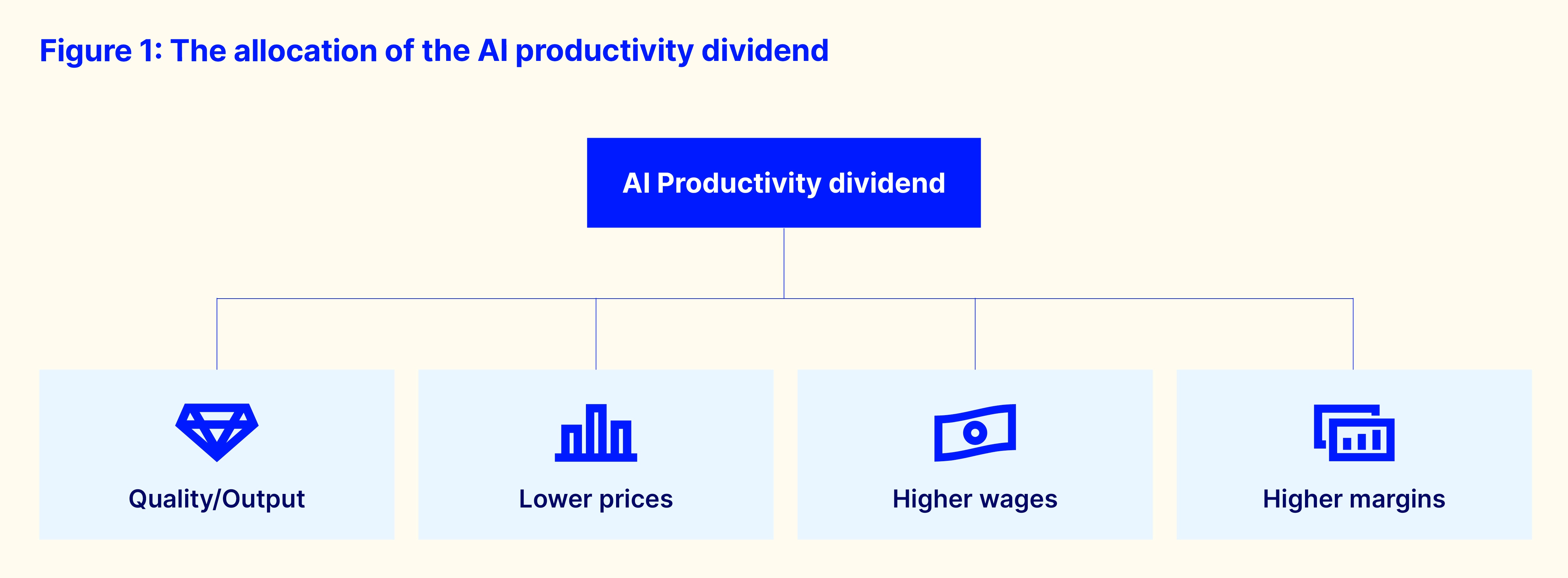
Competition is central to determining whether productivity gains are passed through to consumers or workers or retained by firms. A coffee shop on a street with a dozen rivals is less able to retain a cost saving for long. By contrast, the only pharmacy in a small town — or a vendor with locked-in customers — faces less pressure to pass through the gain. Prices may hold, and the gains may flow to the bottom line. The general principle is that pass-through is strongly influenced by competitive intensity and market structure, rather than determined by the size of the productivity gain alone. Formal pricing models convey the same insight: Competition tends to push prices toward costs, while market power allows firms to sustain a wedge between the two.
Evidence suggests that the US economy has shifted toward the margin-retaining end of the spectrum. De Loecker et al. (2020) estimate that aggregate markups rose from about 21 percent above marginal cost in 1980 to roughly 61 percent in 2016, while the average profit rates increased from about 1 percent to 8 percent. The increase in markups was concentrated in the upper tail of the distribution, while the median remained broadly unchanged. This pattern is consistent with rising market power and greater scope for some firms to retain cost savings rather than transmit them into prices.
Market power can shape how AI-driven productivity gains are distributed across consumers, workers, and shareholders. Product-market power allows firms to retain more cost savings rather than pass them through to consumers. Labor-market power allows firms to retain more of the productivity gain rather than pass it through to workers in the form of higher wages.10 A company that possesses both product-market and labor-market power may convert much of the AI dividend into profits. Such an outcome would generate a smaller decline in measured inflation, weaker wage growth, and potentially higher corporate savings or larger distributions to shareholders.
The impact of technological revolution is dynamic and spans multiple time horizons. High margins can attract additional entry, open-source alternatives, and regulatory intervention. Generative AI may reduce the cost of entering some markets; although data advantages, platform control, and scale economies may strengthen incumbent firms. The relevant macroeconomic variable is therefore not concentration alone, but also contestability; that is, how quickly customers can switch, competitors can enter, and the technology can diffuse.
The likely pattern, therefore, is one of partial and time-varying pass-through. Early adopters may retain a return on the investment required to integrate AI. As tools become standardized and competitors catch up, a larger share of the gain may reach customers. If platform control and scale economies become entrenched, that second stage may be delayed or weakened. This is why the statement “AI raises productivity, therefore inflation falls” is a non sequitur. AI creates the capacity for lower prices, but competition, market power, and the timing of pass-through determines how much of that capacity becomes observed disinflation.
Productivity gains and the equilibrium real rate
Standard growth theory provides a useful starting point for understanding how productivity gains affect the equilibrium real rate.
A useful anchor for thinking about long-run real interest rates comes from a simple question: What real return does a saver need to earn to willingly postpone consumption? Growth theory gives a clear answer, and it has a direct implication for the AI era.
Start with the intuition. In an economy where productivity and per capita income are rising, people expect to be richer in the future than they are today. That expectation changes the math of saving. A dollar set aside today buys consumption for a future self who will already be better off — and an extra dollar simply means less to someone who is already wealthier. In this framework, the faster incomes grow because of increased AI productivity, the less attractive saving becomes at any given interest rate, and the higher the return savers must be offered to defer consumption. Growth, in other words, is a headwind to saving, and interest rates are the compensation that overcomes it.
The same logic runs through the investment side. Higher expected productivity growth can raise the return on complementary new capital: Investment in machines, data centers, and software becomes more attractive when AI raises their expected productivity. Firms want to invest more; households want to save relatively less. Both forces place upward pressure on the equilibrium real rate. The Ramsey framework — a workhorse model for estimating the neutral rate, R-star (r*) — expresses the long-run real interest rate as the sum of a time-preference component plus a growth component:11

Here, r* is the longer-run real interest rate consistent with the economy operating at potential and inflation remaining stable; ρ reflects pure time preference; g_c is the economy's trend growth rate of per-capita consumption; and θ is the inverse of the elasticity of intertemporal substitution, measuring how strongly people prefer smooth consumption over time. Along a balanced-growth path, per-capita consumption growth is closely related to productivity and output-per-capita growth. The key feature is that g_c enters directly and positively: every percentage point of additional trend productivity growth translates, roughly point-for-point (scaled by θ, typically estimated between 1 and 2), into a higher equilibrium real rate. Productivity growth in this setting is akin to “net productivity growth” as productivity growth partly compensates for a declining labor force.
This is where AI enters. If AI adoption persistently raises trend per-capita productivity growth — even by half a percentage point — the framework implies upward pressure on the neutral real rate. The decade of near-zero real rates after 2008 was, through this lens, partly associated with disappointing trend growth, although demographics, global saving, safe-asset demand, and other forces also contributed. An AI-driven reversal of that trend would work the same mechanism — not through inflation or central bank policy per se, but through the fundamental price that equilibrates the desire to save with the demand to invest. Central banks would not create this increase in the neutral rate; over time, policy rates would tend to rise with it in order to maintain a neutral policy stance.
Two important qualifications should be addressed in this context.
First, the r* = ρ + θ . gc relationship is a long-run, steady-state result. It describes where rates settle once the economy has fully adjusted, not the path along the way. During the transition, the effect could be stronger. An AI investment boom in data centers, chips, power infrastructure, and enterprise software adds a surge of capital demand on top of the steady-state logic, and that demand competes for available domestic and global savings. The equilibrium real rate — and potentially observed real yields — could temporarily rise above its eventual long-run level before settling back.
Second, forces on the other side of the ledger can blunt the effect. If AI raises uncertainty about jobs and incomes, precautionary saving may rise; if investors respond to a fast-changing world with greater risk aversion, demand for safe assets may grow. Both channels can compress the real yield on safe instruments relative to what the growth logic alone would imply, although they need not lower expected return on risky capital by the same amount. The net effect depends on which force dominates. Within the Ramsey framework, the growth channel points upward, but its empirical magnitude is uncertain.
This mechanism is already embedded in prominent r* frameworks, including the Laubach-Williams and Holston-Laubach-Williams models. These models treat trend output growth as one important driver of the neutral rate while allowing other persistent forces to affect it as well. All else equal, when these models raise their estimate of trend growth, their estimate of r* rises. Only AI-driven productivity gains that are sufficiently large and persistent to raise trend potential growth would feed into this channel. The theoretical mechanism is well established, but the size and durability of the productivity gains — and the strength of their empirical transmission to r * — remain open questions.
The Fisher equation: Linking real rates, nominal rates, and inflation
The discussion so far has focused on the impact of AI-driven productivity gains on real rates. Yet the ex-ante real rate is only one component of the nominal risk-free rate. For a one-period risk-free rate, the Fisher relationship brings together the real rate and expected inflation over the same horizon to determine the nominal risk-free rate:

As discussed in the previous section, whether AI is disinflationary depends on pass-through. If productivity gains are largely retained as margin, the direct disinflationary impulse is weak, and inflation expectations are, at best, unchanged. At the same time, AI can be inflationary if investment and consumption demand increase before the associated supply gains materialize.
Former Treasury Secretary Janet Yellen makes this case directly. The AI build-out can act as a substantial positive demand shock before the associated supply gains materialize, boosting demand through two channels.12 The first is investment. Because firms expect AI to raise the return on capital, they are investing heavily in data centers, semiconductors, power infrastructure, and the construction and labor required to support them.13 This spending flows directly into demand for goods, equipment, and labor, and can place upward pressure on input costs and real interest rates.
The second is the wealth effect on consumption. Rising AI-related equity valuations have increased household wealth. Historical evidence suggests an annual marginal propensity to consume about 3.2 cents per dollar of additional stock market wealth (Chodorow-Reich et al., 2021), although AI-related gains are concentrated among higher-income groups. Both channels tend to push demand, and therefore prices and the neutral real rate upward.14
Fiscal and strategic policy can amplify this sequencing. Governments may subsidize semiconductor plants, power infrastructure, research, defense applications, and domestic supply chains. When deficit-financed, these measures increase current demand. Preliminary estimates suggest that the CHIPS and Science Act created up to approximately 54,000 direct and indirect jobs,15 subject to substantial caveats, and drove more than US$640 billion in announced private semiconductor supply-chain investment as of May 2026.16
Over a longer horizon, stronger productivity can improve fiscal sustainability by raising the tax base and reducing debt ratios relative to output. The fiscal channel can therefore be inflationary during installation, while stronger long-run growth may later improve fiscal sustainability and lower sovereign risk premia. Again, timing determines which effect dominates.
Aldasoro et al. (2024) formalizes the importance of expectations and timing in a multi-sector macroeconomic model. When future AI-driven productivity gains are fully anticipated, households bring consumption forward before productive capacity has expanded, making the initial effect inflationary even as investment is postponed. When the gains are unanticipated, the supply expansion initially lowers inflation; over time, however, rising consumption and investment can cause the demand effect to dominate.
The plausible baseline is therefore a sequence rather than a permanent sign. During installation – investment, wealth effects, and bottlenecks can dominate. During diffusion – adoption and productivity gains broaden, unit costs fall, productive capacity expands, and supply may become more elastic. In the mature phase, the outcome depends on how the gains are shared and whether competition, labor reallocation, and new entry remain vigorous.
Markets appear to tell a different story, but the signal is weaker than it looks
Up to this point, the note has focused on economic mechanisms. Theory identifies the relevant forces and the direction in which each operates. But how have markets priced the impact of AI on real interest rates? An event study of 5-year, 5-year-forward real and nominal rates finds that these rates tended to fall — not rise — on significant AI model-release days between January 2023 and June 2026.17
The study offers two mechanisms through which AI could lower long-term real yields, although they operate through different components of those yields. First, AI may increase perceived risks of labor displacement and income uncertainty, which could raise precautionary saving. This effect may be amplified if AI-related equity gains are concentrated among a relatively small group of capital holders. Greater desired saving and demand for safe assets may push down safe real yields and, if sufficiently broad, the equilibrium real rate.
Second, a fiscal channel may operate through stronger expected productivity growth, which raises the prospective tax base and expected tax receipts. This can improve expected fiscal sustainability and compresses the term premium. This second channel lowers long-term yields without necessarily lowering the equilibrium real rate.
While these mechanisms are economically coherent, three considerations help place the evidence in context. First, the five-year, five-year-forward rate is not a direct measure of the neutral rate. It combines expected future short-term rates with a time-varying term premium. Indeed, the study estimates that declining term premia account for roughly half of the reduction in long-term yields around AI model releases. A decline in the forward rate therefore need not imply an equivalent decline in r *.
Second, the term premium effect can be two-sided. The AI build-out may improve long-run fiscal expectations, but financing that build out can also increase corporate and synthetic duration supply (De Vere et al., 2026). If public support is deficit-financed, additional Treasury issuance may further place upward pressure on term premia (De Vere et al., 2026; Thiagarajan et al., 2025).
Third, the evidence is based on a relatively short sample of event windows which captures immediate market repricing around selected model releases, not realized long-run equilibrium outcomes. The observed reactions may also reflect anticipation, concurrent macroeconomic news, or changes in risk premia, and the event studies do not by themselves identify which mechanism caused the decline. A substantial empirical literature — Fama (1984), Fama and Bliss (1987), and Campbell and Shiller (1991) — also rejects the pure expectations hypothesis with a constant term premium. Far-forward rates have historically been poor predictors of realized rates, tending instead to co-move with current rates and risk premia.
The market evidence alone does not support a straightforward disinflationary outcome. Instead, several conditions would need to hold. One possibility is that AI-driven productivity gains raise aggregate TFP only modestly, with little or no effect on the equilibrium real interest rate. Another is that productivity improvements are broadly distributed across the economy and are passed through to lower prices, particularly if those gains become visible in aggregate economic data, as many expect. A third possibility is a surge in demand for savings driven by concerns about widespread job losses, leading to a renewed emergence of secular stagnation forces. However, recent evidence on demand dynamics and debt issuance does not support these scenarios. As a result, the disinflationary case remains far from certain and appears to have a relatively low probability.
Three AI adoption regimes: Competitive diffusion, bottlenecked investment boom, and labor-displacement slump
The effects of AI adoption can be organized into three broad regimes. These are not mutually exclusive and may coexist across sectors or emerge at different stages of adoption.
In a competitive-diffusion regime, AI adoption becomes broad, entry remains viable, firms pass a substantial share of cost savings to customers, and workers share in the income gains. Inflationary pressure eases in the medium run, while stronger investment and trend growth place moderate upward pressure on the neutral real rate. This is the most favorable combination from a broad welfare perspective because the economy receives both a supply benefit and relatively broad distribution of the surplus.
A bottlenecked investment boom produces a different path. Capital expenditure, wealth effects from rising equity valuations, public subsidies, and bottlenecks in in electricity, construction, and equipment can lift inflation during the installation phase. Strong investment demand places upward pressure on both the neutral real rate and the nominal rates. Disinflation may emerge only after capacity is commissioned and productivity gains diffuse. This regime is especially plausible when the economy begins near full employment or when complementary infrastructure is slow to expand.
A labor-displacement slump lies at the other extreme. Productivity may improve, but employment insecurity and weak wage income can induce precautionary saving. Aggregate demand may soften, inflation may fall sharply, and the neutral real rate may decline. Such an outcome would be disinflationary, but not in the benign sense usually implied by “productivity-led disinflation.” It would reflect weak household demand as much as expanding supply.
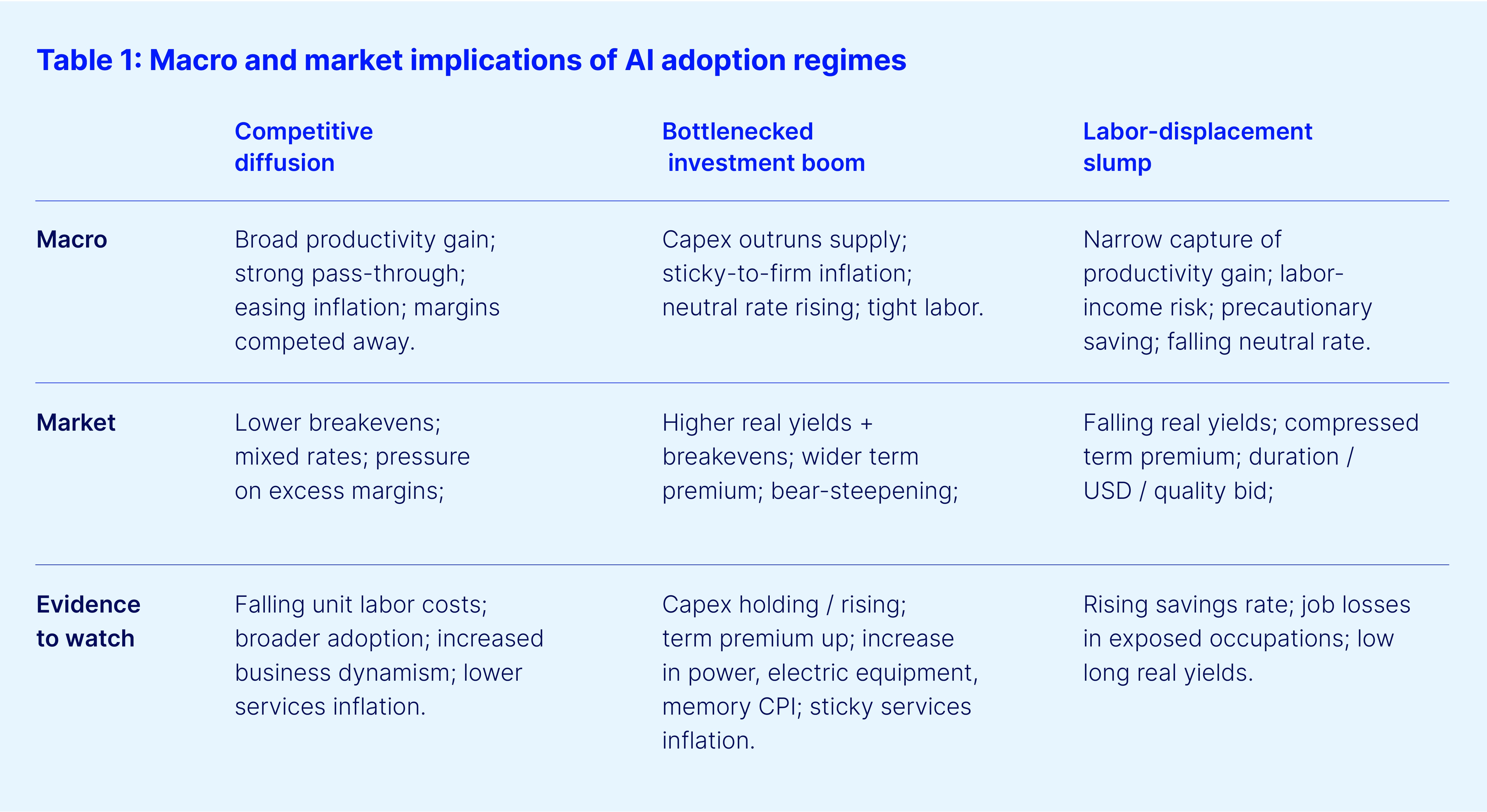
Actual economies are likely to contain elements of all three regimes and move among them over time. The technology sector may display bottlenecked investment and high rents, while some downstream service industries experience competitive diffusion. Regions with data-center construction may face local wage and electricity-price pressures, even as AI lowers the cost of some digital services nationally. The aggregate outcome reflects the interaction of these sectoral and distributional effects.
Implications for investors
Divergent views on AI, inflation, and real interest rates largely stem from collapsing three distinct questions into one. Once disentangled, the productivity question admits a relatively clear answer, while the inflation and interest-rate implications remain conditional.
First, does AI raise productivity? At the task level, generally, yes — the micro-level evidence is strong, even if it may take time for aggregate statistics to reflect these gains.
Second, does higher productivity lower inflation? The answer depends in important part on the balance between margin retention and pass-through, as well as on the allocation of the gains to wages, output, and the quality. Given the costs of adopting AI capabilities, and the long-term rise in aggregate markups, particularly among high-markup firms, the balance of forces currently favors margin retention, especially where market power is strong.
What, then, are the implications for interest rates? On balance, the base case points toward upward pressure on nominal rates over the near-to-medium-term-horizon — not because the Fisher decomposition delivers a definitive sign, but because the demand-side inflationary forces appear more concrete and immediate, while the productivity and pass-through gains may take time to materialize.
In the near term, three forces may place upward pressure on nominal yields: stronger investment demand can raise the equilibrium real rate; the associated demand impulse can raise expected inflation; and AI-related financing can increase duration supply and place upward pressure on the term premium at the long end of the yield curve.
The disinflationary and bond-bullish alternatives are both plausible, but they should be distinguished. A disinflationary outcome requires broad pass-through and/or weaker aggregate demand. A bond-bullish outcome may also rise from a lower neutral rate or a compression in term premia. The market evidence rests on a relatively short event-study sample that captures immediate repricing around selected AI model releases rather than realized long-run outcomes. The precautionary-saving channel is economically plausible but is not yet clearly visible in aggregate saving flows.
For investors, the implication is a directional tilt rather than certainty. The structural case for higher real rates and near-term price pressure supports a bias toward higher yields over the relevant horizon, while the market-implied lower-yield narrative remains an important counterpoint to monitor. The lower-rate case would become more compelling if the demand investment impulse faded, precautionary saving strengthened, or task-level productivity gains failed to raise trend growth. The disinflationary case would gain greater traction if productivity gains broadened and pass-through to prices strengthened, or if aggregate demand weakened materially. Based on the balance of current evidence and theory, the risks to near-term inflation and nominal yields remain skewed to the upside.
Acknowledgement
The authors thank Eric Garulay and Elliot Hentov for their invaluable contributions to the development of this paper. Their thoughtful critiques, constructive feedback, and engaging discussions on earlier drafts significantly enriched the clarity, depth, and rigor of our work.


