
Insights
April 2026
Interest-bearing stablecoins and macroeconomic stability

Stablecoins have grown quickly and are expanding beyond crypto settlement into payments, cross-border transfers, and savings. We evaluate the macro-financial consequences of permitting stablecoin issuers, and affiliated intermediaries, to pay interest.
Drawing on recent analyses from the International Monetary Fund (IMF), Bank for International Settlements (BIS), Federal Reserve, European Central Bank (ECB), and related research, we argue that remuneration represents a regime change, transforming stablecoins from a transactional convenience into a globally accessible “cash-plus-yield” instrument that competes directly with bank deposits and money market funds (MMFs).
At scale, this shift could alter bank funding structures, affect credit supply, amplify run dynamics in short-term funding markets, and accelerate digital dollarization with spillovers across borders. The analysis highlights how remuneration interacts with the regulatory perimeter, reserve asset composition, and governance arrangements to shape these outcomes, with implications for financial stability, global liquidity conditions, and the portfolio environment and asset allocation considerations faced by long-horizon asset owners and asset managers.
Introduction
Ramu Thiagarajan
Head of Thought Leadership
James Redgrave
Vice President of Global Thought Leadership
Priyaam Roy
Thought Leadership Research Analyst
The rapid growth of stablecoins is reshaping how private money interacts with banking systems, capital markets, and cross‑border liquidity. What began as a niche settlement tool within crypto markets is increasingly intersecting with core functions of the financial system, raising questions about credit intermediation, funding stability, and the future configuration of cash‑like instruments.
The Digital Asset Market Clarity Act of 2025 (CLARITY Act), currently being debated in the United States’ Congress, has sharpened opposition between the US administrations’ position — which would allow certain forms of payment currently prohibited under the Guiding and Establishing National Innovation for US Stablecoins Act (GENIUS Act)1 — and a Senate majority and the banking industry, for reasons outlined in this paper. Attempts have been made in Congress to amend CLARITY to close loopholes in GENIUS that already permit certain payments to investors.2 Recent political interventions have increased uncertainty around the future regulatory perimeter for stablecoins, underscoring the importance of understanding the implications of remuneration rather than the specific legislative path taken.
This paper examines the macro-financial implications of interest-bearing stablecoins drawing deposits from banks, their effects on credit supply and financial stability, and the policy constraints needed to mitigate risks using institutional analysis, analytical modeling, sectoral and international assessment, scenario analysis, and policy recommendations.
Stablecoins have evolved from a niche trading tool into a potentially system-relevant form of tokenized cash, not just in the US but internationally. The total value of stablecoins in circulation is estimated to have doubled since 2024 to about US$280 billion—US$300 billion as of September 2025, with around 97 percent denominated in US dollars.3 Stablecoins are increasingly used for cross-border payments, merchant settlement, and as a store of value in countries with limited access to safe dollar assets. Usage has grown in countries with volatile currencies such as Argentina, Nigeria, and Turkey, where stablecoins function as digital-dollar savings instruments. Projections for dollar-pegged stablecoin growth range from from US$500 billion in three years to US$2.9 trillion in five years, assuming they remain non-interest-bearing.4
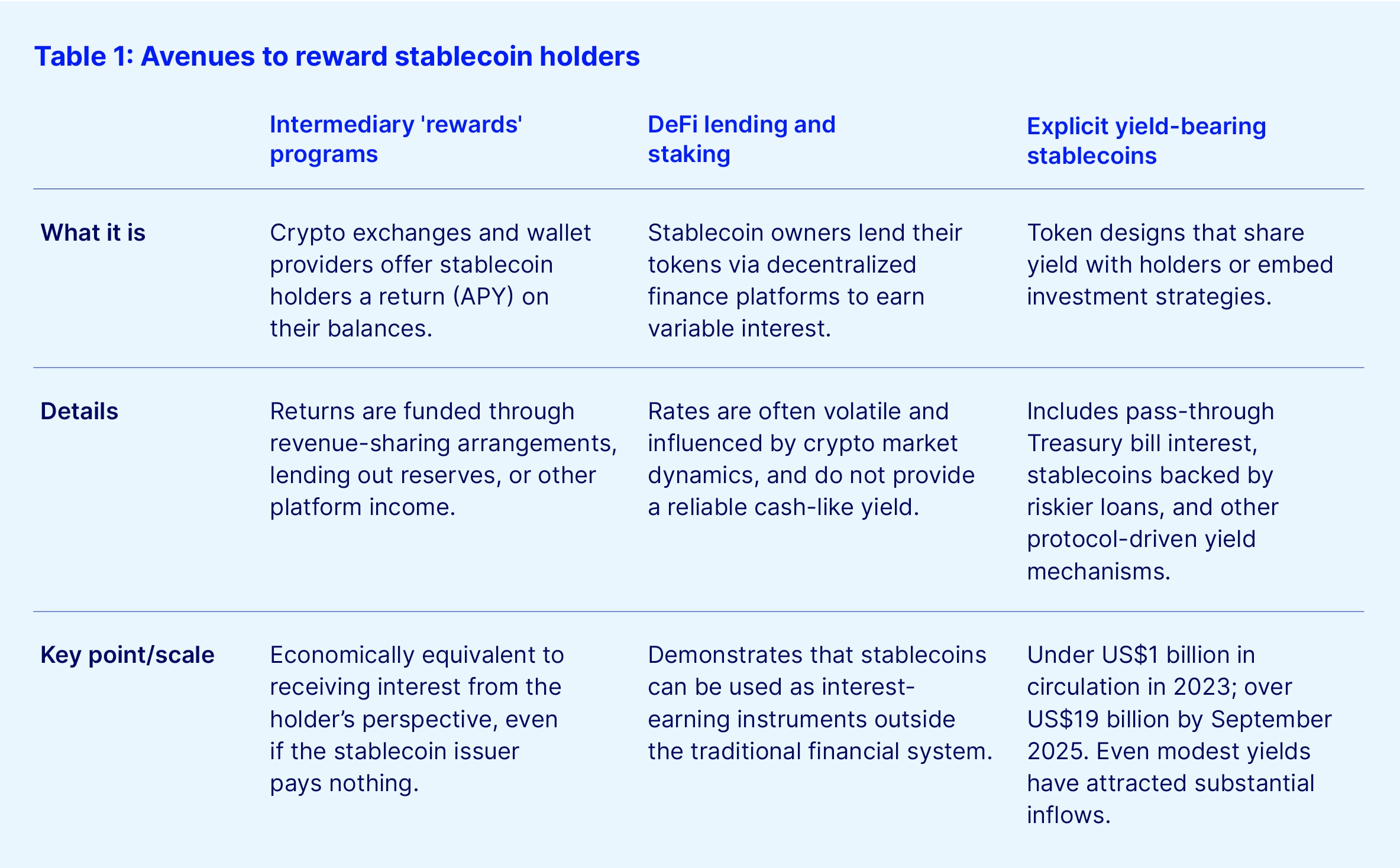
However, whether stablecoins remain non-interest-bearing payment instruments or evolve into interest-bearing savings vehicles is a macro-structural policy choice, as the payment of interest would turn them into deposit-like instruments, with implications for bank funding, credit supply, and financial stability. The GENIUS Act of 2025 establishes a regulatory framework for payment stablecoins and explicitly prohibits issuer-paid interest, although the elements outlined above would be superseded by the CLARITY Act if it were to pass through Congress. Most fiat-backed stablecoins already do not pay interest, with issuers retaining reserve income. Similar non-remuneration rules exist under the European Union’s Markets in Crypto‑Assets Regulation (MiCA) framework and are supported by the IMF. Despite this, yield is emerging indirectly through exchange or wallet-based rewards, Decentralized Finance (DeFi) lending, and explicit yield-bearing stablecoin designs. The BIS reports that yield-bearing stablecoins grew from slightly under US$1 billion in 2023 to more than US$19 billion by September 2025.5
Institutional and market background
“Stablecoin” encompasses instruments with distinct economic and legal features
A policy-relevant taxonomy includes three categories: (1) Payment stablecoins are par-redeemable tokens referenced to a fiat currency, used mainly for payments and settlement, and typically backed 1:1 by high-quality liquid assets. (2) Yield-bearing “stablecoins” distribute returns to holders through reserve income sharing, lending, or embedded investment strategies. By combining a stable unit of account with yield, these instruments more closely resemble cash-equivalent investment products, such as money market instruments, rather than pure payment tools. (3) Regulated tokenized cash alternatives include tokenized bank deposits and tokenized MMF shares, which remain within existing prudential and investor-protection frameworks, and can pay interest while benefiting from established safety nets.
Why interest is usually prohibited — and how “stablecoin-related yields” still emerge
In most jurisdictions, stablecoin and e-money regulations explicitly prohibit paying interest on customer balances, to preserve the boundary between payments and deposit-taking (the latter being reserved for licensed banks with access to central bank liquidity and deposit insurance). For example, the European Central Bank’s analysis of the EU’s MiCA framework emphasizes that e-money token issuers are not allowed to remunerate holders, and stablecoin issuers generally retain reserve income rather than distributing interest. The IMF similarly notes that, unlike bank deposits or MMFs, stablecoin issuers typically do not pay interest or dividends to token holders. The intent behind such prohibitions is to prevent deposit-like instruments from migrating outside the regulatory perimeter — ensuring that money-like instruments remain backed by bank capital, supervision, and safety nets, and that consumers do not confuse stable, non-interest-bearing payment tokens with interest-bearing savings products.
In practice, however, yield has begun to percolate into the stablecoin ecosystem through avenues that exploit gaps in these rules. These developments underscore that the issue of stablecoin remuneration is not merely hypothetical. It is already observable, testing the limits of current regulatory frameworks. The different avenues are outlined in Table 1.
Regulatory perimeter: The GENIUS Act, MiCA, and the “loophole” problem
Recent and proposed regulations treat non-remuneration as a core principle, since a par-redeemable, interest-paying token would be deposit-like and potentially operate outside bank regulation. However, the scope of interest bans differs across regimes. Under the US GENIUS Act, issuers are prohibited from paying interest, but this restriction may not apply to crypto asset service providers such as exchanges or wallets. In issuing rules on the implementation of GENIUS, the US Treasury’s Office of the Comptroller of the Currency (OCC) has indicated the prohibition applies also to “third parties” and “affiliates” of issuers. However, the OCC also accepts that a comprehensive list or definition of such entities is impossible and that potential evasions of the rule should be judged on a case-by-case basis, albeit with an assumption that payments to holders are not allowed unless those involved can demonstrate the legality of their arrangement, with reference to the Act.6
In contrast, the EU’s MiCA framework bans both issuers and intermediaries from granting interest on e-money tokens, defining interest broadly to include any benefit linked to holding periods. This distinction has important macro-financial implications. Allowing intermediaries to offer rewards preserves deposit substitution incentives while diffusing regulatory accountability. As noted by the Bank Policy Institute, some major platforms already pay yield-like rewards on stablecoin balances, effectively remunerating holdings despite issuer-level bans. This creates a regulatory loophole that can be exploited through affiliated entities or permissive jurisdictions.
The global circulation of stablecoins further complicates enforcement. National regulations face cross-border arbitrage, as yield can be provided as “rewards” without formally breaching issuer-level rules. Without comprehensive coverage of all actors and an economic definition of interest, regulatory gaps can persist across regimes.
Reserve assets, banking interconnections, and the location of disintermediation
Even with full 1:1 reserve backing by high-quality liquid assets, large-scale stablecoin growth can significantly alter the composition of financial system liabilities and the allocation of safe assets. In particular, the choice of reserve asset has important macroeconomic implications.
Two stylized reserve strategies illustrate this point:
- Bank deposit reserves: If stablecoin reserves are held as bank deposits, total deposits may be preserved but shift in nature. Retail deposits are consolidated into large balances held by a few intermediaries and treated by regulators as less stable wholesale funding with higher runoff rates. This forces banks to hold more high-quality liquid assets, potentially crowding out lending. Converting many small, insured deposits into a few large, uninsured ones can weaken liquidity ratios and reduce balance sheet capacity for loans, affecting both banks that lose stable retail funding and those that gain more flight-prone deposits.
- Treasury bill or repo reserves: If reserves are instead invested in short-term government securities (Treasury bills) or reverse repos, the stablecoin’s growth more directly reduces traditional bank deposit funding and increases demand for safe government assets. Indeed, a major USD stablecoin already reports reserves concentrated in short-term Treasuries and repos, with only a small portion in cash. In this structure, heavy redemptions of stablecoins would transmit stress to short-term funding markets through forced sales of Treasuries or unwinding of repo positions.
Reserve choices determine whether largescale stablecoin adoption leads mainly to bank deposit disintermediation, concentration of volatile wholesale deposits in certain banks, or procyclical shocks in money markets such as Treasury or repo stress.7 Interest payments would accelerate adoption under any reserve structure, amplifying these effects. When reserves are held largely in government securities, shifts from bank deposits into stablecoins effectively redirect financing from private credit toward public debt, as former depositors end up funding government securities rather than bank lending.
Analytical framework
Money demand, remuneration, and the adoption elasticity of stablecoins
A simple theoretical lens for why interest on stablecoins matters is provided by the classic Baumol–Tobin model of transactions demand for money.8 In this framework, households and firms decide how much transaction balance to hold by trading off the convenience of money against the opportunity cost of not investing in those funds. When a stablecoin does not pay interest, its opportunity cost is roughly the prevailing short-term interest rate; if the stablecoin does pay interest at rate is against a market rate i, the relevant opportunity cost is the spread z = i – is. Lowering this spread sharply raises the desired holdings of the interest-bearing money. In fact, in the Baumol-Tobin formulation, the optimal average money balance S is inversely proportional to the square root of the opportunity cost as given by:

For example, reducing z by a factor of four doubles money demand. Hence, if the market rate is 4 percent and stablecoins pay 3 percent (so z =1 percent), stablecoin demand doubles from US$2 trillion (no interest) to US$4 trillion (with 3 percent stablecoin interest). Similarly, it can be shown that that money demand increases to US$2.8 trillion if stablecoins pay 2 percent and to US$5.7 trillion if stablecoins pay 3.5 percent.
In practice, this means that paying interest on stablecoins could dramatically increase the amount of value users hold in stablecoin form, especially in high-rate environments where the opportunity cost of earning zero on a payments stablecoin is significant. This intuition aligns with market evidence: the BIS has found that when US monetary policy tightens (raising short-term rates), funds tend to flow out of non-interest-bearing stablecoins into higher-yielding cash equivalents like prime MMFs.9
By the same logic, if stablecoins themselves offer interest, both the level of demand and its interest sensitivity are likely to rise substantially. Even a small positive yield on stablecoins can entice users to hold much larger balances than they otherwise would, effectively boosting the money-like role of stablecoins in the economy.
Even modest amounts of interest materially increase how much value users are willing to hold in stablecoin form, especially in high‑rate environments where the opportunity cost of zero‑yield payment instruments is high.
Bank balance sheets: Deposit substitution, liquidity constraints, and credit supply
Stablecoin adoption can affect banks through multiple channels even when fully backed by safe assets. If funds move from bank deposits into stablecoins, banks lose a key source of loan funding. Even when total deposits are unchanged, the mix may shift toward more rate-sensitive and flight-prone deposits, with outflows concentrated at banks reliant on uninsured or wholesale funding, or with weaker digital offerings. These effects are uneven, with larger, diversified banks generally more resilient.
Deposit outflows can reduce lending by more than the initial funding loss due to liquidity and capital constraints. Empirical evidence shows that declines in deposits lead to disproportionately larger contractions in loan supply. Federal Reserve analysis estimates that a US$100 billion net deposit drain could reduce bank lending by roughly US$60 billion–US$126 billion, and industry estimates warn that large-scale stablecoin growth could imply trillions of dollars in reduced lending. Remuneration increases the likelihood and scale of such shifts.
Distributional effects are significant. Community and regional banks may be hit hardest, potentially accelerating consolidation and reducing credit in certain regions or borrower segments. If stablecoin issuers concentrate reserves in a few banks, those banks may receive volatile wholesale-like deposits, weakening liquidity ratios and crowding out lending. As regulators note, even if reserve placement is deposit-neutral in aggregate, it is not credit-neutral.
Banks are likely to respond by raising deposit rates, developing tokenized deposit products, improving payment services, or partnering with stablecoin platforms. Examples include proposals for permissioned networks where banks issue tokenized deposits within the regulatory perimeter. These adaptations may mitigate but not fully offset competitive pressure from widely available high-yield stablecoins.
The reserve-asset externality and a policy trilemma
Allowing stablecoins to pay interest interacts with what can be viewed as a policy trilemma in reserve management and monetary design: regulators face three undesirable outcomes depending on how stablecoin reserves are managed, and cannot avoid all of them simultaneously:
- Competition with money markets: If interest-bearing stablecoins are backed mostly by short-term government securities (e.g., Treasury bills) or repos, they effectively compete with MMFs for the public’s cash yet maintain a promise of stable value and on-demand liquidity. This combination of attributes could increase run and fire-sale risk in short-term funding markets, since stablecoin issuers facing redemptions might need to liquidate large positions in T-bills or unwind repos, amplifying stress in those markets.
- Shadow banking fragility: If stablecoin reserves are held primarily as uninsured bank deposits, the structure begins to resemble a narrow bank (or a “payments bank”) outside the normal bank safety net. Without prudential regulation, capital requirements, or access to central bank lender-of-last-resort facilities, these issuers create a classic shadow deposit risk: a par-valued, interest-bearing claim without the usual safeguards, prone to run dynamics in stress events. Conversely, if those issuers were forced into the full banking regime to mitigate run risk, they would effectively become banks, erasing the distinction.
- Central bank substitution: If stablecoin reserves were held directly as central bank balances (e.g., if issuers have access to Federal Reserve master accounts), interest-bearing stablecoins would be very close substitutes for central bank money itself, raising fundamental questions about who can access central bank liabilities and potentially expanding the central bank’s balance sheet to accommodate non-bank issuers.
This trilemma helps explain why many jurisdictions prohibit remuneration for payment stablecoins and instead steer any yield-bearing tokenized cash into existing regulated structures (like bank deposits or MMFs) rather than allowing interest-paying “stablecoins” to operate unchecked. In essence, policymakers are wary of creating a new class of runnable, deposit-like instruments that fall outside traditional regulatory oversight. As we discuss later, if interest-bearing stablecoins are to be permitted at all, the regulatory response would need to draw from one of the existing models (banking or funds) or a novel mutualized framework — each with its own trade-offs.
Implications
Banking sector implications
Deposit disintermediation and the cost of credit
If permitted at scale, remunerated stablecoins would be likely to compete directly with bank deposits, particularly uninsured and flight-prone funds used to finance lending. A liquid, interest-paying token with high transferability would encourage both retail and corporate depositors to shift holdings into stablecoins, shrinking banks’ funding base and forcing reduced lending or greater reliance on costly wholesale funding. Even without their paying yields, US Treasury analysis11 estimates that the current anticipated growth of stablecoins puts US$6.6 trillion in non-interest paying deposits “at risk”.
The analysis doesn’t put a figure on the potential loss of money from the US$8.3 trillion in interest yielding accounts if stablecoins were to do the same. But it does acknowledge that this “hypothetical” scenario would represent a much higher “magnitude of impact” on market behavior than can be expected under the current rules. However, comparison with MMFs could be instructive at this point, as these are interest-yielding products that are available to retail investors, providing potential competition with their bank accounts.
According to Institute of Investment Companies (ICI) data, total retail investment in US MMFs currently stands at US$3.8 trillion, around a fifth of the US$18 trillion held in all cash account types, interest and non-interest paying, in the US Treasury figures. Estimated effects are large. Each US$100 billion in net deposit outflows could reduce bank lending by roughly US$60 billion–US$126 billion. At trillion-dollar scale, interest-bearing stablecoins could lead to trillions less in bank credit and higher lending rates as banks’ funding costs rise. One scenario with US$2 trillion in stablecoin growth drawn mainly from bank deposits implies US$1.2 trillion–US$2.5 trillion less in lending and an increase in banks’ average funding costs of about 40 basis points, likely raising borrowing costs for households and firms. Even if some growth comes from MMFs rather than deposits, remuneration makes large-scale adoption more likely, sustaining credit contraction risks.
Potential offsets — such as stablecoins drawing mainly from MMFs or attracting foreign dollar inflows into US banks — are unlikely to fully counteract these effects at scale. Even when deposits are replaced with wholesale funding, higher marginal funding costs would tighten credit conditions, particularly for borrowers dependent on relationship-based bank lending.
Composition and concentration: Uneven effects across banks
Deposit substitution into stablecoins would likely be uneven across banks. Institutions with higher shares of uninsured or corporate deposits, weaker digital services, or customers with greater access to fintech alternatives could face larger outflows, while large, diversified banks with strong digital platforms and flexible pricing may retain deposits more effectively. This implies distributional credit effects, with community and regional banks potentially more affected, reinforcing consolidation and altering credit allocation.
A further concentration risk arises from where stablecoin issuers place their reserves. If deposits are concentrated in a small number of banks, both the banks losing retail deposits and those gaining large issuer deposits may experience weaker liquidity positions, even if system-wide deposits are unchanged. Incoming stablecoin-issuer deposits are treated as unstable wholesale funding, requiring higher liquid asset holdings and reducing lending capacity. These dynamics tend to disadvantage smaller banks relative to larger institutions with greater funding flexibility.
Banks’ strategic responses and the role of tokenized deposits
Banks are expected to respond actively to competition from stablecoins. Likely actions include raising deposit rates in vulnerable segments, issuing tokenized deposit products that combine programmability with regulatory protections, and partnering with stablecoin providers through custody, settlement, or white-label issuance. Tokenized deposits are increasingly seen as a safer alternative to interest-bearing stablecoins, as initiatives such as the 2025 Cari Network propose bank-issued, interoperable tokens under shared governance that retain deposit insurance and regulatory oversight while offering digital benefits.
These responses have limits. Higher deposit rates pressure profitability, especially for smaller banks; developing digital infrastructure requires time and investment; and partnerships with stablecoin issuers increase banks’ exposure to the crypto ecosystem. As a result, while such strategies may reduce competitive pressure, they are unlikely to fully offset the macro financial challenges posed by widespread adoption of high-yield stablecoins.
Financial stability risks
Runs, redemption frictions, and spillovers to short-term funding markets
Stablecoins are marketed as par-redeemable, but history shows this can fail under stress. During the ‘March 2023 US regional banking turmoil’, USD Coin (USDC) traded below US$1 after exposure to a failing bank was disclosed. Even with high-quality, fully collateralized reserves, stablecoins can fall below par due to market microstructure frictions and confidence shocks. Because they trade continuously across decentralized, cross-border markets, stress can spread rapidly and outpace traditional interventions.
Allowing stablecoins to pay interest would increase both their scale and their use as stores of value. A larger, yield-seeking holder base would be more prone to runs, similar to prime MMFs during the 2008 financial crisis. The Bank Policy Institute compares interest-bearing stablecoins to prime MMFs, which combined “cash-like” claims with yield and ultimately required extraordinary public support. The same features that attract users in normal times can amplify instability during stress, especially at scale.
The systemic impact of a stablecoin run depends on reserve composition. If reserves are held in Treasury bills or repo, mass redemptions could trigger asset sales or funding stress in short-term markets. If reserves are mainly bank deposits, runs could transmit liquidity stress directly to banks. In either case, remuneration increases the risk that stablecoin stress becomes a systemic liquidity event rather than a contained crypto market disruption.
Risk-taking incentives and the instability of stablecoin yields
Even if issuers intend to pass through only “safe” interest, competitive pressures may push stablecoins toward riskier reserve strategies over time. Paying interest requires sufficient yield after costs and buffers, which can incentivize extending duration, taking credit risk, or leveraging reserves. History shows that such yield-seeking behavior makes short-term instruments more run-prone. The rapid growth of yield-bearing stablecoins suggests that some already use more complex or risky approaches than holding Treasury bills, while DeFi-based yields often reflect crypto-specific risks rather than policy rate pass-through.
Turning stablecoins into mass market savings vehicles therefore introduces additional operational and credit risks. As larger shares of wealth are held in stablecoins, failures in custody, smart contracts, or governance could have economy-wide effects. Stablecoins that promise both par redemption and yield may appear near risk-free, even as hidden risks accumulate, increasing the potential damage when stresses emerge.
Global finance and international spillovers
Digital dollarization: Why interest-bearing stablecoins are globally consequential
From an international perspective, interest-bearing stablecoins could accelerate digital dollarization. Even without interest, dollar-linked stablecoins have already enabled currency substitution and capital flight in economies with high inflation, capital controls, or weak banking systems. The IMF notes that by 2024, stablecoin holdings were rising relative to bank deposits in several emerging markets. If stablecoins paid interest, a US-dollar stablecoin would combine exchange-rate stability, US-linked yield, and global portability, making it especially attractive for savers in countries with unstable currencies or low real returns.
The macroeconomic effects for vulnerable economies could be severe. Widespread adoption would drain deposits from local banks, weakening domestic credit and financial stability, while increasing sensitivity to US monetary policy as savings shift with US rate cycles. Traditional stabilizing tools, such as deposit insurance or lender-of-last-resort facilities, may be ineffective because savings are held offshore in digital form. Governments could face pressure to impose capital controls, potentially reducing financial openness and growth.
Capital flows, safe-asset demand, and global liquidity cycles
Globally, interest-bearing stablecoins could create a highly reactive channel linking liquidity demand to US short-term safe assets. If reserves are mainly held in Treasury bills and repo, growing stablecoin circulation would increase structural demand for US government debt, potentially affecting interest rates and dollar strength.
The more immediate risk is procyclicality. Stablecoin issuance can expand rapidly in favorable conditions and contract sharply during stress. Large redemptions could force asset sales or repo non-rollovers, driving spikes in short-term rates and liquidity stress in dollar funding markets. Limited transparency, including holdings in un-hosted wallets, would make real-time monitoring difficult, potentially prompting central bank interventions that effectively backstop private stablecoins.
Overall, while interest-bearing stablecoins could channel funds into US markets, they also introduce new risks: exporting US monetary conditions abroad, weakening monetary autonomy in smaller economies, and increasing cross-border liquidity volatility. These dynamics could undermine financial stability in emerging markets and complicate global financial management.
Implications for asset owners and asset managers
For institutional investors, the relevance of interest-bearing stablecoins lies less in their direct exposure and more in how these instruments influence liquidity conditions, capital flows, and the behavior of core asset classes that underpin portfolio construction and risk management.
First, the expansion of yield-bearing stablecoins has implications for liquidity and funding dynamics that matter to long-horizon investors. If stablecoins attract savings away from banks or MMFs, the resulting shifts in deposit funding, wholesale liquidity, and short-term funding markets can affect the availability and cost of credit across the economy. For asset owners, this may influence the stability of banking sector counterparties and the resilience of credit transmission during periods of stress. For asset managers, it may translate into changes in funding conditions, repo market behavior, and the pricing of short-dated instruments that are central to portfolio liquidity management.
Second, the growing role of stablecoins in global dollar liquidity can increase the procyclicality of capital flows, with implications for portfolio volatility and diversification. As discussed above, stablecoin issuance and redemption can expand rapidly in favorable conditions and contract abruptly during stress, particularly when reserves are concentrated in Treasury bills or repo. For investors with exposure to short-duration fixed income, emerging markets, or currency-sensitive assets, these dynamics may amplify swings in yields, exchange rates, and cross-border flows, especially during periods of tightening global financial conditions.
Third, interest-bearing stablecoins raise questions about the evolving landscape of cash-like instruments. For asset owners, this has implications for how liquidity is segmented across deposits, MMFs, and digital cash equivalents, and for the governance frameworks used to assess safety, access, and operational risk. For asset managers, it underscores the importance of distinguishing between instruments that appear cash-like in normal times but may behave differently under stress, particularly where redemption mechanics, reserve transparency, or legal protections differ from those of traditional funds or bank deposits.
Finally, the international dimension of stablecoin adoption is particularly relevant for globally diversified portfolios. Increased digital dollarization, especially if coupled with yield, can weaken domestic financial systems in vulnerable economies and heighten sensitivity to US monetary policy cycles. For asset owners with long-term commitments to emerging markets, and for managers allocating across regions and currencies, these effects may influence country risk assessments, currency hedging strategies, and expectations around capital controls or policy responses in stress scenarios.
For institutional investors, interest-bearing stablecoins are an increasingly structural feature of the evolving monetary and liquidity landscape. Monitoring their scale, reserve composition, and interaction with traditional cash and funding markets is therefore relevant for portfolio construction, liquidity planning, and risk oversight, even for investors that do not engage directly with stablecoins themselves.
Scenario analysis: Scaling paths and the macro-financial “damage function”
This section presents several scenarios to illustrate how different regulatory choices and market behaviors could lead to very different macro-financial outcomes. Rather than precise forecasts, these scenarios provide a conceptual mapping from assumptions to potential impacts, highlighting the factors that drive the “damage function” of interest-bearing stablecoins.
Baseline scenario: Non-remunerated payment stablecoins (current policy)
Assumption: Under a baseline regime where payment stablecoins remain non-remunerated and subject to strict reserve and redemption rules, adoption continues to grow mainly for payments, especially cross-border use, and crypto-market activity. In a high-interest-rate environment, the zero yield on stablecoins limits their appeal as savings instruments. Reserves remain concentrated in high-quality, short-maturity assets, with some held as bank deposits, partially recycling funds back into the banking system.
Implication: In this “contained innovation” scenario, stablecoins complement rather than replace bank deposits. Deposit substitution is largely limited to transactional balances and specific niches, keeping credit contraction and bank funding effects moderate. Banks can manage localized pressures through targeted rate increases or improved digital services. While financial stability risks remain, the absence of interest payments constrains stablecoin scale and long-term savings use, making system-wide crises less likely.
De facto remuneration scenario: Rewards programs at intermediaries
Assumption: Issuers do not pay interest, but exchanges and wallets offer stablecoin “rewards,” creating de facto interest in regimes where only issuers are restricted. These rewards could approach money market rates, significantly narrowing the opportunity cost gap and plausibly doubling stablecoin demand relative to a no-interest baseline. Because holders receive real economic remuneration, the macro effects resemble those of direct issuer-paid interest.
Banking and credit effects: Indirect remuneration could generate similar deposit substitution and credit contraction as formal interest payments. Large increases in stablecoin usage could raise banks’ funding costs by roughly 40 basis points and reduce lending by about US$60 billion–US$126 billion per US$100 billion of net deposit outflows. While some impact may be offset if funds come from non-bank sources, remuneration increases the likelihood that stablecoin growth materially erodes bank intermediation. Banks would respond by repricing deposits or offering digital alternatives, but tighter credit conditions would be hard to avoid, especially for bank-dependent borrowers.
Macro outcome: Payments and savings become increasingly unbundled, with households and firms holding larger balances in effectively interest-bearing stablecoins and relying less on banks for deposits. Banks’ franchise values erode as funding costs rise, leading to higher lending rates and constrained credit, disproportionately affecting regions and sectors reliant on banks. Highly liquid, runnable stablecoin savings increase financial system fragility, while regulators face a system where the non-interest rule is bypassed, raising the choice between expanding regulation or accepting a growing shadow deposit system.
Explicit interest at scale: Maximum disintermediation (interest-bearing stablecoins with Fed account access)
Assumption: Stablecoin issuers are allowed to pay interest directly and, in an extreme case, obtain access to Federal Reserve master accounts earning interest on reserves. This would let issuers hold reserves at the central bank and pass through near-policy rates to holders, eliminating the opportunity cost of holding stablecoins and driving a surge in their use as savings instruments.
Key mechanism: This setup would produce the largest reduction in bank deposits. Federal Reserve analysis suggests that interest-bearing Fed accounts for stablecoin issuers could lead to near one-for-one substitution of bank deposits into stablecoins. A US$1 trillion stablecoin supply with no recycling into banks could imply a US$600 billion to US$1.26 trillion contraction in bank credit, with even larger effects if stablecoin adoption reaches multi-trillion levels.
Macro outcome: Banks would shrink and rely more on costly wholesale funding, pulling back from lending as more credit shifts to capital markets and nonbanks, increasing cyclicality and fragility. In severe stress, policymakers might feel compelled to support stablecoin issuers, creating moral hazard by extending public backstops to private firms.
Summary: Explicit interest on stablecoins — especially with direct access to central bank money — represents the worst-case outcome. Policymakers would face a choice between large contractions in bank credit, extending full bank-like regulation and support to stablecoin issuers, or heightened financial instability, which is why current proposals favor keeping stablecoins tightly constrained unless fully integrated into regulated frameworks.
Policy and governance: Regulatory design approaches and their implications
Non-remuneration for payment stablecoins: Closing the rewards loophole
If the goal is to prevent payment stablecoins from developing into a parallel shadow deposit system, the first-best policy is straightforward: maintain a bright-line prohibition on remuneration and enforce it in economic substance, not just form. MiCA provides one template: Its ban covers both issuers and intermediaries (crypto asset service providers/CASPs) and defines “interest” broadly as any net compensation or discount linked to holding a stablecoin, including third-party benefits. Regulatory frameworks that focus on economic substance rather than form aim to ensure that no mechanism — direct or indirect — allows stablecoin holders to earn yield simply for holding a payment stablecoin.
A practical implementation would involve three important aspects: (i) prohibit stablecoin issuers from paying interest and ban stablecoin-specific yield “rewards” at intermediaries (exchanges, wallets) when funded by reserve income or by lending out customer stablecoins; (ii) require prominent disclosure that payment stablecoins are not bank deposits and lack deposit insurance; and (iii) align marketing and communications so that payment stablecoins cannot be advertised or labeled as savings or investment products. Without these steps, a formal “no interest” rule can be easily undermined in practice by creative branding and off-balance-sheet arrangements.
Crucially, authorities should treat any kind of predictable, yield-like benefit for stablecoin users as interest in substance, regardless of how it is labeled (reward, rebate, promotional bonus, etc.). Enforcement must cover the full distribution chain: not only issuers but also exchanges, wallet providers, and affiliated entities that might offer such incentives. Focusing only on issuers leaves open significant avenues for regulatory arbitrage — as the current “rewards” programs demonstrate. Effective supervision in this area will likely require active monitoring of marketing practices and coordination across jurisdictions, since stablecoin services can be offered cross-border to evade local restrictions.
Functional separation: Payment tokens versus savings/investment tokens
A common theme across regulatory discussions is the importance of drawing a clear line between non-interest-bearing payment stablecoins and all forms of yield-bearing digital cash or investment tokens. If political or market pressure demands the introduction of yield on tokenized money, it should be accomplished within existing regulatory categories, not by transforming payment stablecoins into hybrid deposit-like instruments.
In practice, this means enforcing a functional separation among three types of instruments:
- Payment stablecoins: Par-redeemable, not remunerated, used for payments and settlement, subject to strict reserve composition and redemption requirements, and governed like payment systems. These remain clearly distinguished from deposits by not offering yield.
- Tokenized MMFs or “treasury tokens”: Yield-bearing digital instruments regulated as investment products, with proper disclosure, liquidity requirements (e.g., gates or fees), and risk management. These may offer variable net asset values or other mechanisms to manage redemption runs, rather than promising a fixed US$1 stable value if doing so would create run incentives.
- Tokenized bank deposits: Interest-bearing tokenized deposit liabilities issued by regulated banks, operating within the banking system’s full prudential framework (capital, liquidity rules, supervision, deposit insurance, and resolution regimes). These can leverage distributed ledger technology for innovation (e.g., programmability, instant settlement) but are functionally bank accounts in digital form, with the same protections and oversight as traditional deposits.
This functional separation provides clarity to users and regulators. It reduces the risk that a single instrument tries to be simultaneously (i) a frictionless payments medium, (ii) a mass-market savings vehicle, and (iii) a runnable, lightly regulated debt instrument. By keeping payment-focused tokens distinct from yield-bearing investments, authorities can allow innovation in each space without one instrument posing outsized systemic risks. Users would understand that if they want yield, they must move into a product that has appropriate safeguards (and possibly sacrifices features like a guaranteed fixed value or 1:1 redemption in all circumstances).
If interest-bearing stablecoins are permitted, require credible loss-absorption and a prudential perimeter
If despite the risks, policymakers decide to allow stablecoin issuers (or their intermediaries) to offer interest on par-redeemable tokens, then a stronger prudential regime becomes unavoidable.
The regulatory options in that event converge to three choices:
- Bank-like regime: Treat major stablecoin issuers as insured depository institutions (or equivalent), subjecting them to bank-like capital and liquidity requirements, supervision, and resolution planning. This would incorporate stablecoins into the existing safety net (including potential access to central bank facilities), internalizing systemic risks at the cost of extending public backstops to this new sector.
- MMF-like fund regime: Regulate yield-bearing stablecoins as a form of MMF or collective investment scheme. This would allow them to pay interest but likely require abandoning the strict US$1 par redemption (or at least introducing liquidity management tools like fees and gates) because a combination of fixed NAV and full liquidity with yield is exactly what makes them run-prone. Under a fund regime, stablecoin holders might hold shares that fluctuate in value or face redemption gates during stress, akin to MMFs.
- Mutualized-risk “narrow stablecoin” regime: Some have suggested industry-based self-insurance models. For example, Carapella (2024) proposes that issuers mutualize potential losses by contributing to a dedicated reserve fund (similar to a clearinghouse default fund). In theory, this could offer a layer of loss absorption without direct government guarantees. However, such schemes require robust governance and oversight to ensure the loss fund is truly sufficient and that risk-taking doesn’t erode the buffers over time.
Each of these regimes comes with costs and trade-offs, but what is clear is that half-measures won’t suffice. Permitting stablecoins to remain par-redeemable and interest-bearing without robust protections would likely create the worst of all worlds: a highly runnable, fragile shadow banking sector embedded in the heart of the payments system. In other words, regulators would need to “pick a lane” for interest-bearing stablecoins — either fully bank-like or fund-like (or enforce a stringent new self-regulatory paradigm) — to address the systemic risks.
Reserve management and liquidity rules: Reducing procyclicality and concentration
Regardless of the regulatory perimeter, authorities should impose strict reserve management rules to mitigate systemic risks that are amplified by stablecoin remuneration. Two key issues are concentration and procyclicality:
- Concentration risk: Limits should be placed on the share of reserves held as deposits at any single bank, and contingency plans should be required for quickly reallocating reserves if a core banking partner faces stress. This reduces the danger that the failure or distress of a single bank could freeze a large portion of a stablecoin’s reserves (or, conversely, that a stablecoin run could destabilize a specific bank). In practice, jurisdictions might even consider requiring systemically important stablecoins to hold a significant portion of reserves at the central bank (as China has mandated for large payment platforms’ funds) to avoid over-concentration in commercial banks. However, such a move raises its own issues for central bank balance sheets and would need to be carefully designed with appropriate access controls.
- Procyclicality and liquidity: Stablecoin reserve portfolios should be restricted to truly high-quality liquid assets (HQLA) with short duration, and issuers should maintain robust liquidity buffers. This is even more crucial if stablecoins pay interest because the risk of rapid, large-scale outflows (runs) is higher. Supervisors should stress-test stablecoin reserves against severe but plausible outflow scenarios (recognizing that redemptions can occur 24/7). Additionally, if stablecoin reserves are heavily invested in instruments like Treasuries and repos, regulators might require operational capabilities (or standing arrangements) to ensure that assets can be liquidated or pledged for cash without causing fire-sale dynamics in stressed markets.
Together, these measures aim to prevent stablecoin reserve management from becoming a source of instability in itself — either by concentrating risks in particular institutions or by exacerbating liquidity crises through forced asset sales.
International coordination: Preventing regulatory arbitrage
Because stablecoins by nature easily cross borders, national-level rules can be undermined without a degree of international coordination. Major jurisdictions should work together to close regulatory gaps in the treatment of stablecoin remuneration and redemption. A practical agenda might include: (i) agreeing on a common definition of prohibited remuneration for payment stablecoins (so there is no safe haven for interest-bearing “stable” tokens); (ii) establishing supervisory colleges and data-sharing arrangements to monitor large stablecoin issuers’ reserve holdings and flows across borders; (iii) aligning expectations for liquidity management and redemption policies (e.g., when and how redemption gates or suspensions could be implemented in a crisis); and (iv) formulating credible cross-border resolution and wind-down plans for systemic stablecoin arrangements. Absent such coordination, differences in national regulations could be arbitraged by globally active stablecoins, undermining each country’s efforts to protect its financial stability.
Conclusion: Implications of interest‑bearing stablecoins
Allowing stablecoin issuers or their affiliates to pay interest would represent a regime change, transforming stablecoins from payment tools into globally scalable “cash-plus-yield” instruments that compete directly with bank deposits and MMFs. Analysis by central banks and international institutions indicates that this shift could introduce significant macro-financial risks, including deposit disintermediation and credit contraction, more volatile and concentrated bank funding, heightened run risk with spillovers to short-term funding markets, and accelerated cross-border dollarization that may weaken monetary sovereignty in vulnerable economies.
The analysis in this paper shows that these outcomes depend less on the underlying technology than on how stablecoins are positioned economically — as payment instruments, savings vehicles, or hybrid forms of cash — and on the institutional arrangements governing reserve composition, redemption mechanics, and distribution channels. In particular, remuneration materially alters user incentives and balance sheet dynamics, increasing the likelihood that stablecoins function as deposit-like instruments outside traditional prudential frameworks.
For institutional investors, the implications extend beyond direct exposure to stablecoins themselves. Interest-bearing stablecoins have the potential to influence liquidity conditions, funding markets, safe-asset demand, and international capital flows, shaping the portfolio environment faced by asset owners and asset managers even when stablecoins are not held directly.
Interest-bearing stablecoins mark a structural development with far-reaching implications for financial intermediation, market stability, and the global liquidity ecosystem. Their ultimate design and governance will determine whether they remain a contained extension of payment infrastructure or become a more consequential source of systemic risk.
In summary, remuneration marks the dividing line between stablecoins functioning as a payments innovation and stablecoins operating as a deposit‑like source of savings with broader systemic consequences. Where payment stablecoins remain non‑remunerated, they are more likely to function as a contained payments innovation rather than as a large‑scale substitute for bank deposits. By contrast, widespread adoption of interest‑bearing stablecoins would materially increase the likelihood of deposit disintermediation, heightened run risk, and spillovers to short‑term funding markets, potentially placing pressure on existing financial safety net arrangements. At scale, this dynamic implies a trade‑off between accepting greater financial fragility or extending bank‑like protections to new forms of private money.
Acknowledgement
The authors would like to thank Anna Bernasek, Eric Garulay, Hanbin Im, Drew Egan, and Lisa Rossi for productive discussions and insightful comments on earlier versions of this paper.
Related solutions

Digital Asset Solutions
Our solutions provide access to core digital asset infrastructure, offering a unified experience across digital and traditional assets.


