
Insights
Building trust in digital market infrastructure: The role of tokenized MMFs

July 2026
Angus Fletcher
Head of Digital Asset Solutions
As distributed ledger technology (DLT) moves from proof-of-concept toward early-stage deployment in financial markets, tokenization is emerging as a way to improve efficiency through faster settlement, near-24/7 availability, and enhanced programmability.
Although still small relative to traditional markets, tokenized money market funds (MMFs) have expanded rapidly in recent years. This growth is driven by increasing institutional use of these products as an efficient form of collateral and as a vehicle to actively generate yield.
The liquidity of these funds enables their units to be pledged as collateral without requiring conversion to cash during periods of stress. This dynamic was evident during the UK Liability Driven Investment crisis of 2022, when rapid selling of traditional MMFs by pension funds contributed to market stress.
In addition to improving investment operations in normal conditions, these products may also reduce risk if adopted at institutional scale. However, these efficiency gains will only translate into meaningful adoption if market participants trust that these new products operate with the same integrity, enforceability, and resilience as traditional institutional investment systems.
Adoption is being shaped by both cyclical and structural factors. Higher interest rates have renewed demand for short-duration Treasury exposure, while stablecoin balances have continued to grow across digital asset markets. Tokenized MMFs have emerged as a mechanism that connects these environments and serve as yield-bearing instruments within digital ecosystems.
Their broader impact will depend on how effectively they integrate with existing financial systems — and whether they can establish the trust required for institutional-scale activity. These products should therefore not yet be understood as a mature solution, but as an early-stage evolution within the broader transformation of financial market infrastructure.
Structural models and operating architectures
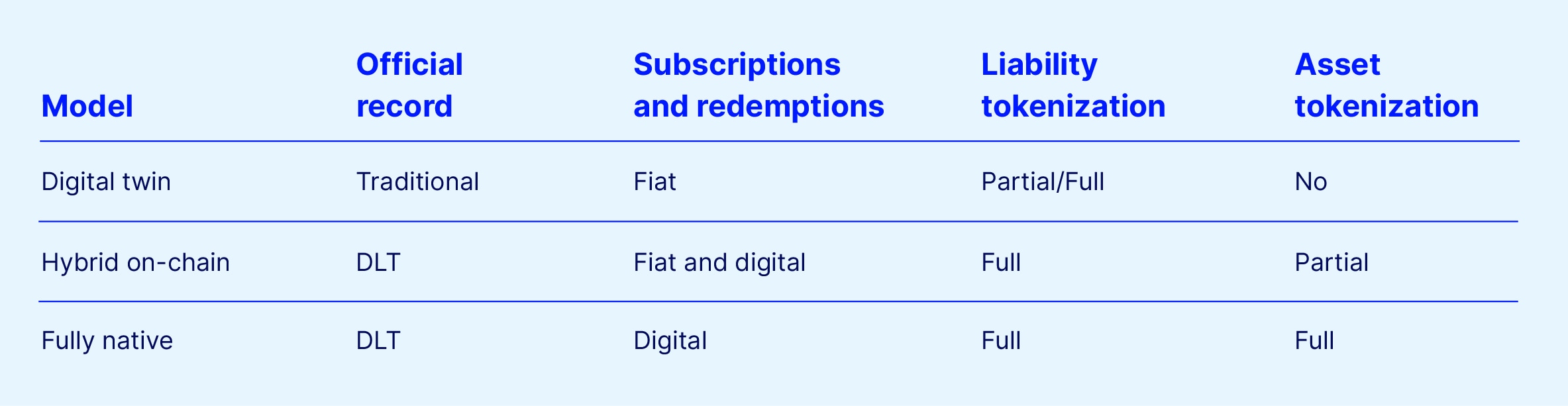
Tokenized MMFs are not a homogeneous category. Their design varies considerably, with important implications for both functionality and risk.
The predominant structure to date resembles traditional MMFs, with tokens representing claims on an underlying fund. These models enable transferability and on-chain interaction but do not fundamentally alter the legal or operational framework. In these cases, trust remains anchored in traditional infrastructure and established regulatory frameworks, particularly in jurisdictions such as Luxembourg, where legal certainty and investor protection are well defined. This reflects the continued institutional preference to anchor trust in proven regulatory structures, even as new technological layers are introduced.
Some structures are beginning to incorporate digital liquidity buffers within the fund itself by holding a portion of assets in stablecoins. This can support near-continuous digital redemptions and reduce reliance on external conversion mechanisms. However, it also shifts part of the trust framework onto the stability, governance, and liquidity of the underlying digital cash instruments.
Models continue to evolve, with more servicing functions moving on-chain, including subscription, redemption, and peer-to-peer transfers. While this increases programmability, it also shifts operational risk toward smart contracts, infrastructure dependencies, and governance frameworks.
Fully blockchain-native fund models remain limited. In practice, the market is evolving incrementally rather than undergoing structural transformation. As a result, the evolution of these models is not simply a question of functionality, but of where trust resides within the overall operating architecture.
Strategic drivers of institutional adoption
Institutional interest in tokenized MMFs is increasingly linked to collateral and liquidity management, rather than distribution alone. Realizing these benefits at scale depends on confidence in transferability, enforceability, and behavior under stress.
Tokenization enables assets to be transferred and pledged more efficiently, supporting their use as collateral in both traditional and digital markets. This may improve collateral mobility, transparency, and intraday liquidity management.
However, these same features may also reshape market dynamics. Greater transferability and programmability can increase interconnectedness across counterparties and facilitate faster collateral reuse, increasing both efficiency and complexity.
Stablecoins, deposits, and the convergence of digital liquidity
Tokenized MMFs are increasingly interlinked with stablecoins and other forms of digital cash.
Both structures share similarities, particularly in their exposure to short-term, low-risk assets and their role within digital ecosystems. These similarities are driving closer interaction between transactional stablecoins and yield-bearing tokenized MMFs. Stablecoin issuers may hold reserves in MMFs, while investors may deploy stablecoins directly into these funds or convert them into cash for investment.
This convergence improves efficiency, composability and creates new interdependencies. As these systems become more interconnected, trust must extend beyond individual instruments to the broader ecosystem in which they operate.
These interlinkages may deepen as tokenized MMFs are increasingly used as collateral in derivatives and repo markets. The combination of continuous trading, programmable settlement, and interconnected positions may alter how liquidity flows through the system.
Central banks have also continued to emphasize the importance of robust settlement frameworks, including the role of central bank money, in maintaining trust and stability in tokenized markets. Trusted settlement assets and strong governance frameworks remain central to confidence in tokenized markets.
Risks, constraints, and structural limitations
The expansion of tokenized MMFs raises several potential risks, many of which relate to how trust is maintained under stress.
First, tokenization does not eliminate underlying liquidity risks. MMFs continue to invest in short-term assets that may not be as liquid as their liabilities, particularly under stress. Tokenization may intensify these mismatches by enabling faster and more continuous redemption.
Second, continuous trading of tokenized instruments, even when underlying markets are closed, can create mismatches between token liquidity and the liquidity of underlying assets.
Third, market fragmentation remains a key concern. Multiple platforms, standards, and asset representations may limit liquidity and create uncertainty around pricing and transferability.
Fourth, operational risks increase as systems become more dependent on digital infrastructure, including smart contracts and blockchain networks. Maintaining trust depends on the resilience and governance of these systems.
These risks resemble those of traditional MMFs but may be amplified by increased speed, interconnectedness, and complexity.
The next phase of market evolution
Tokenized MMFs are likely to continue evolving gradually rather than through rapid transformation. Progress will depend less on technological capability and more on whether market structures can support trusted interaction across participants, platforms, and jurisdictions.
Near-term development is expected to focus on incremental enhancements to existing structures, including improved interoperability and selective integration of on-chain functionality.
While market scale remains limited and secondary liquidity is still developing, the use of tokenized MMFs as collateral is likely to rise as digital trading and settlement infrastructure matures.
At the same time, ongoing adoption will help shape future operating models. These approaches aim to improve settlement efficiency but must be assessed within the broader context of liquidity and stability considerations.
Ultimately, the success of these experiments will be determined by whether they strengthen or weaken confidence in liquidity, settlement, and risk management processes. The long-term trajectory will depend on how tokenized MMFs interact with traditional financial systems and whether supporting infrastructure can scale in a safe and interoperable way.
The way forward
Tokenized MMFs represent a developing segment of digital financial market infrastructure, with clear potential but also meaningful considerations.
They offer improved settlement efficiency, enhanced collateral mobility, and greater integration with digital market environments. However, questions remain around liquidity risk, fragmentation, operational resilience, and financial stability — and the industry is considering various ways to address them.
The most likely path forward is gradual integration, where tokenized MMFs evolve alongside traditional products rather than replacing them. Their long-term role will depend on whether a stable, interoperable, and well-governed financial ecosystem can support them.
At its core, this is a question of trust. Without clear legal certainty, robust operational resilience, and confidence in how these instruments behave under stress, adoption is likely to remain constrained. The scaling of tokenized MMFs will depend not only on innovation, but on the market’s ability to embed trust into the underlying infrastructure.