
Insights
State Street PriceStats: Disinflation disrupted?

United States prices rose sharply again in August, driven by higher energy and food costs, disrupting the disinflation trend of the previous two months.
September 2026
The State Street PriceStats index rose 0.44 percent in August on a non-seasonally adjusted (NSA) basis, marking its largest monthly increase since May after two months of flat or declining prices. Although the rise was smaller than the initial energy-driven jumps following the start of the Iran conflict, the increase pushed annual inflation up 0.2 percentage points to 4.5 percent. While this rise remains below May’s 5 percent peak, the move marks a clear interruption to the recent disinflation trend in the State Street PriceStats data series. We expect official inflation data to follow suit by reflecting similar patterns.
State Street PriceStats enables daily inflation measurement with just a three-day lag, offering timely insights that complement traditional government statistics. It serves as a valuable leading indicator and is especially useful during periods when government releases are delayed or unavailable. Its daily insights are increasingly relevant for policymakers, investors, and analysts seeking to track inflation dynamics in real time.
Covering over 27 countries and multiple sectors — including food, health, and transportation — State Street PriceStats uses consistent methodologies to ensure its indicators are comparable across geographies, time periods, and official data sources.
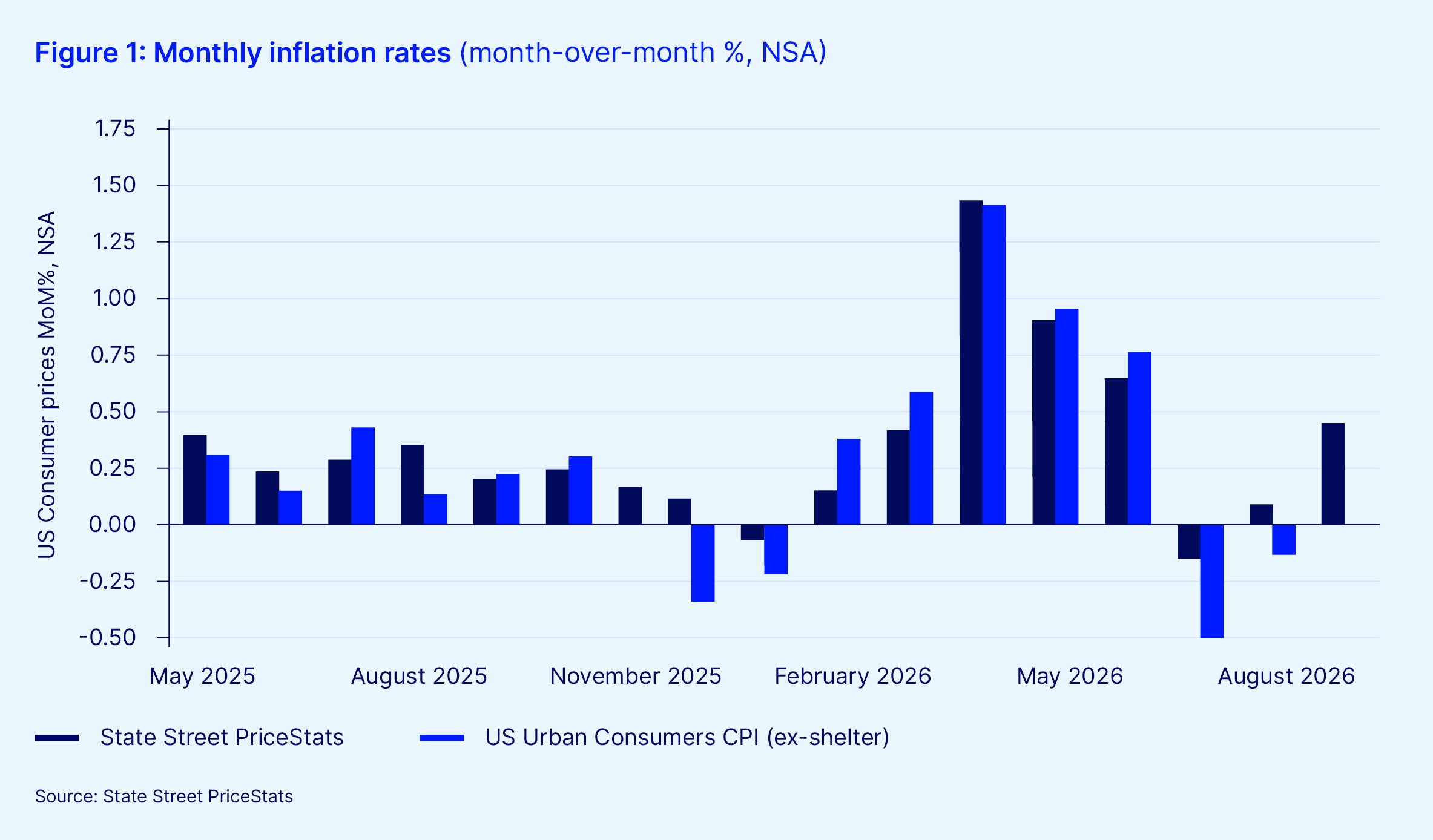
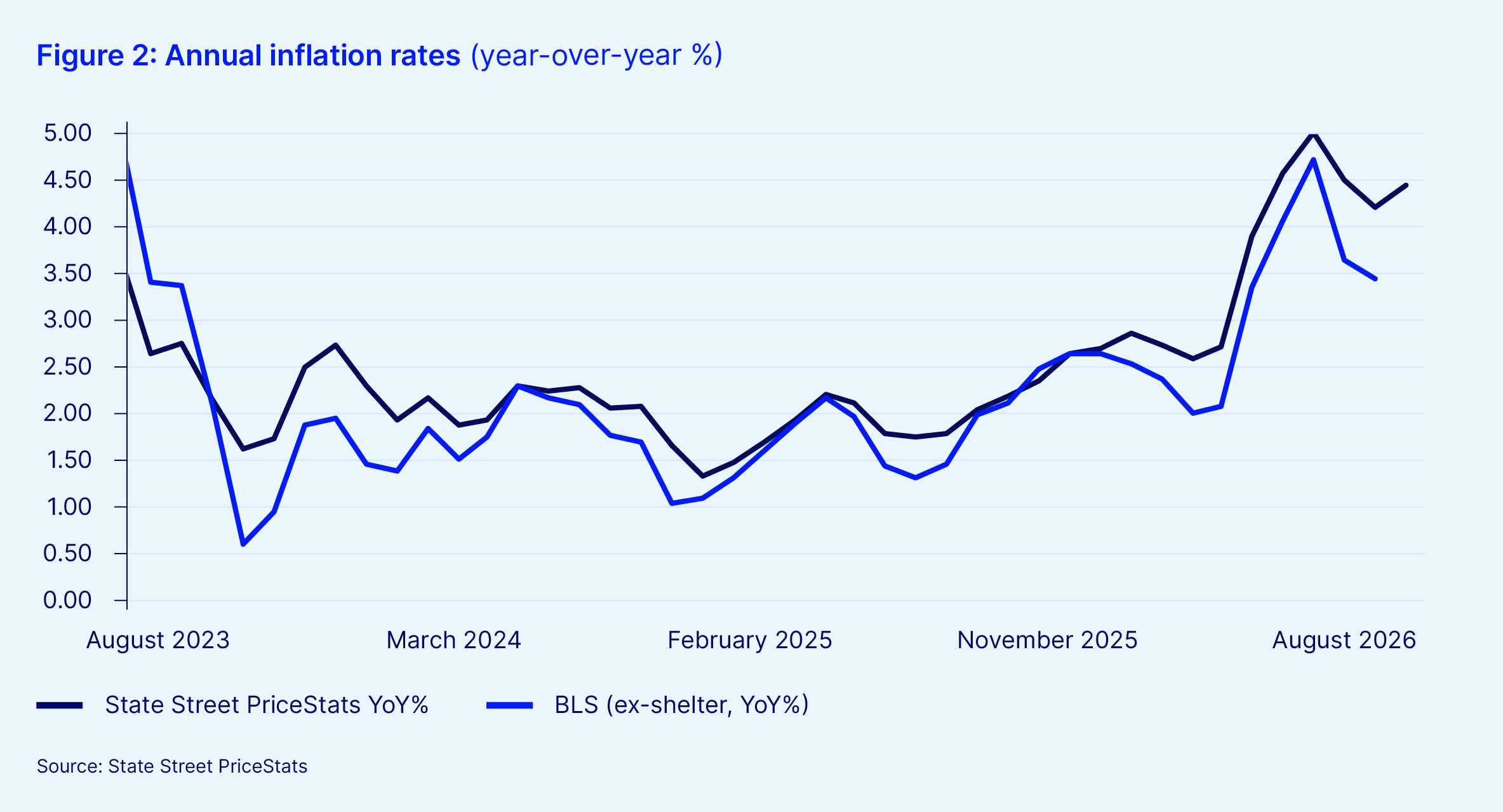
August’s 0.44 percent rise in the State Street PriceStats index comes at a critical moment for the inflation outlook. Energy and transportation prices accounted for much of the increase, rising nearly 1.4 percent over the month. With the Federal Reserve’s September rate decision finely balanced, another rise in headline inflation could tip the balance in favor of higher interest rates.
However, beneath the headline, the overall outlook is more encouraging. Price increases across food, household equipment, and health and beauty were in line with seasonal norms; while only apparel and electronics showed unusual strength. This suggests that a pass-through from higher energy costs into broader — particularly core — inflation remains limited. While this may be enough for the Federal Open Market Committee to keep rates on hold, as it has all year, the renewed rise in headline inflation adds an unwelcome complication for a committee that is already split on the decision.
About the State Street PriceStats indicators
The State Street PriceStats series are designed to provide a low-latency and high-frequency view into inflation trends that is comparable to official consumer price index (CPI). The features of the process are as follows:
- Daily online price collection: State Street PriceStats collects price data daily from over 1,500 multi-line retailers using web scraping technologies, focusing on those with both online and physical stores. Research has shown that retailers tend to adjust online prices first.
- Data structuring and cleaning: Models then clean and standardize raw price data to ensure consistency across more than 40 million products, converting unstructured HTML into structured datasets ready for analysis.
- Categorization and quality checks: State Street PriceStats categorizes prices by economic sectors and sub-sectors, calculates performance statistics, and applies a red-flag system with daily manual checks to resolve data anomalies.
- Index calculation using econometric techniques: State Street PriceStats computes daily inflation statistics using proprietary econometric methods and publishes the results with a three-day lag.
- Retailer and product selection: State Street PriceStats selects retailers based on market share and city presence, and includes over 500,000 daily prices — far exceeding the 80,000 monthly prices used by the Bureau of Labor Statistics (BLS).
- Use of CPI weights and no quality adjustments: State Street PriceStats applies official CPI weights where possible and adjusts for online data characteristics, calculating price changes only from consecutive observations of identical products without applying standard quality adjustments.
For more information or to request a demo, visit our State Street PriceStats Solutions page.


