
Solutions
A new era for repo: Turning compliance into opportunity

Why the SEC Treasury clearing mandate calls for a strategic response, and how our secured financing model can position buy-side firms for what comes next.
Taryn Siglain
Global Head of Execution, Financing, and Clearing
State Street Markets
Travis Keltner
Global Head of Secured Financing
State Street Markets
The United States Treasury market is nearing a critical inflection point. By mid-next year, the Securities and Exchange Commission’s (SEC) landmark mandate will take effect, requiring the vast majority of US Treasury repurchase (repo) transactions to be centrally cleared. For buy-side firms, this represents one of the largest structural disruptions to fixed-income markets in decades — and a fundamental reshaping of the repo market.
The industry is racing to comply with the new mandate. Firms are committing significant legal and operational resources for onboarding and documentation, as they work toward meeting the compliance deadline.
It would be a mistake to approach this transition as simply a "check-the-box" exercise. Compliance may drive the urgency, but the strategic opportunity lies in using the mandatory shift to optimize balance sheet efficiency, secure reliable liquidity, and improve overall portfolio yields.
Architecture for advantage
There is a widespread assumption across the buy side that all cleared repo dealers operate similarly. Look closer, however, and there are significant structural differences. In today’s US Treasury repo market, performance hinges on capturing every additional basis point of yield while securing the substantial liquidity needed to support asset growth.
The right dealer clearing platform can help advance these goals. Yet many traditional dealers typically rely on an outside tri-party agent to support their funding activity and collateral mechanics. This reliance on third-party intermediaries introduces extra fees and operational friction — eroding client yields, driving up financing costs, and leaving money on the table through missed market opportunities. Furthermore, relying on external processing schedules restricts a dealer’s ability to manage late-day cash, execute dynamic reallocations, or deliver tailored support when market conditions tighten.
We take a fundamentally different approach. Having pioneered sponsored cleared repo in 2005, we have built more than two decades of operational platform experience, backed by continuous technology investment, to guide clients through the SEC mandate. Our end-to-end platform handles global custody, collateral management, administration, and Fixed Income Clearing Corporation (FICC) clearing under one roof. For institutions looking to outsource front-office trading, we can also act as execution agent, pairing front-office execution with clearing compliance and collateral management. By removing middleman fees and processing delays, this unified model turns back-office efficiency into higher yields for cash lenders and lower costs for borrowers.
Money funds and other cash managers gain an integrated service that provides greater intraday flexibility, including access to liquidity and the ability to rapidly reallocate cash after-market cutoffs. This is especially valuable in volatile conditions, when liquidity decisions are increasingly time sensitive. Giving cash managers the tools to maintain stable, reliable investment options creates a powerful feedback effect for cash borrowers, particularly asset owners and alternative asset managers that value flexible, dependable access to the balance sheet capacity across a range of market environments. By addressing the needs of both investors and borrowers, the model creates a scalable repo platform engineered to preserve stability through spot dates and volatile market cycles.
Ultimately, the right platform allows institutions to go far beyond basic compliance with mandatory clearing, so they can develop a powerful liquidity engine and unlock a much broader range of trading choices.
More choice, greater efficiency
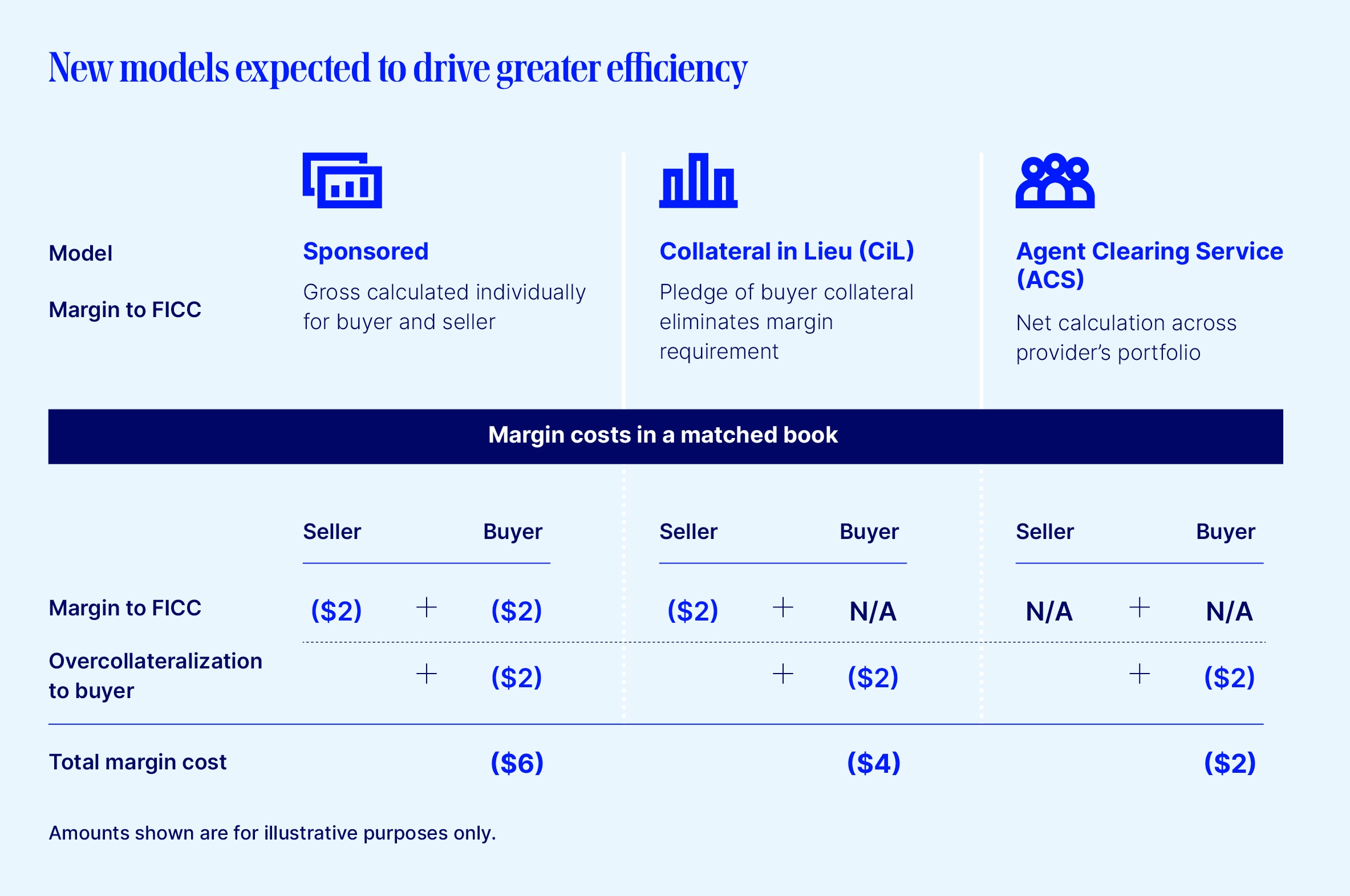
For buy-side firms, navigating the regulatory transition cost-effectively depends on choosing access models tailored to their specific trading strategies. The key driver here is margin efficiency: maximizing balance sheet effectiveness reduces drag on intermediaries, reducing cost and improving liquidity. FICC's expanded framework provides a broader set of choices designed to support these objectives. Sponsored Collateral-in-Lieu provides a broadly scalable option for cash lenders enabling dealers to realize margin efficiencies regardless of how their books are structured and pass those benefits through to end users. Agent Clearing can deliver similar benefits to both lenders and borrowers with dealers realizing the underlying margin efficiencies through portfolio netting. The level of efficiency ultimately depends on how effectively dealers balance lending and borrowing activity to maximize portfolio margin offsets. As the margin comparison illustrates (see figure 1), shifting from classic sponsored clearing to these new models can cut total margin costs on a matched book by up to two-thirds.
With money market assets surging and traditional dealer capacity constrained, accessing expanded clearing options shouldn't create operational friction. Leveraging our position as an industry leader serving the market's largest cash investors and borrowers, we make growth simple. Portfolio managers trade on familiar tools, while our platform silently manages settlement, collateral administration, and clearing end-to-end.
By consolidating this full range of options under a single, global partner, buy-side firms get maximum market flexibility without the operational challenge of onboarding with dozens of individual sponsors.
Global reach
The Treasury clearing mandate is a US regulation, but its impact is global. For firms in Europe and the Asia-Pacific region, navigating FICC's strict operational windows and clearing rules across distant time zones can be challenging.
This is where the value of a global operating model becomes clear. International clients need more than basic clearing infrastructure. They need local trading, operational, and client coverage teams in their own time zones. For institutional investors that lack a US trading desk, outsourcing the entire lifecycle to a single global partner is often the smartest move.
With the mandate now less than a year away, the pace of clearing adoption is accelerating rapidly. Rather than settling for basic compliance, forward-thinking buy-side firms are using this transition to upgrade their execution models and strengthen overall liquidity. With the right combination of native clearing capabilities, global coverage, and proven market scale, institutions can turn a regulatory obligation into a long-term competitive advantage.
Looking ahead
Unlocking capital through cross-margining
Mandated clearing is only one piece of the broader balance sheet optimization story. We are seeking to launch a dedicated Futures Commission Merchant (FCM) next year to unlock cross-market liquidity.
Historically, clearing repo trades and clearing futures derivatives have operated in silos. New regulatory rules now permit "cross-margining," enabling institutions to offset their repo positions directly against their futures trades under a single umbrella.
For hedge funds and alternative managers, this dramatically reduces the amount of collateral tied up in trades, freeing up balance sheet capacity. For cash investors, it expands access to high-quality collateral, creating a deeper, more resilient pool of liquidity for the entire network.


